
The most recent official snapshot of the US economy arrived last Friday, the very same day the Supreme Court struck down most of Trump’s tariffs.
The Bureau of Economic Analysis (BEA) released its advance estimate for last year’s fourth quarter GDP, placing annualised real growth at just 1.4%, well below forecasts that had clustered around 2.5% and a sharp deceleration from the 4.4% registered in the third quarter.
For the full year, real GDP grew 2.2% in 2025, down from 2.8% in 2024.
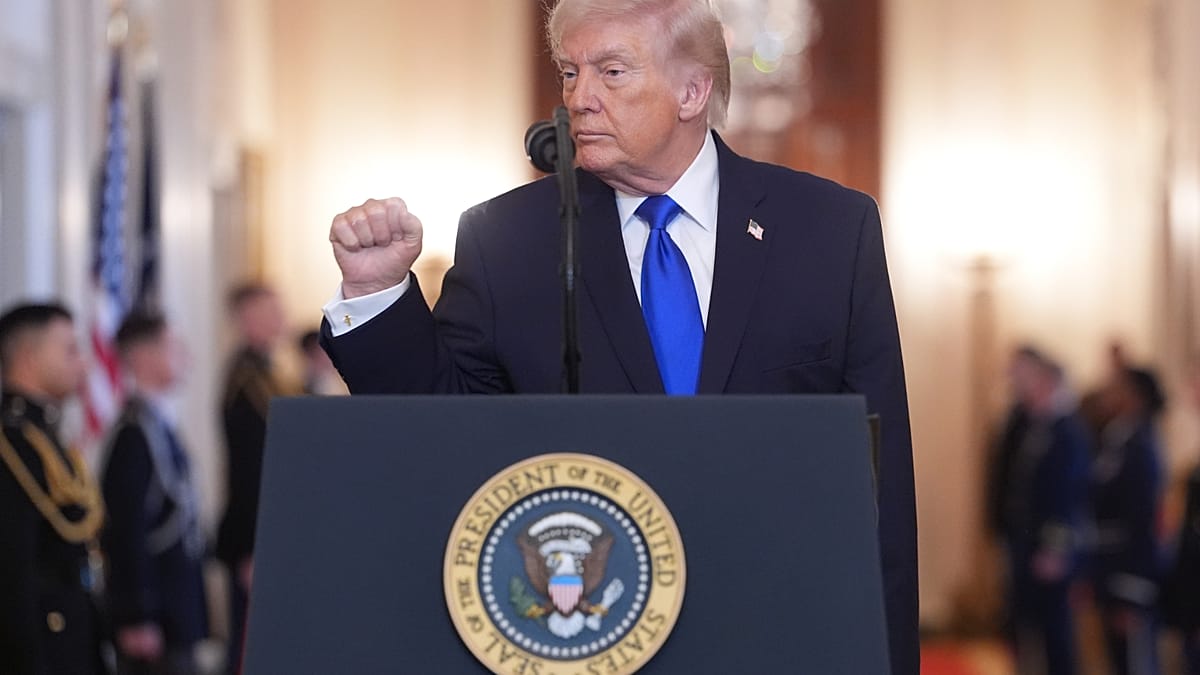
The numbers starkly contrast with President Trump’s declarations during a Fox Business interview just a week before, when he stated: “I’m popular and I’ve done well. I mean, I think we have the greatest economy actually ever in history.”
Even so, the BEA itself was quick to flag an important caveat: the October–November 2025 federal government shutdown, the longest in US history, subtracted an estimated 1% from Q4 growth on its own.
A little over half an hour before the BEA’s numbers came out, President Trump also posted on Truth Social, seemingly aware that the economic data would be less than ideal and claiming the shutdown had double the negative effect estimated.
“The Democrat shutdown cost the U.S.A. at least two points in GDP. No shutdowns!” stated President Trump.
The Atlanta Federal Reserve’s GDPNow forecasting model put its estimate for the first quarter of 2026 at 3.1%, suggesting the US economy may be bouncing back as shutdown-related distortions fade.
A resilient year but not a great one
According to data from the Bureau of Labor Statistics (BLS), the US job market expansion last year was notably weak. The economy added an average of just 15,000 non-farm payroll jobs per month across 2025 compared to 168,000 the year before.
The BLS’s benchmark revision, alongside the January 2026 jobs report released this month, erased a cumulative 862,000 positions previously attributed to the period through March 2025.
However, this January did bring a brighter number: 130,000 jobs added, comfortably above the 55,000 consensus estimate and the strongest monthly figure since December 2024. Overall, the unemployment rate edged down to 4.3%.
On Truth Social, President Trump posted “GREAT JOBS NUMBERS, FAR GREATER THAN EXPECTED!” and by the standards of a year in which the labour market had effectively frozen, January’s reading was indeed an encouraging sign.
One element that President Trump will potentially mention but is unlikely to dwell on during his State of the Union address this Tuesday is the fate of the federal workforce.
The BLS confirmed that since federal employment peaked in October 2024, the government workforce has shrunk by 327,000 positions, or 10.9%.
In January 2026 alone, another 34,000 federal employees came off payrolls as workers who had accepted deferred resignation offers in 2025 formally left government service.
This results from deliberate efforts by the current US administration to cut federal jobs.
“I don’t feel badly because now they’re getting private sector jobs and they’re getting sometimes twice as much money, three times as much money,” President Trump has repeatedly argued.
Yet, the job data so far does not support the claim.
The tariff earthquake
Whatever domestic economic story Trump chooses to tell during the State of the Union speech, it will be shadowed by last Friday’s 6-3 Supreme Court ruling against his tariffs.
The ruling voided import taxes that had generated an estimated $129bn (€109bn) in IEEPA-specific revenue through December 2025, according to the US administration’s own figures.
Moreover, questions over whether importers are owed refunds remain unresolved.
Treasury Secretary Scott Bessent said at the weekend that refunds would require courts to weigh in and that the Trump administration would not proceed unilaterally.
Within hours of the ruling, President Trump invoked Section 122 of the Trade Act of 1974, a rarely-used provision, to impose a 10% across-the-board tariff on imports from all countries. The following day, this number was revised up to the maximum of 15%.
Nonetheless, the tariff goes into effect this Tuesday at 10% and will last for a period of 150 days, through 24 July 2026, before it requires congressional approval to remain in place.
A lengthy list of exemptions covers energy products, critical minerals, pharmaceuticals, passenger vehicles, books and agricultural goods including beef and tomatoes.
The Council on Foreign Relations, an American think tank, noted that without the IEEPA tariffs, consumers now face an average effective tariff rate of 9.1%, the highest since 1946, excluding last year.
Legal experts expect the Section 122 route to face its own court challenges, given that the statute was designed for short-term “balance-of-payments emergencies” rather than as a broad trade-policy instrument.
An Associated Press poll published this month, in collaboration with NORC at the University of Chicago, found that just 39% of Americans approve of President Trump’s current handling of the economy.
Whereas 59% disapprove, a sharp reversal from the political advantage he held on the issue going into the 2024 election.
During the State of the Union address, President Trump will likely argue that the picture is entirely different. Still, the data suggests he faces an uphill case.