
Evidence of one of the world’s earliest places where horse domestication occured has been found in Kazakhstan.
Previous archeological discoveries within the Botai culture of Central Asia suggested the practice dated back to 2200 years BCE. New research, however, indictes the process may have begun as early as 3500 years BCE.
A history of horses
Horses take a very special place in the nomadic culture of the region and were once central to trade, warfare, and migration.
Over many centuries, horses symbolised people’s power, wealth and means of transportation.
The animals were used to carry settlements across the steppe, feed families and move armies from campaign to conquests across the vast Asian plains.
The Huns, Avars, Magyars, and Mongols all depended heavily on mounted travel. Horses stayed important in transport and military systems well into the industrial period and even during the World Wars.
The relationship between man and horse inspired art and created a rich cultural tradition which endures. In Kazakhstan for instance, most national celebrations and popular gatherings are still marked by horse races. You also won’t find a historical museum which doesn’t display the famous nomadic “horned horse”.
Presidential approval
Recently, a social media post by Kazakh President Kassym-Jomart Tokayev went viral after he visited the presidential stables and spoke about the breeding horses under his care.
The head of state noted that he decided to personally inspect the conditions under which the animals are kept and cared for.
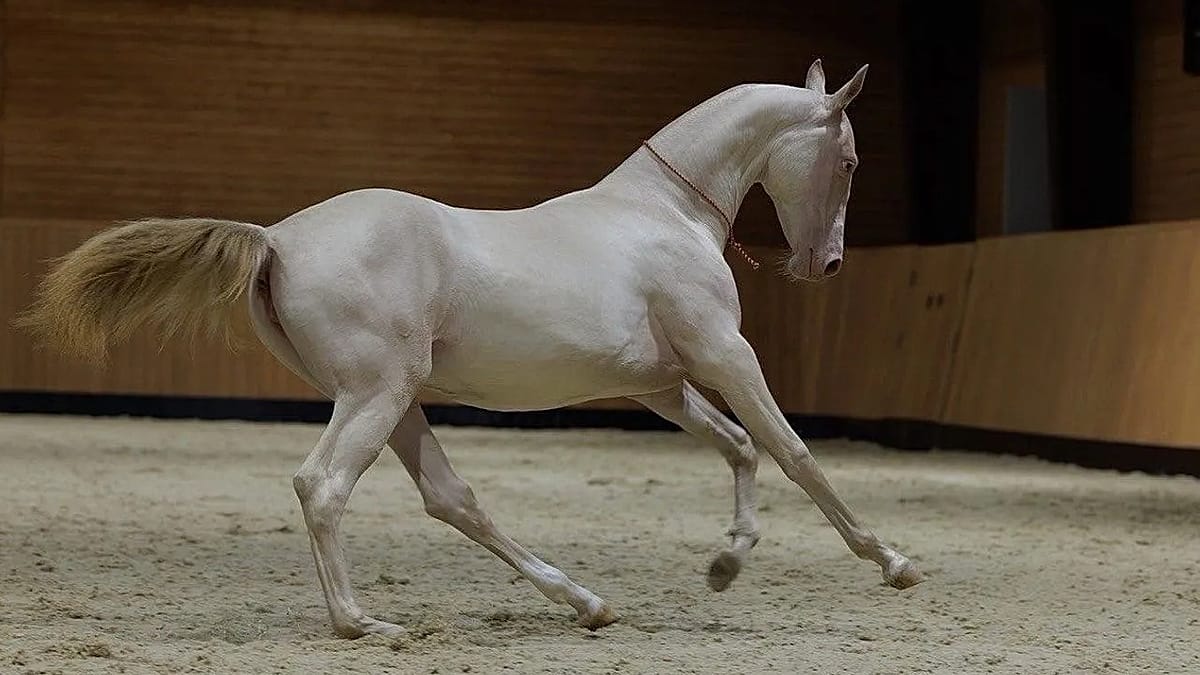
“During the May holidays, I found time to stop by and see how the horses, donated over the years, are being cared for. A year ago, I named a light-colored Akhal-Teke foal Aqzhan. His breed characteristics are immediately apparent from his appearance: tall, with a graceful neck, neat ears, a slender body, and a clear gaze. He moves confidently and appears intelligent and noble,” the president said.
Perhaps unsurprisingly, the appearance of the horse attracted widespread attention. Aqzhan has the unique isabelline colour – only 3% of Akhal-Teke horses have it – and was born in Astana on March 30, 2025. To a layman’s eye it might appear that the animal has a kind of albinism, but it doesn’t.
Her coat possesses an optical effect: the finest hairs refract light, creating a satin-like, almost otherworldly shine. In steppe culture, an isabelline horse has always been considered a good omen, a herald of luck and prosperity. And this is no surprise, since such a colour is rare even among Akhal-Tekes.
Her radiant coat and noble appearance have become a topic of discussion on social media and in international magazines.
“Aqzhan is not merely a celestial horse of the Great Steppe” a local Kazakh newspaper writes. “She is a metaphor for modern Kazakhstan, where civic responsibility and moral values play a key role in shaping urban identity and national consciousness.”
The name Aqzhan – “Pure Soul” – sounds like the slogan of a new era. An era in which true luxury is the ability to remain honest, environmentally conscious, and responsible in everyday life.
Following Kazakh tradition, as head of state, Tokayev is the patron of the Presidential Stables. There are many special horses in them, including those gifted by foreign leaders like the Arabian horses donated to Kazakhstan by Qatar. The president noted that he regularly visits the stables and personally participates in the care of the animals, including feeding them.
Tokayev also emphasized the importance of horses in Kazakh culture. He stated that horses traditionally hold a special place in the lives of the people, and therefore the development of horse breeding and equestrian sports deserves special attention.
He often uses the care for horses to popularize equestrian sports but also to raise awareness of animal rights issues and urge people to adopt a zero tolerance approach towards abuse, calling for those responsible to face criminal charges.
Over the past ten months Kazakhstan has successfully completed the first phase of the project of re-introduction of the Przewalsky horse into the steppe – the horse that is considered to be a genetically unchanged ancestor of modern horses.
Modern science however believes that it is only one of the ancestors. Be that as it may, the wild horses are undergoing a major reintroduction program in the Altyn Dala State Nature Reserve in central Kazakhstan. After being locally extinct for 200 years, an international effort has brought 22 horses from European breeding centers to the reserve, with the goal of establishing a self-sustaining population of around 40 horses by 2029.