
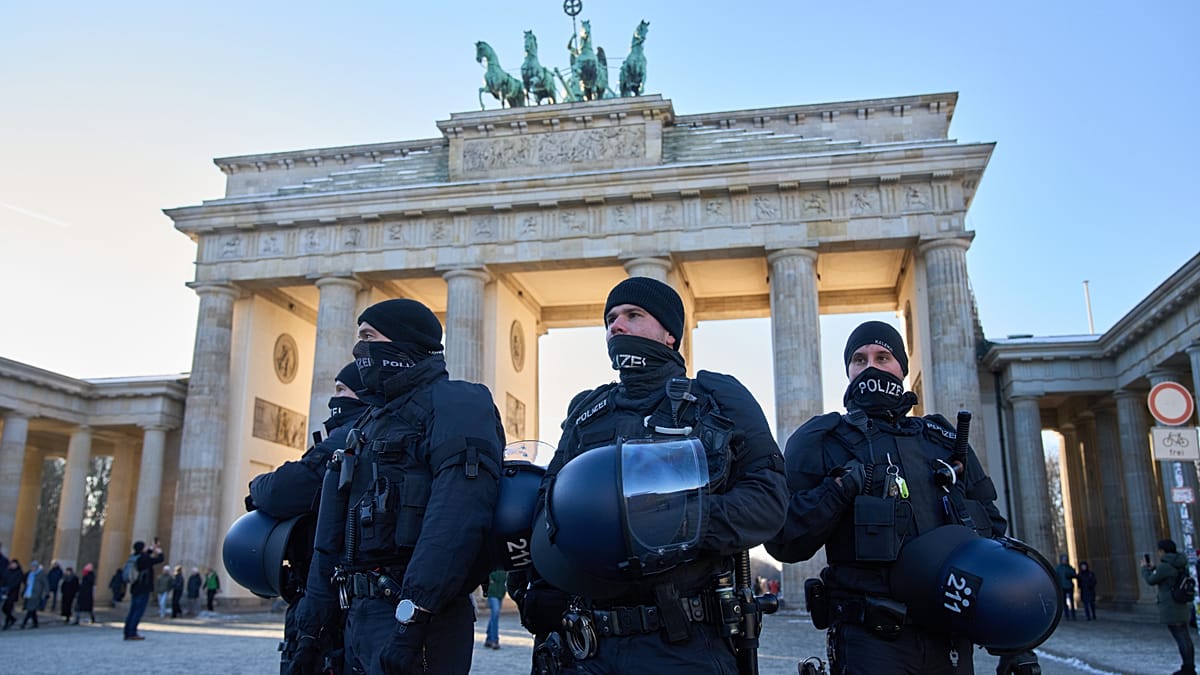
Germany faces heightened security concerns following a fatwa issued after the killing of Iranian Ayatollah Ali Khamenei, with security experts warning of potential attacks by Iranian sleeper cells across Europe.
Grand Ayatollah Nasser Makarem Shirazi issued a fatwa on 1 March calling for holy war against the US and Israel following Khamenei’s death in joint US-Israeli strikes Saturday.
The fatwa declared that all Muslims were obligated to avenge the “blood of the martyr” and identified the US and Israel as “the main perpetrators of this crime”, according to Iran’s state-run Tasnim News Agency.
A fatwa is a ruling made by an Islamic religious authority or high-ranking scholar, binding on those who recognise their authority.
The Tehran regime has used it repeatedly as a tool of intimidation or terror, with Ayatollah Ruhollah Khomeini issuing a fatwa in 1988 against “unrepentant” opponents to the regime, which led to mass executions.
Another 1989 fatwa by Khomeini against writer Salman Rushdie led to global protests, violent attacks on his translators and publishers — including the shooting of Norwegian publishing company CEO William Nygaard — and a 2022 knife attack on Rushdie, who suffered serious health consequences and lost an eye as a result.
‘An accelerant for possible attacks on Europe’
Extremism expert Heiko Heinisch told Euronews he estimates “the risk of spontaneous single offence attacks and the activation of sleeper cells to be relatively high”.
Terrorism researcher Nicolas Stockhammer warned the fatwa acts as “an accelerant for possible attacks in Europe”, affecting “existing networks, sympathisers and hybrid actors” aimed at a “diffuse, transnational support base”.
Heiko Teggatz, head of the German Federal Police Union, said it “cannot be ruled out that Iran will send people all over the world to carry out terrorist attacks on Israeli and American facilities”.
US authorities are warning of increased threats from “lone wolf” attacks and sleeper cell activation. Two attacks occurred in North America on Sunday, though exact motives remain under investigation.
A gunman killed two people and wounded 14 at a bar in the Texas city of Austin on Sunday morning. The FBI identified the suspect as Ndiaga Diagne, 53, a naturalised US citizen originally from Senegal.
Diagne wore a sweatshirt reading “Property of Allah” and a shirt featuring the Iranian flag during the attack, according to law enforcement officials who spoke to CBS News and AP. A Quran was found in his vehicle, according to authorities.
The FBI is investigating the shooting as potential terrorism, though officials cautioned Diagne had prior mental health issues. Investigators are examining whether he self-radicalised.
Hours earlier, a boxing gym in Richmond Hill, Ontario owned by Iranian-Canadian dissident Salar Gholami was targeted by a gun attack in the early morning on Sunday. No one was injured.
Gholami, a prominent organiser of anti-regime protests in Toronto, told Iran International he believes the attack was “intimidation directed at critics of the Islamic Republic”.
York Regional Police said they are investigating but have not established a motive or made arrests.
Threat change possible ‘at any time,’ officials say
Germany hosts significant Iranian networks linked to the Islamic Revolutionary Guard Corps. In 2022, Babak J threw a Molotov cocktail at a synagogue in Bochum on behalf of the IRGC. The same year, shots were fired at a rabbi’s house in Essen with IRGC involvement.
North Rhine-Westphalia’s Interior Ministry told Euronews there are currently “no findings or indications” of specific threats, but acknowledged “a change in the threat situation” is possible “at any time” due to the dynamic situation.
Interior Minister Herbert Reul said, “If there are new findings, we will react immediately and increase the measures.”
“We currently have no concrete evidence of a threat” but “our security authorities are monitoring developments closely,” Bavaria’s Interior Minister Joachim Herrmann told Euronews.
Germany’s Federal Ministry of the Interior said all security authorities are “continuously assessing the threat situation” and are “on high alert”.
Heinisch noted that since 1979, there have been “over 100 executed and foiled attacks in Europe that can be attributed to Iran”. A UK MI5 report from late 2024 mentioned 20 attempted Iranian attacks in Britain since January 2022.
Teggatz urged the German government to “immediately suspend all admission programmes in which NGOs are involved in the selection of people,” specifically mentioning Afghanistan, South Sudan and Gaza.
Heinisch criticised political failures: “Politicians should have reacted to the Iranian threat much earlier, put the Revolutionary Guards on the terror list and closed all mosques linked to the Mullah regime, the IRGC or Hezbollah.”
Even after the closure of the Islamic Centre in Hamburg, several mosques in Europe remain under direct control of the Iranian regime, according to security experts.