
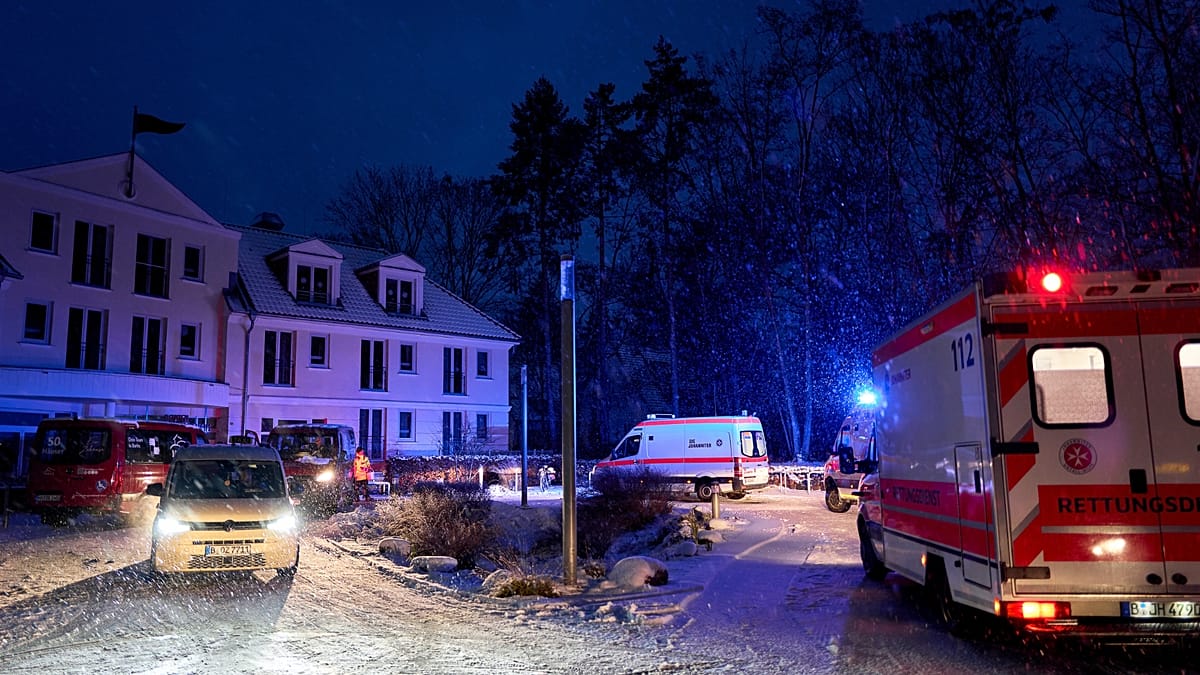
German federal prosecutors on Tuesday launched an investigation on terrorism charges into an arson attack on high-voltage cables that caused a power blackout impacting 45,000 Berlin households.
The service said it was probing the January 3 attack — claimed online by a far-left extremist group — on charges including “membership in a terrorist organisation, sabotage, arson and disruption of public services”.
The attack on Saturday morning severed several high-voltage cables crossing the Teltow Canal in the Lichterfelde district, leaving around 25,500 households still without power on Tuesday.
Berlin’s governing mayor Kai Wegner said repairs to the 300 metres of damaged cable would not be completed until Thursday.
Berliners seek emergency shelter and warm meals
The far-left “Vulkan Group” claimed responsibility in an online letter authorities have now verified as authentic.
Berlin’s Interior Senator Iris Spranger said the attack was “left-wing terrorism”, a characterisation confirmed by federal Interior Minister Alexander Dobrindt in a telephone call.
“This is an act of terrorism,” Wegner said at a press conference on Tuesday. “These perpetrators deliberately endangered people’s lives.”
The city initially drew criticism for offering only emergency shelter in gymnasiums before agreeing to cover hotel costs for displaced residents.
Wegner said the government would reimburse accommodation expenses “in full retrospectively” after residents submit hotel bills with proof of address and identity.
Authorities evacuated several hundred people from 74 care homes, though some facilities relied on emergency generators. The German Armed Forces deployed personnel to assist police and fire services with logistics and emergency power operations.
Berlin set up public showers in three swimming pools, established food banks distributing hot meals, and deployed charging buses for residents to warm up and charge devices.
Supermarkets and S-Bahn services to Mexikoplatz, Nikolassee and Wannsee stations have resumed operations.
Stromnetz Berlin managing director Bernhard Büllmann said 17 emergency generators are operating, with 36 available in total after deliveries from North Rhine-Westphalia.
Each generator connection increases the number of households with power, though engineers must carefully verify electrical capacity before restoring service.
Repairs technically challenging
Police vice-president Marco Langner said investigators are analysing hundreds of hours of video footage and have received eight tips considered relevant.
The federal prosecutor general has taken over the investigation, with state and federal criminal police cooperating with the Office for the Protection of the Constitution.
The Vulkan Group’s letter said the attack targeted a gas-fired power station. Senator for Economic Affairs Franziska Giffey questioned whether the perpetrators were “just left-wing groups of activists who are ideologically driven, or is there more to it,” and called for federal assistance with the investigation.
Repairing the cables presents technical challenges because the seven-component high-voltage lines require processing at temperatures above freezing under controlled conditions.
Engineers constructed an enclosure around the work site to maintain proper environmental controls.
Around three-quarters of Berlin’s critical electricity infrastructure is under video surveillance, but a quarter located in public spaces — including the Teltow Canal cables — had not been monitored due to data protection concerns.
Giffey said authorities plan to install permanent surveillance on these cables and deploy AI monitoring programmes to detect minor temperature changes via thermal imaging.