
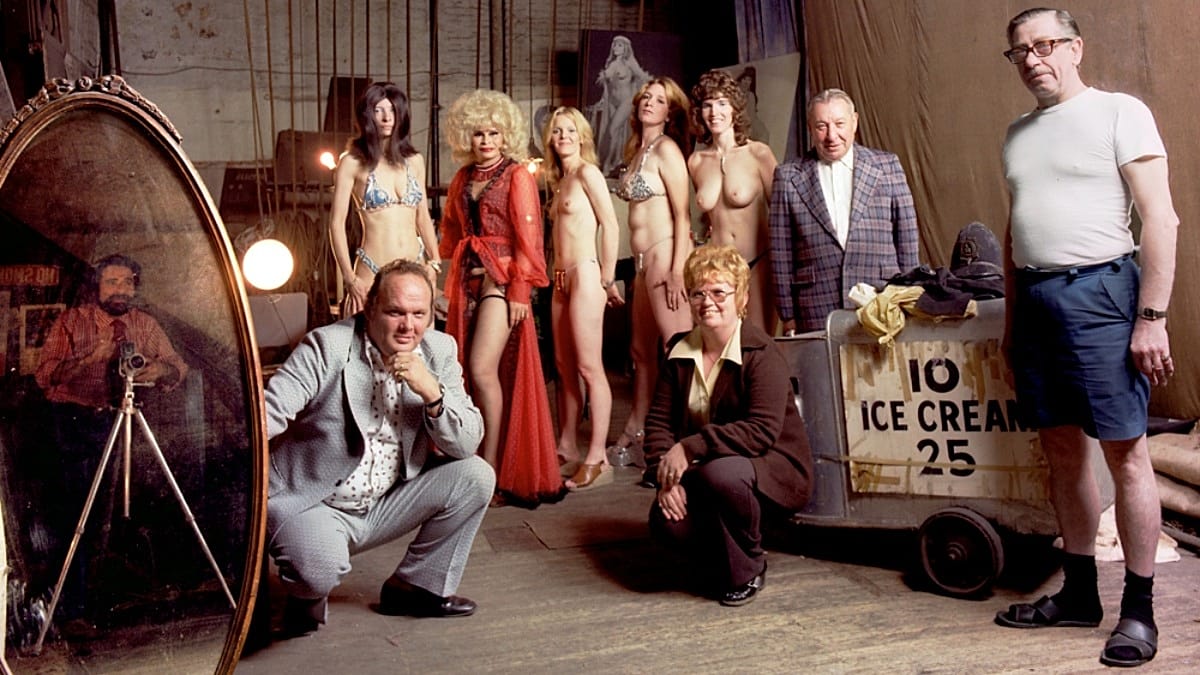
Neal Slavin is a pioneer in group photography.
The American’s portraits are an important touchstone in the history of the use of colour and they offer an unsentimental yet incisive view of his native country’s social and political structures.
Germany’s Kunstpalast in Düsseldorf is currently hosting the exhibition Photography and Belonging that features his much of his work that’s become a crucial record for understanding social dynamics in the late 20th century.
This year marks the revised 50th-anniversary edition of his foundational study “When Two or More Are Gathered Together “, and to mark the occasion, Slavin’s talked to Euronews Culture about the past, present and future of photography.
When “Two or More Gathered Together” was first published in 1976 it quickly became a landmark in early colour photography. What originally drew you to the idea of photographing groups rather than individuals?
Well, first, let’s start this way. There’s a misnomer and a mistake. Groups are individuals. And I believe that when people try to do group shots, even photographers who put together a group to be photographed are so concerned with the composition and the formation of the group that they forget that, however many individuals are in that group, they are indeed individuals.
I don’t really have an answer for what drew me to photograph groups, except that I will say that I was fascinated when I saw a Boy Scout troop that was photographed about 10 or 11 years prior to my seeing this panoramic picture. I was absolutely intrigued by what I saw. And what I saw mainly was 32 boys, or whatever they, you know, number of young boys there were. The first thing that hit me was memory. I said, ” This is fantastic, but where are these boys? Now? They’re 11 years older. What happened to them? And suddenly, that plugged into my concept of photography as memory.
All photographs, more than any other medium, be it painting, film, music, anything, photography evokes memory the best and relives time and time and time again. In other words, it relives the experience for the viewer over and over and over again. So that’s what got me into photographing groups -i.e, that’s what got me into photographing individuals in a group.
In the early 1970s, colour photography was still fighting for recognition in the art world. How conscious were you of working within or against that photographic moment?
Very conscious. I think there were about 15 or 18 photographers who were now ready to jump in and photograph in colour. Colour was used mainly as a commercial vehicle for advertising, but not for quote, unquote, serious photography. We got a lot of guff from the old-timers who told us this wasn’t serious work.
First of all, the photographs won’t last because they’re not archival, but we, as young folks, didn’t really care about that too much. We were more concerned with getting each person’s statement out into the environment and opening up the dialogue. And the dialogue was indeed coloured as a descriptive form. That was, I think, I could say pretty boldly for pretty much everyone at that time. Colour was the answer to putting one more step into the reality of the photographs we made. We saw that black and white was also a kind of beautiful abstraction. We were not really out to debunk black-and-white photography. What we were really out to do was just extend the meaning of what the world was like in colour, in real colour.
I don’t know if I’m jumping the gun, but I’ve had experiences, and early on, very early on, where I remember photographing a group portrait. It was actually my first colour photograph, a group portrait of ambulance corps volunteer drivers. They used to have races in their spare time and won trophies. They came in three different colours, of course, gold, silver and bronze. And I happened to shoot that picture just quite by accident, in black and white and in colour. And I remember, after I developed the film and made the contact sheets, I was looking at them with a loupe, and I suddenly discovered something really important. When I looked at the contact sheets in black and white, I could not tell the difference between a gold trophy and a silver trophy; of course, in colour, there it was as plain as day. So for me, immediately, I seized upon the moment that colour is information and without information, what have you got?
I don’t know if this is true, but I think I read somewhere that Cartier Bresson, when asked why he doesn’t work in colour, said that there is too much information. When I found out about the gold and silver trophies, I couldn’t help but suddenly realise I didn’t have enough information, and so I went headstrong into photographing everything I saw in colour, while black-and-white faded away from me. Although I never criticised it. I never felt it was a bad way to go. It’s a beautiful medium, but for me, colour was very important.
You allowed your subjects to arrange themselves within the frame. What did that process reveal to you about hierarchy, identity and power?
When most people photograph a group of people or even a single individual portrait, they order the person or the people around into configurations that may not fit the personality of the group, in this case. I recognise that right off the bat, you can’t fit people into sausage wrappers.
It doesn’t work because all you get are people in sausage wrappers. So, what I do is I look at the environment. Usually, that’s done with the president or the director or the head honcho of a group that he’s comfortable with this particular location that I think could work, and once we have that established, I find out how many people are going to be in the group, and when the time comes, I usually just say come on to the set.
And then, they come on and I say, take up any place you want. I don’t care, wherever you think you belong. Belonging becomes a very, very important word in the phenomenon of groups. But, the idea of feeling a sense of belonging in a space is very much part of the photographic process. It’s a fantastic subtlety that not too many photographers consider.
So once everybody feels comfortable where they are, I will usually tighten up the group, and if somebody is not being seen, I will say, you know, I think John needs to come in a little closer, or whatever. But at the same time, there’s another thing operating.
There are some people who don’t want to be in the picture, but they’re in it because of who the group is, whether it’s a corporate group or a hobby group, or whatever, a vocational group, they’re going along for the ride, but they’re a little shy, so I have to respect that. And if their head is turned a little bit, I have to feel that out and see if I can say: “Would you mind looking forward, or do you want to stay that way or whatever?” And when I do that, the adventure of creating a photograph filled with 30 or 40 or 100, or whatever it is, people are an incredible experience.
Mentally and psychologically, I wade into the crowd so they get to know me a little better, and they trust me, and they play a game of, I’m going to face the camera or I’m not going to face the camera. I’m going to smile, or I’m not going to smile. I let them do anything that they feel it is appropriate. I’ve learned over the years that one phenomenon of letting people be again, that word individual is what makes up a group. A group does not make up a group. Individuals make up a group.
Nearly 50 years later, why did you feel this was the right moment to publish a revised and expanded edition of the book?
It is 50 years later that we see the world through a different lens. Not to make a pun here, but the moment has come where the phenomenon of gathering together. Hanging out together has diminished. The percentage of people who get together, for instance, for a coffee group in the morning has gotten fewer takers. Religion has suffered. Religious groups have suffered loss of people in their congregations. But I believe that people need people. Humanity needs to feel, to touch, to embrace, to have the emotions out there with other people. And if you give people a chance, they will do it.
People love to be in a group, to be photographed. The problem is we’re living in a very different age from when I started photographing groups, in 1972. At that time, we did not have computers, personal computers, and we did not have the ubiquitous smartphone. So between screens, smartphones and social media, people have kind of backed into these, I call them traps. People don’t answer the phone anymore. It’s an email or text. I was standing in the street one day, and I heard a kid say to his friend, that just came from visiting his house “see you online.” And it just occurred to me, sure, see you online, that’s where I’ll see you. That didn’t happen in 1972, so that’s one of the reasons I wanted to republish this book, the first book. I’ve worked in this genre for over 50 years now.
I published several books, the first one being “When Two or More are Gathered Together” in 1972, it wasn’t really my idea. It was an idea whose time had come, and that is, we’re reminded that we are humans and individuals, and if you didn’t have groups, which we still do, it’s just fewer of them. What we have, as I said before, are screens, smartphones and social media. But for the most part, people still love congregating, getting together and taking pictures.
The smartphone has replaced much of the tittering that used to go on when you had yourself photographed. What’s happened is that the selfie is the new group portrait, as it were, 50 years ago. And so it wasn’t me that really decided this book needs to come out now, although, when somebody mentioned it to me, I said: “Yeah, I fully agree”.
Although I have other books out that are of the same nature, where people are in groups and whatever they’re doing, it’s the same problem. Quite frankly, my absolute firm belief is that if we didn’t have groups which we still do, no matter what anybody tells me, we’d be a planet of ghosts. And I don’t want to live on a planet of ghosts. Neither does anyone else. So it’s time to remind people that they are part of some kind of group, whether they know it, whether they like it or not, we’re all part of each other, and as soon as you get two or three or four people, you have a group that’s your group. And I’m watching it very closely, because I’m fascinated sociologically, by the way, people still, regardless of the drop in numbers of, as they say, hanging out, still love to be together. Thank goodness for that, because without that, as I say, we’d be a planet of ghosts.
The new addition arrives at a time of deep political and social division in the United States. Do you see the work differently today than you did in the 1970s?
That’s a difficult question to answer. Do I see it differently today than I did in the 1970s? No, I don’t. People at their core are the same. We’re concerned about all the same things that we had in the 60s in America, the civil rights movements, the segregation and on and on and on. Human beings seem to gravitate towards confrontation. So, we are the same people that we were then.
Looking through the lens today, as opposed to the 1970s, it’s the same people, but the differences are different. The concerns are different, but we’re still fighting for the same rights, the same ways of living, of seeing each other. There’s no difference. We all have one head, two arms, and two legs. We’re the same, and that’s not changed. So how could you say we’re different today than we were then? The causes are different, but at the root, at the base level, the causes are always the same. It’s a cause, made by individuals blossoming into groups. I don’t know if that makes any sense, but I’m trying to give you the lens that I see the world through.
The Anniversary Edition includes new groups photographed as recently as 2023. What struck you most about photographing contemporary groups compared to those from the original series? You selected 10 favourite images for Euronews Culture from the book. What guided your choices?
They came out of an upcoming show. And I approved them because I like the images. So really, the question has to do with, how you pick the pictures that you can live with? How do you like the pictures? Can you live with them? And that becomes a very difficult question to answer, because every picture is different.
They may look alike because they’re all groups, but I think I pick my pictures based on how much they communicate to me on a daily basis. If I go away from that picture for a week and come back, and it talks back to me, then I like it. If it goes, lies there, has no vibrancy, and it’s all gone because you’ve seen it too much. Then it takes a stand backwards. This question poses this: the beauty of making art is that it’s never finished.
I’m a painter, and I’m a photographer. In painting, everyone knows this. A painting is never finished. It’s finished for the day, for the moment. Three days later, you may say to yourself, “I don’t know, I think it needs a little more red in this area.” Photography is the same way. It’s difficult with photography because it’s an already-made image. You can’t do anything. So, you kick yourself if you don’t like the picture, and you say, Why in the world did I ever take that picture that way? But that’s the learning curve. That’s the beauty of it.
So next time when you go out with your camera, or however you photograph, you find that you’ve suddenly been on a learning curve that says, don’t take it this way. Take it another way. Look beyond. Look inside the group. Look inside the person. Have a conversation with the person. I like to say that even though I photograph 100 people in a group, and I said earlier, I wade into the group. I make probably 50 10-minute friendships, and that’s fantastic. I get to know a bit about a lot of different people, and that’s more than I can say that most of us ever get, even with our good friends.
So, for me, photographing groups is no different from the 70s. The content has changed, but the people, for me, haven’t, and that’s what I love about it. If this dynamic didn’t exist, I wouldn’t still be doing this. I’ve done this, as I say, for over 50 years, and it’s indeed a dynamic. I think what it takes is an incredible love for people of all kinds, all people on this planet, white, black, whatever you have, Hispanic. I just love the differences. But at the end of the day, we’re all the same, And that’s what keeps me going.
Across your work, there is often humour, but also a quiet association of sociological precision. How do you balance irony with empathy when photographing communities?
I think I answered part of that question when I said, with empathy, when photographing communities: “I just love people.” To see somebody, in a situation, with a blue shirt; somebody else in a red shirt; it may sound silly, but I love people watching, and people participation. So, I don’t balance anything; I let it all hang out. I think that’s the error, trying to balance it out. That’s a horror show. Because you can’t balance it out. People belong to each other, in groups comprised of individuals in red shirts, blue shirts, black shirts, and white shirts. It’s part of our DNA. I can’t deny that, and neither can you; that is humanity.
You can only have one form of belonging. You either belong or you don’t belong. Don’t forget, we humans are very good at ostracising others while welcoming others, and that makes the others the other. Now, if you have ever been in and then out of a group, you will know exactly what I am talking about. The feeling of being in a group is vital. It’s what humans are about. This is not about taking funny or serious pictures of people making up groups. This feeling of belonging to a group is the most vital sociological element of humanity. Just the word humanity is a group force.
About humour in my work, there isn’t always. Unlike some other photographers, I love people, and I love people’s flaws. The way we make mistakes, the way we laugh at ourselves. And those moments are what make my pictures. When people look at some of my pictures, and they see funny things, it’s because they laugh with themselves, not at themselves. And that’s the difference, I believe, with different photographers, who do sociological work. I never laugh at anyone; I laugh with people, and we all laugh together. I’m not looking to do derision, I’m not looking to deride or criticise anyone. If there is a funny situation, and we are all in on the joke, terrific. So I just wanted to clear that up.
What do you hope your European audiences, in particular, take away from these images of American society?
I think Europe has always been fascinated by America. That’s because America created the great experiment. All men and women are created equal. That wasn’t always the principle that went on in Europe and the rest of the world. America became this petri dish of a way of life that people historically never had. We had and have our problems, we still do, we hope that that country makes it through out troubled times, but, historically, I can’t answer what European audiences in particular take away from these images, because I think what these images stand for are not just America or Americans, but the way people behave, talk and communicate with each other. And we are known for a very open discourse in America. And I think that’s what fascinates everybody.
I have other books, of all groups. I have a book called “Britons”, I am working on a huge project on prayer and meditation in groups; what we look like when we come together to pray. Those pictures would not be the ones that one would find funny, but you will find in those pictures the same elements that you found in 1974, which is the core thread between us all. And that’s what is so important. And I think Europeans understand that, and are fascinated with what we do. But I think Europe has come such a long way that I can’t criticise any particular country, because I don’t want to; they have come a long way. They look less at America as odd because there have been democracies and social forms of government in Europe, so they don’t view America the same way they did in the 50s or 60s.
I understand the question very clearly, and there is still a fascination with this country, which is 24000 miles across, and who we are, and the things we do, which a lot of Europeans wouldn’t ever think of doing. So, we all have ideas of different sociological configurations, let’s call it, and we all learn from them. And somehow I think less of America, but Americans are fascinating to Europeans. As I talk, I realise that the sentence: Europeans are fascinated by Americans rather than America. I get that feeling.
Photography has transformed radically since the 1970s. From analogue processing to digital ubiquity and AI-generated imagery. What, in your view, has been gained, and what has been lost?
I could talk for a whole day about that one. What has been gained, I don’t know. The only thing I can see as gained is that if you see something happening, you can pull out your smartphone and document it. Because by the time a photographer gets ready, unless you’re a war photographer, where you are always ready, the event can already be over. In the process of all of that, that goes along with what I said earlier, and that is: in a way, it’s the dumbing down of the world, you type a sentence, and half is filled in by your computer’s spell checker. Little by little, we are becoming lazy.
We are living a life looking at screens. You and I have known of corporate situations where people work side by side in little booths, and instead of pushing your chair back and asking, “Hey Joe, when are you going for lunch?”, they send an email to Joe, and you have to wait for an answer. This is very troubling. At the same time, the digital world has opened up incredible possibilities that we never thought possible. So, like anything else, it’s a balance.
How much AI do you need to benefit your life or to ruin your life? That’s a big one, and I don’t have that answer. I’m purely a bystander in this arena. On an equality level, I don’t see the difference between digital and analogue photography. Yes, the process is different; we didn’t have cameras that could figure out exposures within the camera, as a smartphone can, but we are after the same thing, if you boil it down. If you boil the whole situation down, we are still taking pictures of each other, we are still putting our best foot forward when we are taking a selfie. And we did that in 1927 and 37. So, there really is no difference from a human point of view. The difference is the mechanics. But the problem is, the mechanics are what operate to dumb us down. We are in a situation where we need to be extremely careful not to dumb ourselves down, not to become (here I go again) ghosts on this planet.
How do you see the role of photography today, in an era saturated with images?
The director of photography, before he passed away, John Szarkowski, said, this is back in the 80s, I’m guessing, but he said, “We now have more photographs in the world than we do bricks”. So, what does that say? That says that we never stop wanting to be mirrored by this object, so we can look back.
There is this joke, that I remember, where two grandmothers are walking down the street, and one of them has a pram, a baby carriage, with a baby in it, and the other grandmother looks into the carriage, and says “ oh, what a beautiful baby!” and the other grandmother pushing the carriage says, “if you think she’s cute, you need to see her picture.” So, I think that says so much about photography. What is it? It’s a memory, a self-reflection, it’s a way of contemplation. I could go on and on in this track, because that’s what photography is. And in many ways, it has taken the role of painting. Because that’s what painting was trying to do. But photography does it better. That doesn’t mean painting is dead, as the artists used to say. Painting is a whole different experience. I know that; I am a painter. And I love painting for many different reasons. Some overlap with photography, some do not.
But we will never lose our need to communicate with each other, and communicate with ourselves by looking at a photograph. Take that away, and you have what? A planet of ghosts.
What materials and tools are you working with in 2026? How has your relationship to the physical photograph changed over time?
I’m working in digital photography, as I can do more digitally than I could with film. But I do love analogue images because they have a different flavour; they are softer, and they relate differently. But working digitally gives me the ability to lock in an image without experimenting with it, getting the same image if I have to make 5 print pictures, all the same. We did that all the time with analogue photography. But, you know, in the final analysis, that’s a question, not to be rude, that I have long since passed, that feels irrelevant to me. I don’t think about it anymore; I work digitally. I can’t remember the last time I worked with film, which I have a great respect for. It’s just not what I’m about. I’m about looking at the subject and saying what is this about? How am I communicating with my subject, and how is my subject communicating back to me? That is the essential part of a photographic relationship with your subject, and it never changes. It didn’t change in 1972, and it didn’t change in 2026.
Do you think group portraits still hold the same cultural weight in an age dominated by the selfie and individual branding?
If you are good at it, yes, it does. With all the selfies going around, it has dulled the eye tremendously. But if you see something that speaks; if you see 500 people in a room, and you can identify all 500 of those people, not by name but by characteristic, “oh that guy has dark hair, oh she’s blond, oh she’s sitting down” etc, they are roadmaps, to a place none of us no to where, but it’s like looking at a roadmap and saying,” now I see that this town is only 5 miles away from that city I thought it would be further” that’s what a group portrait is, it’s a roadmap to humanity.
As you look at it, you realise how one person relates to the one next to them and what about the person 4 people away? Are they looking over at each other, wishing they were with them? It’s a goldmine. And that’s where the conversation really begins.
Ultimately, what message or question would you like your work to leave with your viewers today?
My work is part sociological, part aesthetic. I couldn’t answer what message I would like the work to leave, because I’m not in control of that. If possible, I would like people to understand that we are all human and relate to each other, which is why we stay in groups. And if I may make a prediction, if the planet lasts, so will the groups. One way or another, we will never forsake each other.
“When Two or More Are Gathered Together” by Neal Slavin is available now from Damiani Books.