
Close Menu
Daily Guardian EuropeDaily Guardian Europe
  • Home
  • Europe
  • World
  • Politics
  • Business
  • Lifestyle
  • Sports
  • Travel
  • Environment
  • Culture
  • Press Release
  • Trending
What's On

International astronauts launch to ISS after NASA’s first medical evacuation

February 13, 2026

UK ban on Palestine Action as terror group unlawful, High Court rules – POLITICO

February 13, 2026

Ukraine’s call to join EU in 2027 forces major re-think of enlargement rules

February 13, 2026

Brussels government reaches coalition agreement after 600-day deadlock

February 13, 2026

Metals retreat on reports Trump may soften aluminium tariffs

February 13, 2026
Facebook X (Twitter) Instagram
Web Stories
Facebook X (Twitter) Instagram
Daily Guardian Europe
Newsletter
  • Home
  • Europe
  • World
  • Politics
  • Business
  • Lifestyle
  • Sports
  • Travel
  • Environment
  • Culture
  • Press Release
  • Trending
Daily Guardian EuropeDaily Guardian Europe
Home»Lifestyle
Lifestyle

Future of autonomous driving and robots just went up a gear. Nvidia and Boston Dynamics CES latest

By staffJanuary 6, 20263 Mins Read
Future of autonomous driving and robots just went up a gear. Nvidia and Boston Dynamics CES latest
Share
Facebook Twitter LinkedIn Pinterest Email

Published on
06/01/2026 – 0:35 GMT+1

The evolution of artificial intelligence (AI) and its propelling advancements in robotics and autonomous driving are two of the key themes of the CES 2026 technology conference in Las Vegas this week.

On Monday, chip giant Nvidia unveiled its autonomous driving plans, while Hyundai-owned Boston Dynamics publicly demonstrated its humanoid robot Atlas for the first time, marking it as no longer a prototype.

Here are some of the key advancements unveiled by the companies.

Hyundai said Atlas reduces repetitive human physical tasks such as carrying objects, which reduces human physical burden by performing higher-risk tasks; laying the “groundwork for robot commercialisation and collaborative human-robot environment”.

At the event, the robot walked around the stage for some minutes and waved at the crowd.

The company said a product version of the robot that will help assemble cars is already in production and will be deployed by 2028 at Hyundai’s electric vehicle manufacturing facility near Georgia, in the United States.

Hyundai also revealed an entire robot strategy, including a so-called MobED Droid, a wheeled ‘bot that can cover various terrain, which scored a CES 2026 Innovation Award as the show opened this week.

Boston Dynamics also made it into the Nvidia press conference, which was happening simultaneously with Hyundai’s.

The chip giant announced a strategic AI partnership with Boston Dynamics and Google DeepMind.

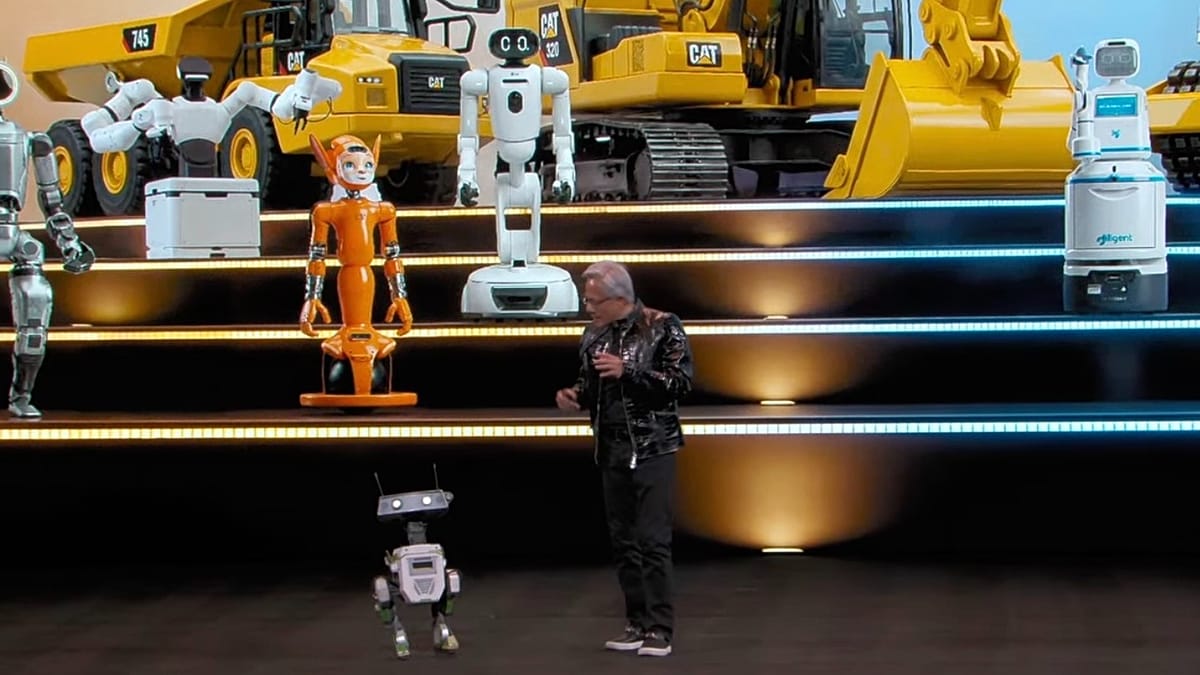
“The ChatGPT moment for robotics is here. Breakthroughs in physical AI — models that understand the real world, reason and plan actions — are unlocking entirely new applications,” said Nvidia founder and CEO Jensen Huang.

Huang also brought robots on stage, but these were the small Star Wars robots, of BDX droids. Though not as useful as the Atlas robot, as they probably can’t carry much, they are very cute.

Nvidia takes to the roads

Meanwhile, the other important message from Nvidia is its autonomous driving plans.

The company also has a pilot, which will launch in the new Mercedes-Benz CLA, which Nvidia said would launch in the United States in the first quarter and in Europe by the second, followed by Asian roads.

The technology that underpins this is called Alphamayo, which Nvidia unveiled on Monday.

Alphamayo is a set of open source artificial intelligence (AI) models, datasets, and simulation tools that are used to train physical robots and vehicles.

It works by helping the autonomous vehicles reason through various driving situations, such as traffic at intersections.

“Not only does [Alpamayo] take sensor input and activate the steering wheel, brakes, and acceleration,” Huang said.

“It also reasons about what action it’s about to take. It tells you what action it’s going to take, and the reasons by which it came about that action. And then, of course, the trajectory.”

The technology is open source, meaning other companies can fine-tune the technology to their needs.

Share. Facebook Twitter Pinterest LinkedIn Tumblr Email

Keep Reading

International astronauts launch to ISS after NASA’s first medical evacuation

ESA satellite finds ‘inside-out’ planetary system that challenges formation theories

From Baikonur to Beijing: How Kazakhstan is carving out new space horizons

Can Europe’s infrastructure handle the AI boom?

European Commission, Interpol and 100 others call to outlaw AI nudification tools

Women in tech at Web Summit: Next decade’s mission is closing the gap

Cisco president warns AI agents need ‘background checks’ like human employees

Cyprus connects to Greek supercomputer as it enters AI race

Meta faces trial over child sexual exploitation claims as wave of lawsuits targets Big Tech

Editors Picks

UK ban on Palestine Action as terror group unlawful, High Court rules – POLITICO

February 13, 2026

Ukraine’s call to join EU in 2027 forces major re-think of enlargement rules

February 13, 2026

Brussels government reaches coalition agreement after 600-day deadlock

February 13, 2026

Metals retreat on reports Trump may soften aluminium tariffs

February 13, 2026

Subscribe to News

Get the latest Europe and world news and updates directly to your inbox.

Latest News

ESA satellite finds ‘inside-out’ planetary system that challenges formation theories

February 13, 2026

Bottoms up: No-alcohol wines take pride of place at Paris international trade fair

February 13, 2026

Europe’s China shock worsens as trade deficit widens – POLITICO

February 13, 2026
Facebook X (Twitter) Pinterest TikTok Instagram
© 2026 Daily Guardian Europe. All Rights Reserved.
  • Privacy Policy
  • Terms
  • Advertise
  • Contact

Type above and press Enter to search. Press Esc to cancel.