
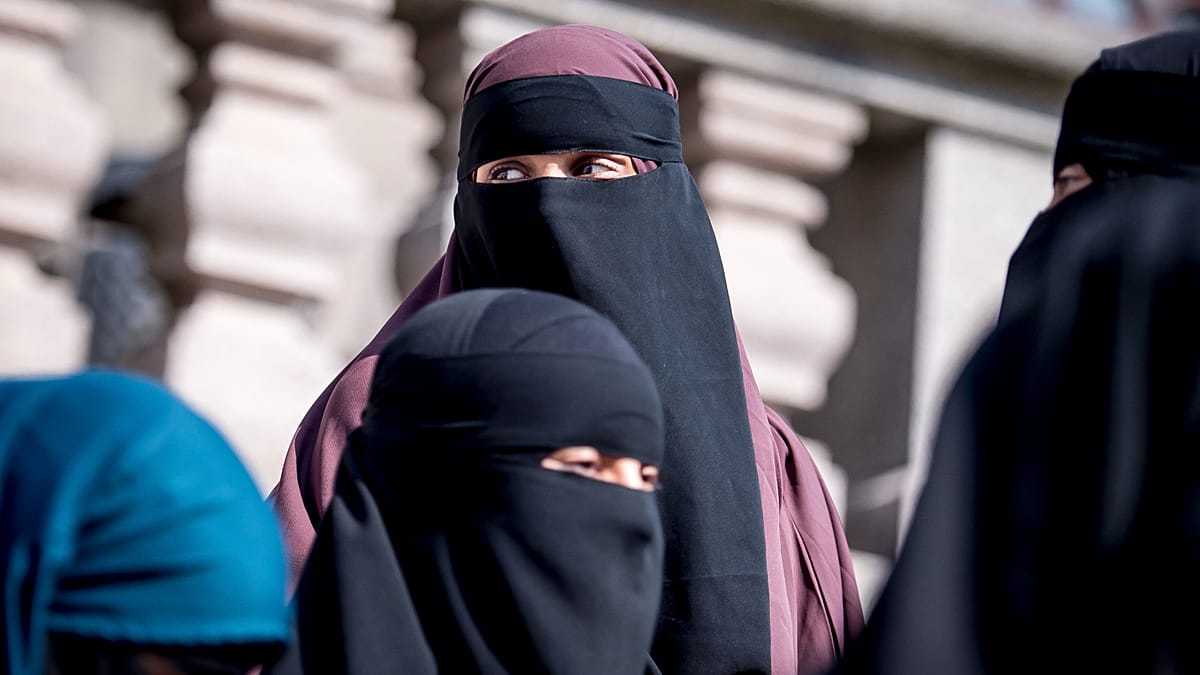
On Thursday, Portugal joined a growing list of European countries that have banned or restricted burqas and other full-face veils in public spaces.
But rules vary widely across the continent. Euronews breaks down how different European countries regulate face coverings.
France pioneered Europe’s face-covering ban
France became the first European country to ban full-face coverings in public spaces in 2011. Violations can result in a fine or mandatory civic education.
The French government argued that face coverings prevent people from being clearly identified, posing potential security risks and hindering social interaction in a society where facial recognition and expression play an important role in communication.
During the COVID-19 pandemic, questions were raised over whether protective face masks were compatible with the ban. Authorities later clarified that masks were permitted under existing health and safety exemptions.
Belgium: Fines and prison for violations
In Belgium, the ban dates back to 2011, with offenders facing fines or up to seven days in prison.
Alongside France, Belgium was one of the first European countries to introduce such restrictions, citing public security and social integration.
The law aims to facilitate communication and prevent people from concealing their identities in public spaces, measures Belgian authorities have defended as essential to ensuring the full participation of all citizens in society.
Bulgaria: Full-face veils restricted to private spaces
The wearing of burqas and other full-face veils has been banned in public spaces in Bulgaria since September 2016 and is restricted to private homes and places of worship. Muslims make up around 12% of Bulgaria’s population.
Austria: Face-veil ban extended to schools
In Austria, a ban on full-face veils, including the burqa and niqab, came into force in 2017 under legislation known as the “Anti-Face-Veiling Act”. The measure was introduced on security and integration grounds, with authorities arguing that face coverings hinder communication and social cohesion.
Additionally, in 2025, Austria’s parliament approved a law banning Islamic headscarves for girls under the age of 14 in schools. The ban explicitly refers to “the headscarf that covers the head in accordance with Islamic tradition”.
Denmark: A blanket ban on face coverings
Denmark enacted a full ban on face coverings in all public places in 2018. The law, which prohibits any clothing that conceals the face — including burqas and niqabs — has been justified primarily on grounds of public identification and societal transparency.
Netherlands: Partial restrictions in key institutions
In the Netherlands, a 2019 law restricts face coverings in specific public settings — such as schools, hospitals, and public transport — where clear communication and identification are deemed essential.
While not a total ban, it reflects a growing inclination toward regulating religious expression in state spaces.
Germany: A fragmented approach to face-covering bans
Germany has taken a fragmented approach, with some states introducing partial bans in schools and public spaces on security and communication grounds. Specific restrictions also apply to certain professions and everyday situations.
While some regions consider such bans necessary to promote integration and social cohesion, others fear they could isolate certain communities and undermine social inclusion.
Luxembourg: Full-face veils restricted in public institutions
In Luxembourg, a law restricting the wearing of full-face veils came into force in spring 2018.
Face coverings are prohibited on public transport, in schools and on school grounds, in facilities for children under 16, hospitals, common areas of care homes for older people, including corridors and lifts, as well as in judicial buildings and public administration facilities open to the public.
Spain: Legal silence, local discretion
Spain lacks national legislation on the issue, leaving decisions to the discretion of schools and institutions.
In 2013, the Supreme Court backed a Madrid high school’s decision to exclude a hijab-wearing student, setting a precedent but not a standard.
While Islamic groups have stressed that the Spanish Constitution and a 1992 cooperation agreement together protect the right to wear religious attire, the Ministry of Education has not prioritised national guidance, arguing that such cases are rare and manageable at the local level.
Portugal: Legal neutrality, selective application
Portugal doesn’t explicitly ban religious symbols but permits institutions — both public and private — to enforce neutral dress codes, as long as these are applied uniformly.
The aim is to protect employees from religious pressure while ensuring that workplaces remain ideologically neutral.
Italy: A law from another era
Italy does not have a specific ban on religious dress, but a 1975 anti-terrorism law prohibits face coverings in public.
Though originally unrelated to religious attire, this law has occasionally been invoked to restrict the niqab and burqa in certain public or security-sensitive environments.
Sweden: Freedom first, local pushback
Sweden has no national ban on religious attire, and the veil remains permitted across public life. The national approach favours individual rights, though some municipalities have attempted to impose school-specific restrictions, citing integration and gender equality. These moves have sparked debate but have not yet reshaped national policy.
Greece: Legal protections with practical limits
Greek law offers robust anti-discrimination protections based on religion across employment and public services. Yet, practice has sometimes told a more complicated story. In one 2022 case, a hospital barred a nursing student from wearing a headscarf during her internship, citing uniform regulations.
The Greek Ombudsman ruled the policy did not violate anti-discrimination laws, framing it as a dress code issue, not a religious one.
Restrictions on face- or body-covering veils, varying in scope and extent, are also in place in countries across several continents, including China, Australia, Russia, Canada, Sri Lanka, Gabon, Chad, Senegal, the Republic of the Congo, Cameroon, Morocco, Algeria and others.