




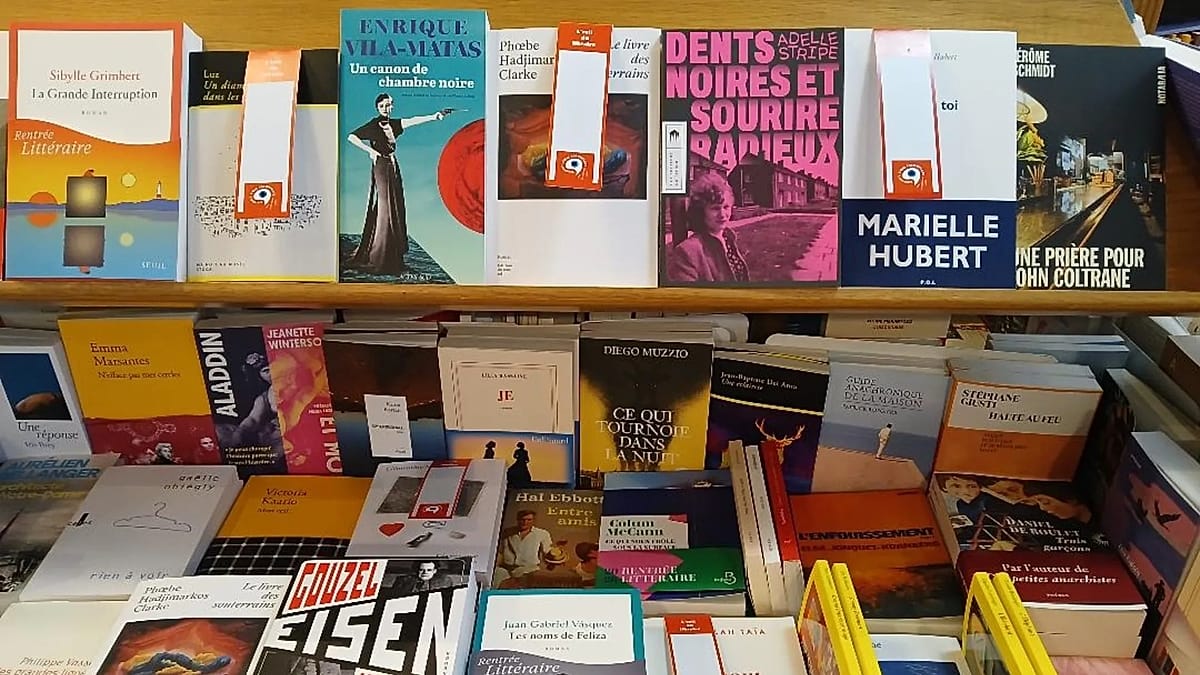
Sonia Devillers, Philippe Jaenada, Amélie Nothomb, Philippe Besson, Ananda Devi. They all have one thing in common: they will be part of the 2026 literary season. Between now and October, some 461 novels, including 344 French titles, will reach bookshops. That is a slight drop compared with the previous year, when 484 books were published.
For publishers and booksellers, this period is unmissable, all the more so at a time when reading is playing a smaller and smaller role in our daily lives. “The share of French people who spontaneously describe themselves as readers is falling across all categories, particularly among regular readers (down 5 points vs 2023)”, notes the 6th barometer from the Centre national du Livre (CNL), published in 2025. “Over the last 12 months, 63% of French people say they have read at least five books (down 6 points vs 2023) and the share of daily readers is declining (down 4 points vs 2023), reaching its lowest level in 10 years”, the study also points out.
“It is our shared duty to reassert the central place of reading in our lives. Reading is a vital time, time for oneself, that absolutely must be protected”, argues Régine Hatchondo, president of the CNL.
And the trend is even more pronounced among young people: they spend an average of 3 hours and 1 minute a day in front of screens, but only 18 minutes reading books, according to the study “Les jeunes Français et la lecture” (“Young French people and reading”), published in 2026. “Regular reading is declining and young people very often do something else at the same time as they read”, adds the head of the CNL.
In Belgium and Switzerland, all eyes on France
Although it is a particularly big deal in France, the literary season also exists in several other European countries.
In Switzerland, the phenomenon does not have the same impact. “There is far less media hype and fewer prizes [literary] at that time of year too”, observes Nicolas Julliard, a literary journalist at RTS, speaking to Euronews. “It is not the same phenomenon.”
However, he acknowledges that Switzerland is aligning more closely with the French market. “More and more publishing houses are matching their schedules to this calendar in order to release their biggest titles”, the journalist continues. One reason is that this allows Swiss publishers to gain greater visibility in France. “Quite a few books are exported and are even starting to appear in certain prize lists.” In short, the Swiss literary season “is increasingly becoming a key date for publishers, particularly for the newer publishing houses”, concludes Nicolas Julliard.
In Belgium, it is “quite a paradoxical period”, says Nausicaa Dewez, editor-in-chief of the journal “Le Carnet et les Instants”, speaking to Euronews. “Driven by the pull of the French literary season, there is intense media and public attention on books and literature, and at the same time the space is saturated by titles published in France. […] Belgian publishing houses are present during this period, but they also know that commercially they cannot compete with much larger and more powerful structures. So they do not throw all their strength into the autumn season.”
Nausicaa Dewez adds another nuance: “For most literary publishers in French-speaking Belgium, the first major moment of the year is the Brussels Book Fair, held in March”, which explains why the start of the year is also an important time for Belgian literature.
An important phenomenon across Europe as well
In Spain, this period is known as the “temporada editorial de otoño” (“autumn publishing season”). While the country “does not reach France’s level of activity, publishers prepare major titles every year for the beginning of September”, explains journalist Pepa Blanes in the pages of the Cadena SER (source in French). “Events also start to fill much of the month.”
In Germany too, the end of summer means a wave of new books, though again with less impact than in France. Across the Rhine, this period is called Bücherherbst (“book autumn”) or Literaturherbst (“literary autumn”). The press then showcases the big new releases and regards this season as an important one for bookshops. It is an event that is “planned long in advance”, reports the Tagesspiegel (source in French).
Above all, this flurry of new releases comes a few weeks before the Frankfurt Book Fair, held every October and a key date for the industry. It is there that the Deutscher Buchpreis is awarded, a prize created along the lines of France’s Prix Goncourt, notes Deutsche Welle (source in French).
In Italy, “autumn is when some of the year’s most important books are concentrated, although in recent years this market approach has changed and publishers, to avoid an overload of titles in autumn, have started to spread their output more evenly over the rest of the year”, explains Paolo Ambrosinin, president of the Associazione librai italiani, speaking to Euronews.
The British literary season perhaps comes closest to what we see in France, even though it follows a different timetable. “‘Super Thursday’ is an exciting day for booksellers, because hundreds of new books arrive in bookshops on the same day”, says Kate Skipper, chief operating officer at the book chain Waterstones, speaking to The Guardian (source in French).
It usually falls on the first or second Thursday in October. “It is always an extremely busy day, but there is a real buzz when you unpack so many big titles for Christmas all at once”, Kate Skipper continues. In 2024, more than 1,900 books were published for this “Super Thursday”, reported The Guardian (source in French).
That exceptional volume dropped sharply the following year: the number of releases was almost halved, as publishers adopted a strategy summed up by the slogan “publish less, but publish better”, reported The Bookseller (source in French) at the time.