
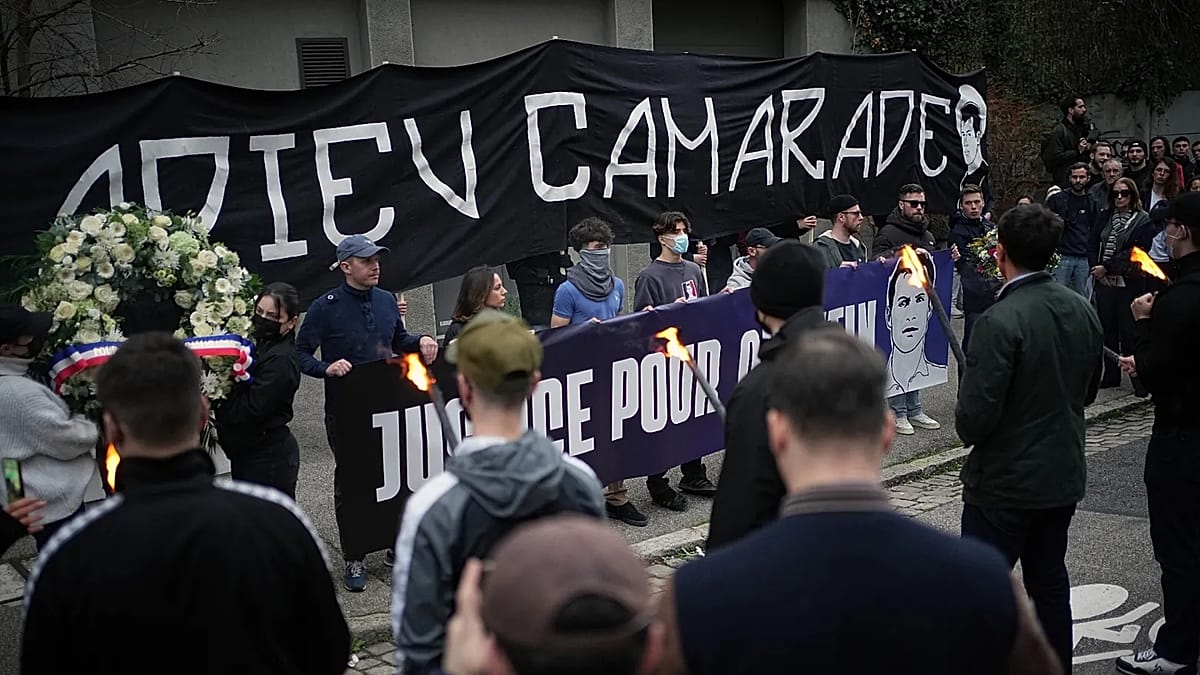
French prosecutors have opened an investigation into whether the disbanded far-left group La Jeune Garde has reformed under satellite structures, months after authorities dissolved the organisation.
In a statement sent to Euronews, the Paris prosecutor’s office said it had been notified on Tuesday of a report from the ministry “denouncing the group’s revival, in the form of satellite structures, of La Jeune Garde.”
The prosecutor added that the investigation has been assigned to the Paris Research Section (SR) of the Gendarmerie, France’s national military police force, which has judicial investigation units alongside the civilian police.
The Paris prosecutor also noted that La Jeune Garde had challenged the June 2025 decision to dissolve it before the Council of State, the country’s highest administrative court, and that a hearing initially scheduled for 11 February had been postponed.
The new probe comes amid intense political tensions following the death of the young far-right activist Quentin Deranque, who was violently beaten on 12 February on the sidelines of a conference at a Lyon university where French MEP from the left-wing France Unbowed party (LFI) Rima Hassan was invited to give a speech.
Seven people have been formally charged in that case: six with voluntary homicide, aggravated violence and criminal conspiracy, and one as an accomplice.
Among those named in the case is Jacques-Éli Favrot, a parliamentary assistant to LFI MP Raphaël Arnault — a far-left activist himself and one of La Jeune Garde co-founders.
Does dissolution really make a group disappear?
The opening of a probe into a possible reformation of the group goes to the heart of the issue: if a group can re-emerge after being dissolved, does the measure actually eliminate an organisation, or does it mainly force it to adapt and reorganise?
In France, dissolving an organisation is an administrative tool rooted in a 1936 law.
It allows the government to ban a group if it is linked to violent acts, resembles a private militia, or contributes to discrimination, hatred or violence.
Since 2017, more than 40 radical groups have been dissolved under President Emmanuel Macron.
On the far right, examples include Bastion social (2019), Génération identitaire (2021), Zouaves Paris (2022) and Groupe Union Défense (GUD) (2024). On the far left, the Groupe antifasciste Lyon et environs (GALE) was dissolved in 2022.
France’s State Council has also overturned some dissolution decrees, including those banning Défense collective and the climate activist collective Les Soulèvements de la Terre.
What difference does it make on the ground?
In practice, the immediate impact of a dissolution is often described as organisational and financial, experts say.
It can disrupt structures and cut off resources, without automatically erasing the networks behind them, and the main effect is to break momentum and discourage part of a movement’s base.
“It disorganises. It tends to push away the least motivated activists, the newest, the youngest, those who feel they are jeopardising a career, those whose families pressure them to stop, political scientist Jean-Yves Camus, director of the Political Radicalities Observatory at the Jean-Jaurès Foundation, told Le Parisien.
“But it doesn’t make everyone give up, far from it,” he said.
Speaking to Euronews, Loïc Walder, national delegate of UNSA Police Union, made a similar point.
According to Walder, dissolution does not transform day-to-day police work. It remained necessary, Walder argued, because it targets groups identified as involved in violence.
“It is necessary today to start procedures for those identified as having committed violent abuses. It is also a way of working differently to ensure the safety of citizens,” he explained.
Even if the practical effect is limited, doing nothing would send the wrong signal, according to Walder.
Operationally, Walder believes dissolutions can at least slow down a group’s ability to organise: “When you dissolve a violent action group, you can potentially curb their organisation.”
But a major challenge remains: some networks learn, adapt and professionalise. “There is a kind of professionalisation of these groups,” Walder said, referring to training camps and tactics designed to “get around our methods.”
It becomes an ongoing race, he argues, pushing law enforcement to constantly adapt its strategies.
At the same time, other dissolution procedures are currently under way in France: four groups are reportedly being considered — three on the far right and one on the far left.
Among those already mentioned publicly are Patria Albiges — whose members have received several convictions for violence and public incitement to hatred — and the Montpellier bloc, suspected of assaulting communist sympathisers last year.
Two other names have not yet been made public.