
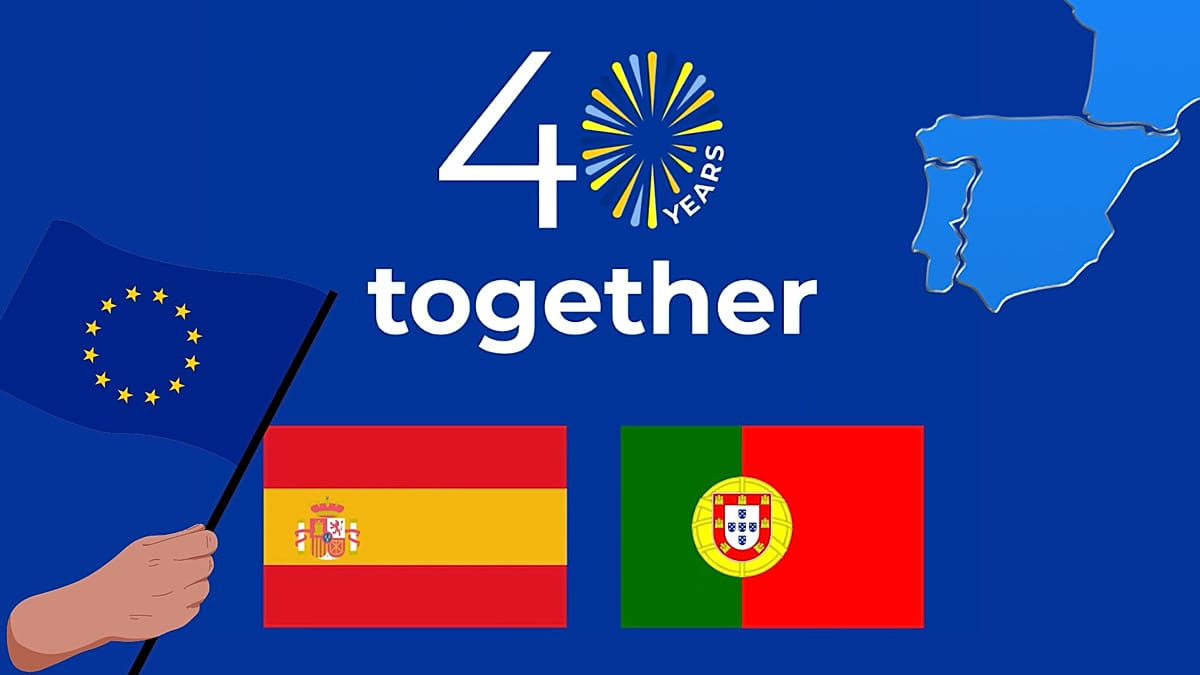
The day Spain and Portugal signed up to what was then the European Economic Community in 1986, few imagined how far the countries would go, particularly as both were still healing after decades of dictatorship.
In Spain, fascist dictator Francisco Franco had died only 11 years earlier, while in Portugal, the 1974 Carnation Revolution was still a fresh memory.
The Spanish economy was in serious trouble. GDP was barely €226 billion. More than 2 million people were out of work and the unemployment rate was around 21%. Inflation had reached 20% in the previous years.
The country was still paying for the consequences of the 1973 oil crisis and a political transition that had consumed much of the country’s energy.
Portugal fared no better. After almost half a century under the regime of António de Oliveira Salazar, the Portuguese economy was among the least developed in Western Europe, reaching only around 60% of the average European GDP.
The loss of the colonial empire had left the country without protected markets and without the sources of capital accumulation that had sustained its merchant bourgeoisie for generations.
The two countries shared something else in common: they had had each other’s backs for decades. The dictatorships supported each other in international forums, but little else.
Ignorance and mistrust defined the bilateral relationship. Europe was generally seen as the only possible way out for both.
The leap forward
But 40 years later, the outlook is a little different. Spain closed 2025 with a GDP close to €1.5 trillion, a sixfold increase on what it once was.
The country has gone from being a developing economy to becoming the fourth-largest in the European Union. Unemployment, while still a problem, has fallen to 11%.
European funds have played a decisive role in this change. Spain has received more than €185 billion since 1986, with the money money been used to build motorways, modernise the countryside, finance employment programmes and support innovation. Without these resources, convergence with Europe would have been much slower and more painful.
Portugal has followed a similar path. Portuguese GDP doubled in real terms during the first two decades with growth rates of around 6% until the beginning of the 21st century, outperforming the European average. The purchasing power of the average Portuguese went from 50% of the then EEC average in 1986 to values close to 75% of the current EU average.
Structural Funds made it possible to modernise infrastructure that had become obsolete, heralding a “golden age” of motorways, the improvement of national roads and regional access, as well as the modernisation of ports and airports, electrification and the expansion of basic sanitation and vocational training.
Today, almost 200,000 Portuguese farmers receive direct support from EU agricultural policies. Portugal has received more than €100 billion in EU funds, mainly for road and rail infrastructure, basic sanitation, education and administrative modernisation.
But it has not all been about economics. Free movement within the Schengen area has changed the lives of millions of people. 1.6 million Spanish citizens have taken part in the Erasmus education exchange programme since its creation.
In Portugal, more than 55,000 university students have studied abroad thanks to this programme in recent years.
Travelling, studying or working in another European country is no longer a privilege, it is a matter of course. The adoption of the euro as a currency in 1999, made official in 2002, was also a step forward for both countries.
Challenges remain
It has not all been plain sailing though. The 2008 financial crisis hit Spain and Portugal particularly hard. Spain reached 27% unemployment in 2013. Portugal had to ask for a bailout. Social cuts and austerity policies left scars that are still being felt.
“A yearning for progress and hope became the greatest transforming lever of our country,” Spain’s Prime Minister Pedro Sánchez said in a post on X.
“Today, a strong and democratic Spain means a strong and democratic Europe,” said Foreign Minister Jose Manuel Albares.
Moreover, both countries still face structural problems. Spanish productivity remains low compared to countries such as Germany or France.
Portugal has one of the lowest birth rates in the world, which threatens its future growth. And although public support for the EU remains high, with 73% of Spaniards and 91% of Portuguese people rating EU membership positively, the Union faces challenges that call its model into question.
As part of the celebrations marking the 40th anniversary of the signing of the Accession Treaty in June, Portugal’s Prime Minister Luís Montenegro, stressed that “the process of European integration has irreversibly changed the course of the country, enabling a profound economic, social and democratic transformation.”
The head of government also stressed that “accession to the European Union represented a collective strategic commitment, decisive for accelerating economic growth, consolidating democratic institutions and strengthening social and territorial cohesion, affirming Portugal as an active and committed member of the European project.”
On the same occasion, the prime minister and the president signed the Lisbon Declaration, which “reaffirms Portugal’s firm commitment to defend, enhance and strengthen the European project, with the objective of contributing to a more secure, fair, innovative and prosperous European Union, promoting social progress, economic growth, convergence and cohesion, for the benefit of all citizens.”