





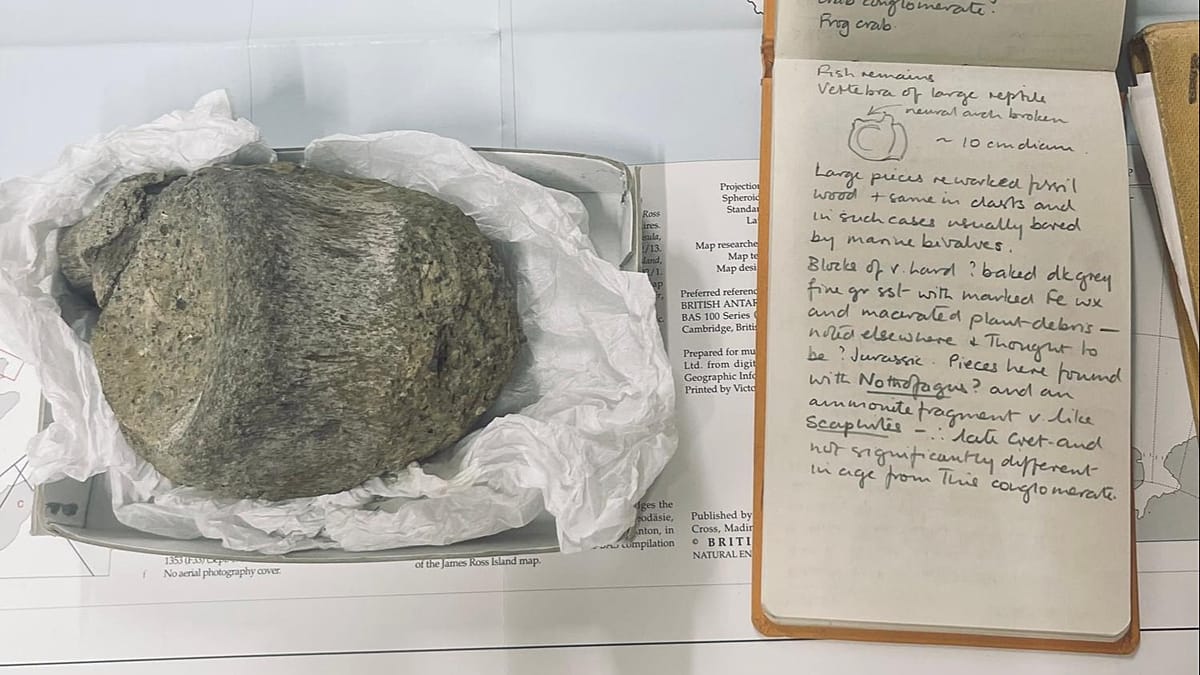
A bone discovered almost 40 years ago during a British scientific expedition has now been officially identified as the first dinosaur fossil ever found in Antarctica. The find is a vertebra from a titanosaur, a group of sauropod dinosaurs that includes some of the largest land animals ever to have lived.
The fossil was discovered in 1985 by British Antarctic Survey (BAS) geologist Mike Thomson during an expedition to James Ross Island on the Antarctic Peninsula. The mission aimed to map the rock strata to make it easier to date future palaeontological finds in the region. At the time, Thomson recorded the bone as belonging to a large reptile, but it is only now that it has been confirmed as a dinosaur.
Palaeontologist Mark Evans, curator of the BAS geological collections, said the fossil caught his eye a few years ago while he was reviewing the organisation’s holdings. “When I first saw this bone in our collections a few years ago, I suspected it was a dinosaur. After examining it more closely, I thought it was probably a caudal vertebra from a titanosaur. When we went back to Mike’s field notebooks, we found he already knew it belonged to a large reptile, so it is very special to be able to confirm his discovery 40 years later,” Evans added in a BAS statement.
A titanosaur from 82 million years ago
The researchers identified the fossil as a vertebra belonging to Titanosauria, the group that includes the largest dinosaurs ever to walk the Earth, which typically weighed more than 15 tonnes. However, the Antarctic specimen would have been between six and seven metres long.
The vertebra was found in the Santa Marta Formation, a marine layer from the Late Cretaceous that is around 82 million years old. It is the only dinosaur fossil discovered in Antarctica that comes from this geological formation. Scientists believe that after it died, the animal was carried out to sea, where it was buried on the seabed and eventually became fossilised.
New clues about the spread of dinosaurs
Professor Paul Barrett, a researcher at London’s Natural History Museum and co-author of the study, said the discovery offers new clues about how dinosaurs spread across the continents of the Southern Hemisphere.
“This discovery sheds more light on how dinosaurs spread across the southern continents. Until now, no titanosaurs had been found in Australia and the evidence from New Zealand is very limited. Confirming their presence in Antarctica suggests these animals continued their expansion into those regions, which were then connected,” Barrett said.
When this dinosaur was alive, around 82 million years ago, Antarctica was very different from today. According to BAS, the continent was covered in lush temperate forests and enjoyed a much warmer climate, driven by intense volcanic activity that released large amounts of carbon dioxide into the atmosphere.
The researchers point out that Antarctica remains the continent with the scarcest dinosaur fossil record because of the vast ice sheet that covers most of its surface. However, they believe there are still many fossils waiting to be found and that the retreat of the ice could reveal new evidence of its ancient biodiversity.
The study, titled ‘A titanosaurian sauropod dinosaur from the Late Cretaceous of Antarctica’, has been published in the scientific journal ‘Acta Palaeontologica Polonica’.