
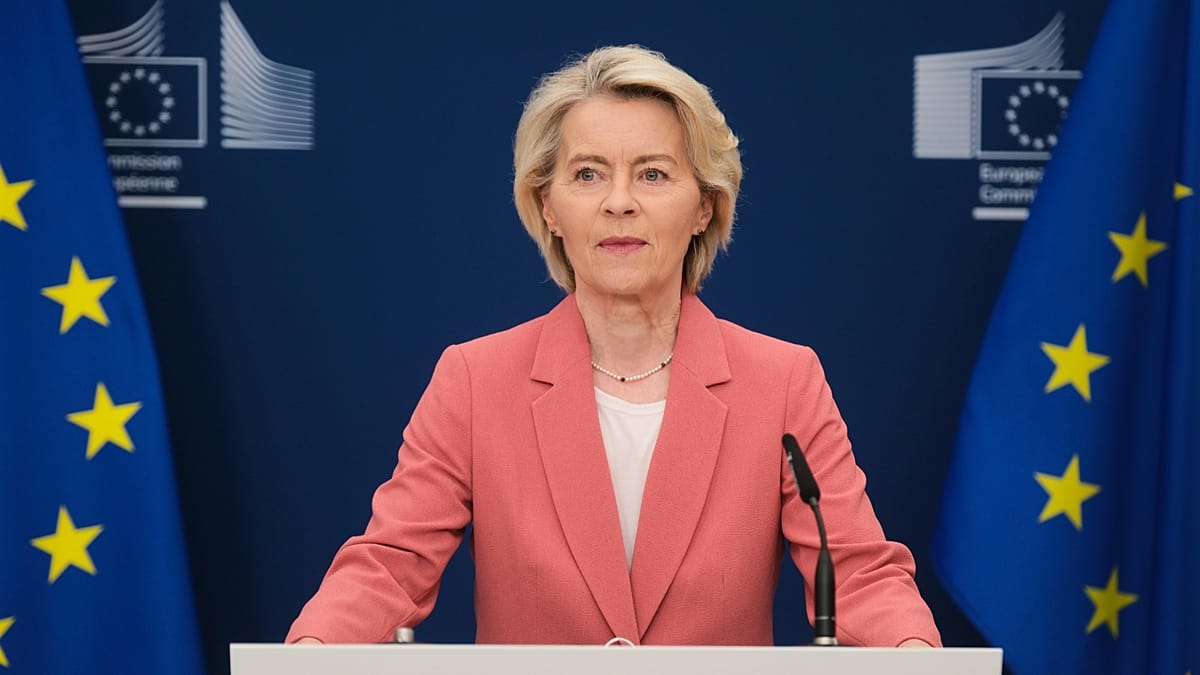
A video recently shared on Instagram claims that European Commission President Ursula von der Leyen is “automatically increasing” her own salary by €2,400 per month.
The claim has resurfaced on social media after being amplified by far-right political figures, including former MEP Florian Philippot, who cited an article published by the German newspaper Bild.
The article states that “EU officials have received their seventh pay rise in three years”.
According to publicly available data published by EUR-Lex — the European Union’s official database of legal texts and public documents — it is true that the salaries of EU officials increased between 2020 and 2025.
However, these increases are not the result of a personal decision taken by Ursula von der Leyen herself.
How are the salaries of EU officials actually determined?
Salaries of EU civil servants are, in principle, adjusted once a year.
The salary adjustment mechanism, in force since 2013, was approved by EU member states and the European Parliament. It is based on a formula set out in the EU Staff Regulations.
The calculation, carried out by Eurostat — the EU’s statistical office — is not an automatic inflation-linked pay rise. Nor is it a simple indexation.
Instead, it reflects changes in the purchasing power of national civil servants across EU member states.
In practice, this means that the salary of an EU official working in Brussels may rise or fall depending on how the Belgian government adjusts the pay and purchasing power of its own civil servants.
Applying the current rules for high-ranking EU officials, Ursula von der Leyen’s monthly salary rose from around €28,400 in 2020 to approximately €35,800 today.
However, EU salary increases have often lagged behind national inflation rates. In 2022, for example, the salaries of EU officials based in Brussels increased by 4.4%, while inflation in Belgium reached 10.5% that same year.
A European Commission spokesperson told The Cube, Euronews’ fact-checking team, that “there is absolutely no such thing as ‘self-raising salaries’ at the European Commission”.
“The overall situation for the 2025 salary update is below the level of nominal increases in Member States,” the spokesperson said.
By comparison, nominal salary increases stood at around 3.4% in Austria, 6.7% in Sweden and 18% in Poland.
The spokesperson also said that “over the period 2004–2025, EU staff endured a significant loss in real purchasing power”.
According to Commission figures, EU staff have lost around 11.9% of their purchasing power as a result of successive reforms of the staff regulations and repeated limits on salary adjustments.
Do EU officials pay taxes?
It is often claimed in public debate that EU officials do not pay taxes. That claim is misleading.
International organisations such as the European Union do not fall under the tax jurisdiction of any single member state. As a result, EU officials do not pay national income taxes in the countries where they work.
However, they are subject to EU-level taxation.
EU officials pay a progressive EU income tax, which can reach up to 45%, as well as an additional solidarity levy of up to 7%, alongside social security contributions. These taxes are paid directly into the EU budget.
In addition, EU staff do pay value-added tax (VAT), local taxes and regional taxes, like other residents.
EU officials may also receive allowances linked to their personal circumstances, such as expatriation or family allowances. Depending on the situation, these can range from around €2,300 to €18,000 per month.