


By Euronews
Published on
The United States wants to land humans on the Moon, send nuclear reactors into space and develop missile technologies that can be launched into space before the end of the decade.
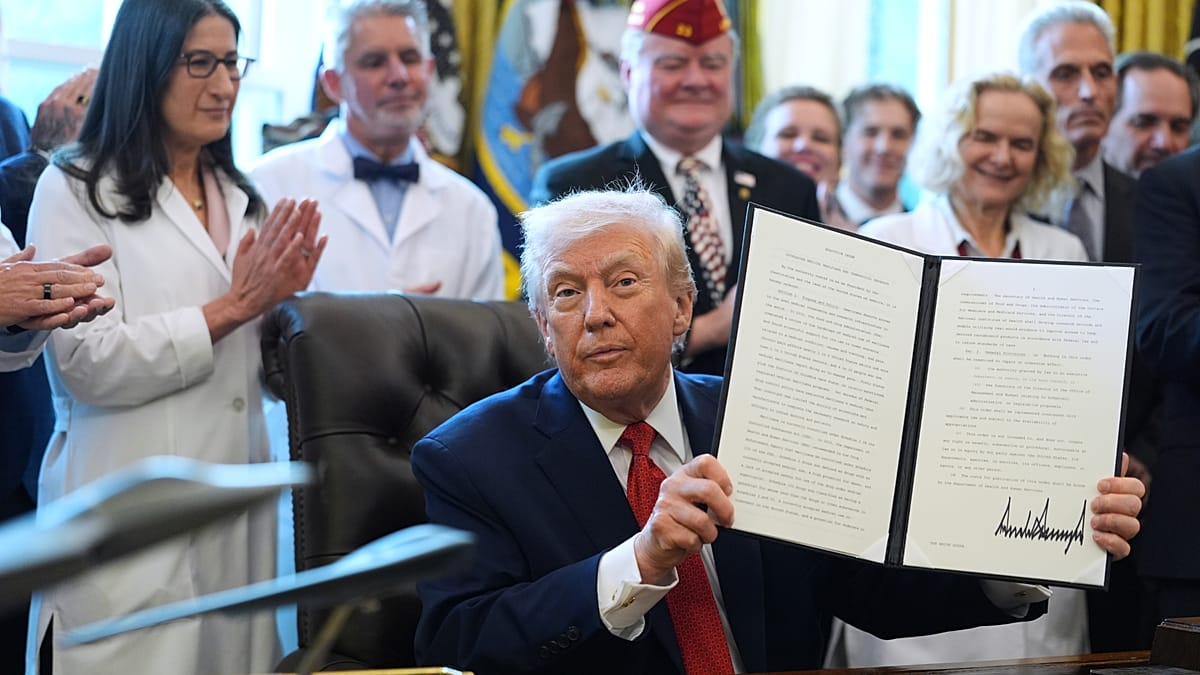
In a sweeping new executive order, US President Donald Trump laid out a five-year roadmap for what his administration will achieve in space.
We take a closer look at what’s in the new policy directive.
Return to the Moon
First among the list is a return to the Moon by 2028 with the establishment of a “permanent lunar outpost” by 2030.
The US’s National Aeronautics and Space Administration (NASA) and partners like the European Space Agency (ESA) are gearing up for the launch of the Artemis missions, which will see humans return to the Moon’s surface.
Artemis II, scheduled to orbit around the Moon in February 2026, has three American astronauts and one Canadian on board.
There is no crew list yet for the later Artemis III mission, where astronauts will walk out onto the Moon’s surface.
Experts previously told Euronews Next that the mission, scheduled for 2027, will likely be delayed due to the ongoing testing of SpaceX’s Starship, the vessel that the mission is supposed to use.
Trump’s executive order also said his administration will increase the “cost-effectiveness of launch and exploration architectures,” such as creating commercial launch services, to bring on lunar exploration.
The US will be ‘first nation to land’ on Mars
NASA is working on a so-called “Moon-to-Mars” mission pipeline, where scientists will use the teachings from the Moon’s surface, as well as a base there, to work towards an eventual mission to Mars.
However, Trump has said in the past that the agency should just focus on getting to the Red Planet instead.
The Red Planet got a mention in the executive order, that the United States “will be the first nation to land an astronaut on Mars”.
Trump is quoted by the Washington Post during his first mandate in 2017 as saying that he would want to see Americans set foot on Mars during his second term, but no updated timelines have been shared since then.
New space missiles by 2028
The Trump administration wants to defend “America’s vital national and economic security” in space by building missile defence technologies.
The order states the next-generation missile technology will enhance Trump’s Golden Dome project: a layered defence system that will protect the country from various types of missiles, including ballistic, hypersonic, and cruise missiles. It will also be able to conquer drones and advanced aerial threats.
In May, Trump announced that the Golden Dome would cost an estimated $175 billion (over €150 billion) and could be built before the end of his second term in 2028.
The eventual space-based defence system will be able to “detect, characterise, and counter threats to the United States” from very low-Earth orbit, including any nuclear weapons placed in space.
The executive order also gives the US government six months to implement a space security strategy.
Developing a commercial space economy
Trump’s executive order says he will also set aside at least $50 billion (€43.15 billion) to create a “vibrant commercial space economy” by 2028.
The administration’s focus will be on creating more high-paying jobs in aerospace manufacturing, increasing the number of launch and reentry testing and policy reforms.
This follows another executive order in August, where he directed multiple federal agencies to streamline regulations, speed up launches and support space infrastructure for a new economy in orbit. The August executive order also eliminated environmental reviews for launches and reentries.
A commercial space economy makes sure “the United States maintains its leading role in the commercial use of space,” the August order reads.
Another part of December’s executive order is also a call to action to private companies to upgrade their launch infrastructure, so the International Space Station (ISS) can be replaced by 2030.