
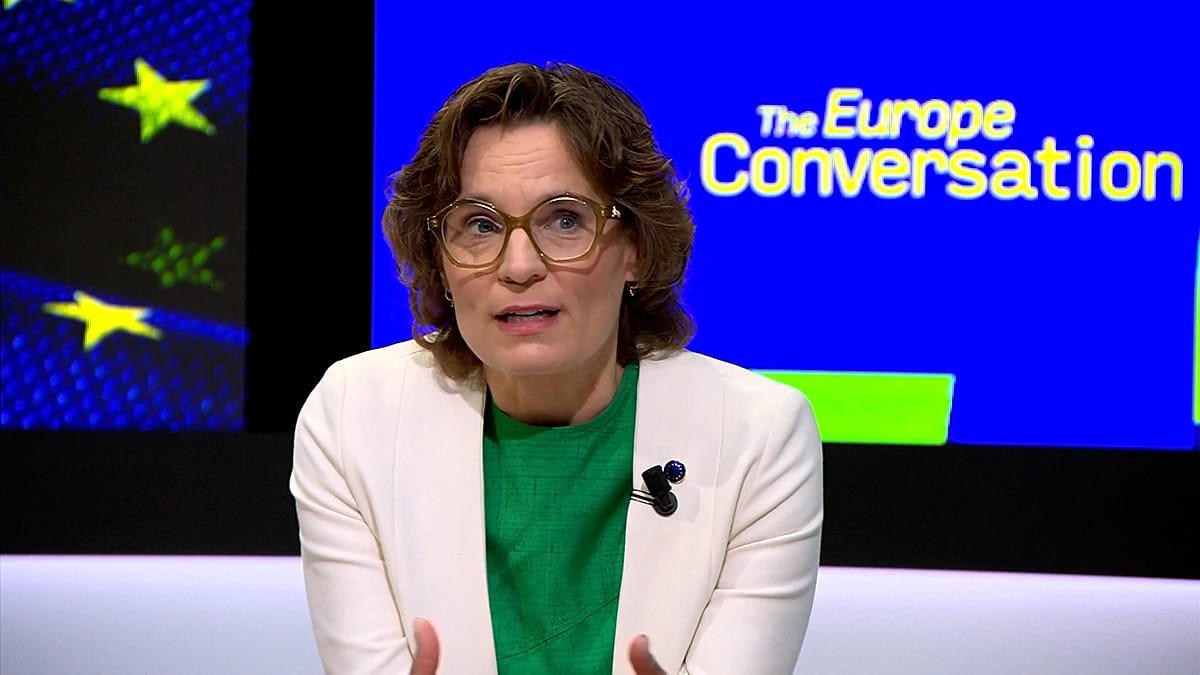
The European Union’s environmental policy should now be considered a key part of Europe’s defence strategy, Jessika Roswall, European Commissioner for Environment, Water Resilience and a Competitive Circular Economy, said.
She noted that many of the environmental concerns felt by the bloc, including the impacts of climate change, pose an existential risk to Europe and its security.
“There are a lot of examples. [Like] water, which is not only a resource. We need water for our daily lives; we need it for energy production; we need it for food production. And when water gets scarce, we are in trouble, and that eventually is also a security threat to us,” the Commissioner said on Euronews’ interview programme The Europe Conversation.
“On a global level, we also know that water is driving conflicts and so forth,” Roswall said.
However, she noted that natural resources can also be used as strategic tools. For example, Poland, Finland and Lithuania are evaluating the restoration and re-flooding of drained peatlands along their eastern borders as a dual-purpose strategy for climate change and national defence.
The reasoning behind this is that boggy terrain physically impedes the advance of heavy military equipment like tanks.
“We see how you can turn wetlands into border controls, and make it more difficult […] for an invasion to pass,” she said. In Lithuania, the ministries of defence and environment are joining forces on this.
“But the main concern is that biodiversity loss, crop loss, floods and droughts all pose a security threat.”
Geopolitical instability
This threat was highlighted by a recent report published by the UK’s Department for Environment, Food and Rural Affairs (DEFRA), which is understood to have involved the intelligence and security agencies MI5 and MI6.
“It said that natural degeneration is the main threat to the UK’s national security. The effects, of course, are the same for many other countries,” Roswall said.
The report’s authors warned that without “major intervention”, threats posed by biodiversity loss risk creating geopolitical instability, economic insecurity, conflict, migration and increased competition for resources.
“We need to understand that the risk of not investing in nature comes with an economic risk, but also with a security risk. And that’s why I think we don’t have a choice on whether to invest in our future; we need to do it.”
Concerns were also raised in the report over the UK’s reliance on global markets for its food and fertilisers.
The bloc’s own reliance on fertilisers from outside Europe has been revealed by the US conflict with Iran and the resulting Iranian blockade of the Strait of Hormuz, a key waterway for global agricultural supply chains.
As a result, European farmers are now facing significantly higher fertiliser prices.
“That again shows us that dependency comes with a cost,” Roswall said, adding that Europe is also dependent on non-EU countries for energy and critical raw materials.
She argued that, in this context, the Circular Economy Act, spearheaded by the Commissioner, will be instrumental to Brussels’ strategic autonomy.
“It is not only Europe that needs these critical raw materials. The fight for these materials is getting tougher. So we need to be more self-sufficient, and circularity plays a crucial role in using the materials that we have in Europe more efficiently. We are a goldmine [of raw materials], actually, but we don’t use it.”
Changing mindsets
The Circular Economy Act, scheduled to be proposed in late 2026, aims to increase the proportion of materials recovered from waste for reuse and reduce the share of virgin materials (raw, pristine resources extracted directly from nature) imported, for example, for new electrical and electronic equipment.
To reach its goal, the bloc wants to create a single market for secondary raw materials — recycled materials recovered from waste or end-of-life products.
“We need to make the business case for secondary materials, because virgin materials are cheaper today than secondary materials, but they are also scarce and being weaponised,” Roswall explained.
“So we need to get rid of this dependency, and for this, consumers, policymakers and businesses need to have a change in mindset.”