
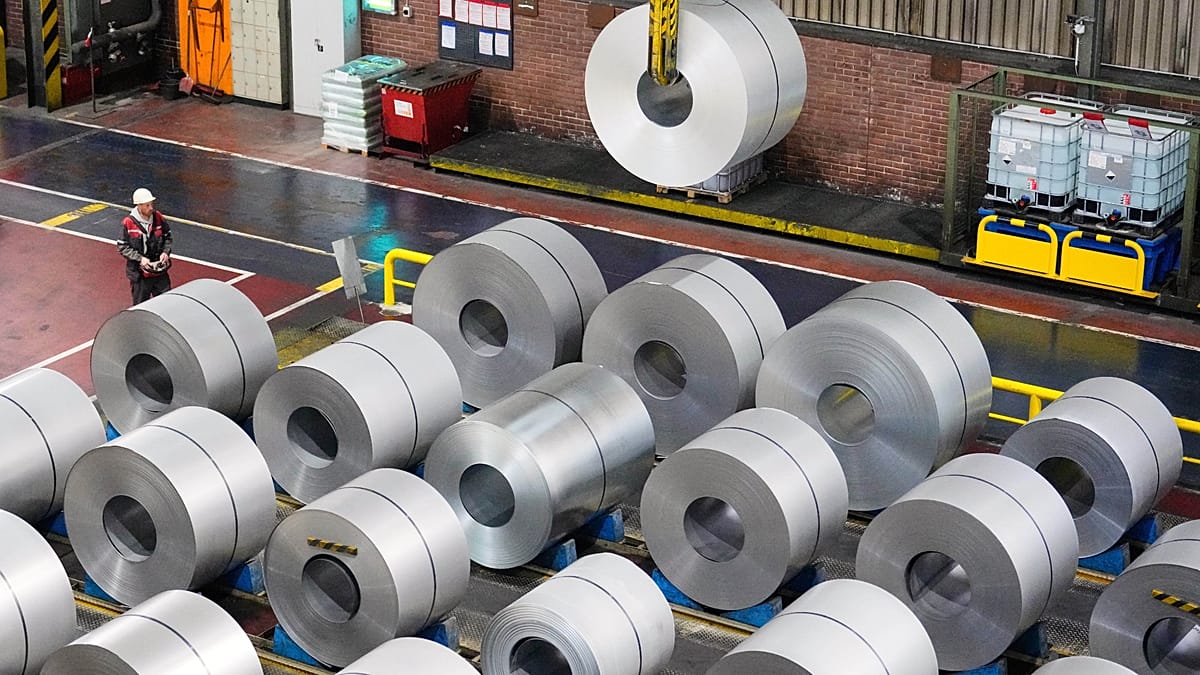
Imports of steel, aluminium, cement and other heavy goods to the European Union will start paying for the CO2 emissions they produce from 1 January, as the bloc seeks to protect EU manufacturers facing more stringent obligations compared to foreign peers.
While the measure is meant to ensure fair competition for European industries, the EU’s carbon border tax, the Carbon Border Adjustment Mechanism (CBAM), may create trade frictions and lead to disputes with non-EU countries, further exacerbating the trade feuds dominating the international stage since the arrival of Donald Trump to the White House with an aggressive global tariff policy.
The United States has pressured the bloc to withdraw the law during an October official visit of US Energy Secretary Chris Wright to Brussels, saying the law will create massive trade barriers among the transatlantic partners. Earlier this year, the US tripled tariffs on EU good and raised tariffs on steel and aluminium to 50%.
China, India, Russia, and South Africa have also voiced opposition to the EU’s law, saying it amounts to protectionism, with some countries raising questions about the EU’s law’s compatibility with rules under the World Trade Organization (WTO).
Egypt is so far the first country to have requested an EU CBAM exemption, according to local media. Cairo is working on its own domestic carbon tax to protect local industry from the EU’s CBAM, noting that the iron and steel industry could bear 74% of the carbon tax’s financial impact.
From reporting standards to financial charges
A three-year transition phase for the carbon levy began in 2023 to give industries time to report on CO2 emissions by collecting data and testing methodologies.
From 2026, EU importers will need to buy and surrender CBAM certificates corresponding to the CO2 emissions embedded in their exports, priced in line with the EU’s carbon market, at around €70-€100 per tonne of CO2.
Countries already operating under a carbon market will be able to offset their exports based on their domestic tax.
According to the United Nations Framework Convention on Climate Change (UNFCCC), heavy industry, such as steel and aluminium, is a major source of CO₂ in the energy sector, accounting for up to 15% of total EU energy-related greenhouse gas emissions.
Jean-Marc Germain, CEO of Constellium, which represents the aluminium industry, said that the CBAM will ultimately raise European aluminium costs.
“CBAM, as currently designed, risks weakening European aluminium competitiveness without delivering meaningful emissions reductions,” Germain said.
CBAM critics also argue that the system is too burdensome, citing complexities in accurately measuring the embedded carbon emissions.
Jaime Amoedo, executive director and co-founder of The ESG Institute, an organisation that accredits businesses for their sustainable practices, said EU importers of steel, cement, aluminium, or fertilizers will likely see material cost increases, especially where emissions data is incomplete or relies on default values.
Although exporters are not legally obliged under EU law, the implications they face as a result are just as significant.
“If an exporter cannot provide reliable, verifiable emissions information, the importer must use conservative default values, which increase certificate costs,” said Amoedo.
“In practice, this makes high-quality data a commercial requirement, not a regulatory nicety. Exporters who cannot meet these expectations risk losing EU customers altogether.”
CBAM revenues to help European industries
The EU’s carbon border tax is intended to send a global signal to countries outside the EU, encouraging them to adopt carbon pricing and cleaner production methods.
The bloc insists that the new law will prevent industries from relocating to countries with less stringent sustainability requirements, a phenomenon known as carbon leakage.
However, the carbon border tax will inevitably raise production costs and European industries have been lobbying the European Commission to help mitigate the loss.
On December 17, the EU executive proposed a temporary fund backed by CBAM revenues to help industries cope with the implementation phase.
Around €1.5 billion in CBAM revenues are expected to be raised by 2028, according to the Commission.
Ed Collins, managing director at InfluenceMap, an independent think tank studying global corporate and industry association lobbying on climate policy, said the fund resulted from “intense lobbying from incumbent industry actors” that have been calling for reimbursement of carbon costs for exported goods.
“The introduction of the ‘Temporary Decarbonisation Fund’, although bound to decarbonisation investment mandates, appears to partially grant this wish by ensuring companies will not have to pay for the full cost of the carbon they emit,” Collins said.