
European Commissioner for Sport Glenn Micallef said he respected the International Olympic Committee’s decision to disqualify a Ukrainian skeleton racer over his custom helmet featuring portraits of fallen Ukrainian athletes, while expressing sadness that “the situation could not be resolved.”
Vladyslav Heraskevych was disqualified before his first run at the 2026 Milano-Cortina Winter Olympics, after the IOC banned him from using his custom-made helmet, which features portraits of Ukrainian athletes killed in Russia’s full-scale invasion since early 2022.
The helmet does not display any slogans or political symbols.
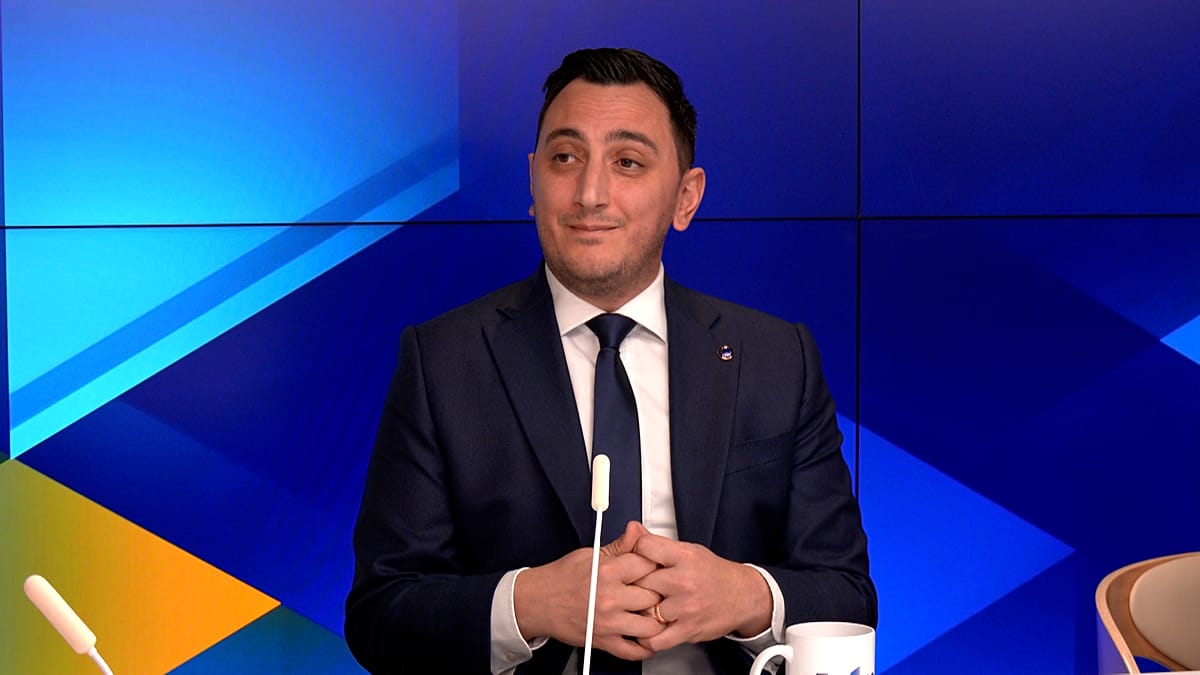
Speaking exclusively on Euronews’ Europe Today morning show, Micallef said he appreciated the IOC’s decision.
“The decision by the IOC is one I respect,” he said.
“I respect particularly the fact that Kirsty Coventry, the president of the International Olympic Committee, was speaking to Vladyslav (Heraskevych) face to face, explaining the situation, trying to resolve the dispute through dialogue.”
“I also admire the fact that … in the event of the extraordinary situation, (Coventry) made an appeal to the disciplinary committee also to revoke the accreditation and restore the accreditation,” Micallef added.
The IOC allowed Heraskevych to remain at the Olympic venues in Milan and Cortina d’Ampezzo, albeit without competing.
The Olympic Committee also said it had offered Heraskevych alternatives, such as wearing a black armband and displaying his helmet before and after the race, but the athlete rejected them.
The helmet at the centre of the controversy depicted over 20 Ukrainian athletes killed in Russia’s war against Ukraine.
Among them are former competitors who left their sporting careers to join the Ukrainian Armed Forces, as well as civilian athletes killed in Russian attacks, including minors.
“I did not break any rules. I defended the interests of Ukraine — not just the country, but the memory of these athletes. They deserve it,” Heraskevych said before leaving the Olympic village on Thursday.
European Commissioner for Sport told Euronews he was “sad to see that the situation could not be resolved before the competition in a way that would have allowed him to express himself and pay respect to the fallen heroes in Ukraine.”
“Ukraine is going through a very tough time”, he said, reiterating “But the decision by the IOC is one I respect.”
‘This is price of our dignity’
Micallef stated that it is for the IOC and the federations to set the rules and regulations for the competitions and “this is uncontested”.
“What we’re talking about here is messaging and messaging rules, particularly to come out of the Olympic Charter”, he told Euronews.
“In this particular case, the rule is not directed at a particular country. These are rules to safeguard safety for athletes, but also fair competition, and I emphasise this point.“
Meanwhile, other Ukrainian athletes have spoken out about similar restrictions imposed by the IOC.
Two more Ukrainian Olympians had their helmets barred from competition on the grounds of “politicisation”.
Ukrainian freestyle skier Kateryna Kotsar said the IOC disqualified her helmet for the inscription “Be Brave like Ukrainians”.
Oleh Handei, a Ukrainian short track speed skater, said his helmet was banned for what the IOC claims is a “political slogan.”
“I have an inscription on my helmet by (Ukrainian poet) Lina Kostenko: ‘Where there is heroism, there is no final defeat,'” Handei explained.
“They banned it, saying that it was a political slogan, that it was about war, that it was not allowed. I translated it word for word for them — no, it’s not a political slogan. These are just motivational words for me, for my team, and for my country.”
Sports court to hold appeal hearing
The Court of Arbitration for Sport began hearing Heraskevych’s appeal on Friday.
Although the competition began without him on Thursday morning, the Ukrainian athlete is seeking reinstatement or, at a minimum, a CAS-supervised run.
“I’m pretty positive about how it went,” he told reporters outside the office of CAS in Milan following his appearance before the court. “I hope the truth will prevail and I know that I was innocent.”
On his social media platforms, Heraskevych pointed to several similar instances at the 2026 Olympics in which athletes honoured the memory of the deceased without facing punishment.
At the opening ceremony, Israeli skeleton racer Jared Firestone honoured the memory of those lost at the 1972 Munich Games by wearing a kippah inscribed with the names of the athletes and coaches who were killed.
US figure skater Maxim Naumov paid tribute to his own family after his performance. He held his childhood photo depicting him and his parents, who died in a 2025 plane crash.
Canadian skier Jessica Linton also carried a personal message on her helmet, “I ski for Brayden,” and displayed it to the cameras after her run, likely in memory of moguls skier Brayden Kuroda, who passed away in 2020.
Heraskevych said after his disqualification he was getting threats from Russians and blamed the IOC’s decision for that.
“I believe that these Games now and this act of the IOC also serves as an instrument of propaganda for Russia,” Heraskevych said. “I still receive a lot of threats from the Russian side.”