


She was Slovenia’s Woman of the Year 2021, and a few years later, she is also entering the European stage: anthropologist Nika Kovač and her institute “8 March” are at the start of the European Citizens’ Initiative “My Voice, My Choice”.
The initiative to improve access to abortion across Europe was presented to the European Parliament in December 2025, and the Commission decided on follow-up measures in March 2026. It is one of twelve European Citizens’ Initiatives that have managed to change the agenda in the EU Parliament.
This is because the “lack of access to abortion in many parts of Europe not only poses a risk to women’s physical health,” as stated in the citizens’ initiative’s motion, “but also places additional economic and mental burdens on women and families – often in marginalised groups who can least afford it”.
In December, the Parliament called on the Commission to set up a voluntary funding mechanism that all Member States can participate in and is supported by EU funding from the European Social Fund+.
The aim is to help people from countries with limited access to legal abortions: Other EU states should be able to provide them with safe and legal abortions, within the framework of their respective national laws.
There have only been twelve EU citizens’ initiatives so far
“In the case of the My Voice, My Choice initiative, for example, the result was that the EU recognised this issue as an important public health issue,” explains Nino Kavelashvili, Ambassador of the European Citizens’ Initiative (ECI) to Euronews.
She is also a consultant for European communication at the Federal Network for Civic Engagement (BBE) in Berlin. “And without this initiative, the issue might not be on the agenda at all,” Kavelashvili continues.
The “My Voice, My Choice” campaign is one of twelve successful European citizens’ initiatives to date. Not a particularly outstanding record, as ECI Ambassador Kavelashvili admits, considering that the instrument has already been in existence for 14 years.
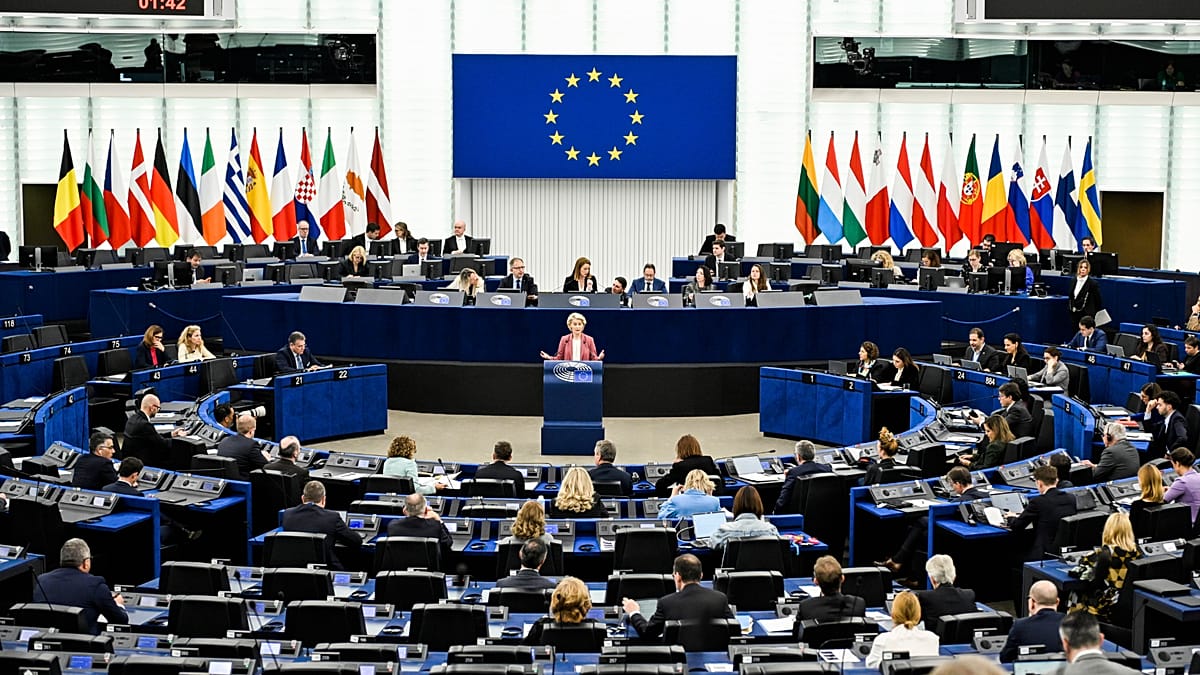
One problem is that many Europeans do not realise that they can call on the EU to make a statement and thus directly influence the agenda of the EU Parliament – i.e. 720 MEPs from all EU countries.
“It’s important that we have a voice, that we have a say, that we help shape democracy,” explains ECI Ambassador Nino Kavelashvili to Euronews. “And this is actually very important from a political point of view, because it shows that democracy in the EU does not only work through institutions, but is also complemented by direct participation and is also participatory.”
How the European Citizens’ Initiative works
However, a number of hurdles had to be overcome before Kovač from Slovenia could get her initiative into the EU Parliament.
Before an initiative is discussed in the EU Parliament and the Commission adopts a position, people from at least seven countries have to join forces on a single issue. This is how Nika Kovač started with the 8 March Institute in Slovenia, but sought allies in other European countries.
Broad support is then needed. “You need one million signatures from at least seven European member states. And that has to be achieved within a year,” explains Kavelashvili.
Within one year, they must then collect one million signatures from at least seven EU countries: “My Voice, My Choice” submitted 1,124,513 signatures to the European Commission in September 2025. One month later, they met the EU Commissioner for Equal Opportunities, Hadja Lahbib, and presented their initiative.
The European Citizens’ Initiative will then be heard in the EU Parliament. “And at this moment, European parliamentarians are discussing it, the media are there, and the initiative and the topic are getting attention,” says Kavelashvili. “And in my opinion, this is when things really take off in the direction of politics.”
The Commission is then obliged to publish a written and reasoned opinion within six months.
EU must respond, but not obliged to pass a law
According to Kavelashvili, it is important that the EU Commission then has to address the content of this initiative and respond with reasons. In the case of “My Voice, My Choice”, the Commission has also adopted measures.
“However, the EU Commission is not obliged to develop a legislative proposal, which is not included in this ‘package’,” emphasises Kavelashvili. Nevertheless, in her opinion, the effect will not fizzle out. The problem at the European level is that the results cannot be realised immediately. They are not very striking.
However, “My Voice, My Choice” has had the effect of putting the topic of sexual and reproductive health more firmly on the European political agenda and making it more visible in the public debate. “As a result, such initiatives can trigger political discussions and shift priorities, even if this does not automatically result in direct legislation.”
What the ECI ambassador wants to change
ECI Ambassador Nino Kavelashvili knows firsthand how fundamental the instrument of participation is in the EU, as she has only recently been able to use it. Kavelashvili is originally from Georgia, a country that is not part of the EU. She has only had a German passport for a few weeks and can therefore participate in the EU in the same way as German citizens.
She also knows where to start in order to publicise the initiative. “Communication strategies really need to be rethought and improved,” she explains, calling for more use of social media and information sessions in schools, for example.
In her opinion, a topic must not only be strong, but also understandable. “A strong topic is the main ingredient, but you cook this soup in seven countries.”
Strong networks are needed that can mobilise locally. “Translation work is also very important, not only linguistically but also culturally,” adds Kavelashvili. This is because the preparatory work is demanding and sometimes scary, says the ECI ambassador. The figure of one million signatures is “a deterrent”.
“I come from a non-EU country and therefore had no direct access to the European Citizens’ Initiative. And I found that sad,” says Kavelashvili. “And this personal experience made me realise how valuable it is to have this right, that this democratic right cannot be taken for granted.”
Democracy has broad support in Germany, as the Bertelsmann Stiftung’s Democracy Monitor 2026 shows. 82% of around 5,000 respondents had an above-average positive view of the values of democracy. Principles such as elections, parliament, the separation of powers and civil rights are held in high regard by respondents.
The last European elections in 2024 also saw a high voter turnout of 50.74%. 10 years earlier, for example, this figure was 42.61%.
“I think it’s important that the voice for democracy is louder,” explains ECI Ambassador Kavelashvili. “That we are not frustrated, but that we are actually hopeful about fighting for democratic values. That’s important, especially in these times,” she told Euronews.
The idea that people from different countries can build something is what the EU is for her.
There are currently 129 initiatives registered with the European Commission, including those on transport, animal welfare, and the fur ban.