
The opinions expressed in this article are those of the author and do not represent in any way the editorial position of Euronews.
With AI, Europe has within its reach the biggest productivity opportunity the world has seen since computers and the internet. Much of Europe missed that last wave. It cannot afford to miss this one. It is a chance to break out of decades of sluggish growth and meet the costs of an ageing society.
That is if it makes the right decisions, makes them quickly, and manages the risks without giving up the upside. It would mean higher wages, rising living standards and the revenue to fund public services without relying on ever higher taxes or more debt. The question is whether Europe will genuinely seize the opportunity, and seize it with sufficient speed.
Over these past two days, I joined Europe’s finance ministers in Dublin, at the Eurogroup to discuss productivity and at the informal ECOFIN to discuss AI. Europe’s productivity challenge, which is real, and the AI opportunity are two sides of the same coin. For Europe, AI is not just a technology question. It is a growth, incomes and budget question, and increasingly one of competitiveness and security.
Start with the challenge:
Europe’s productivity growth has been sluggish for decades. Since 2022, productivity across the EU has essentially been stagnating, while the gap with the US is widening.
Productivity is what lifts wages and living standards. When it stalls, so do they. People feel this in their daily lives: it gets harder to keep up with the cost of living, and harder to get ahead.
Europe is also ageing, and its working-age population is shrinking.
Across the EU, there are about three people of working age for every person over 65 today; by 2060, there will be fewer than two. Pensions, health and long-term care will cost more every year; defence and the energy transition add to the bill. OECD analysis suggests these pressures could add close to six points of GDP to public spending in many European countries by 2040.
Those bills cannot simply be paid with higher taxes or more debt. Tax burdens in much of Europe are already among the highest in the world, and debt and interest costs are rising.
That leaves one path: sustained growth. But with an ageing population, growth can no longer come, as it has in the recent past, from more and more people in jobs. It has to come from each of us producing more, from higher productivity. That is where AI offers an extraordinary opportunity.
On OECD estimates, AI could add up to 1.2 percentage points a year to productivity growth over the coming decade. That means revenue that grows without tax rates going up.
A fiscal dividend: helping to create room to fund care for an ageing population, invest in security and still bring debt down. And AI can make public services themselves more efficient.
None of this is automatic. The dividend only arrives if AI is used across the whole economy. Adoption, while rising fast, is still narrow. One in five firms across the OECD used AI last year, double the share two years earlier – but one in two large firms and only one in six small ones, with dramatic differences across sectors.
To get there, Europe has to do three things.
First, build the infrastructure: data centres, reliable and affordable power, fast networks. Permit and connect them faster, and integrate Europe’s electricity market so power flows where needed. Which means finding better ways to finance it.
The AI build-out is a trillion-euro investment wave, increasingly funded through bond and capital markets rather than company cash flows. Europe has the savings, but too much of it sits in bank deposits or flows abroad. A genuine capital markets union, which would channel European savings into European infrastructure and give young, innovative firms the risk capital they need to scale, has become even more important and more urgent.
Second, ensure access. Small and medium-sized businesses employ most Europeans. They need affordable tools, trusted advice and a single market in which a product built in one member state sells in all 27.
Third, invest in people. Skills are the binding constraint on faster adoption. Firms tell us the main reason they do not adopt AI is that they cannot find people who can use it.
Yet workers are ahead of their employers. More than 40% of people in work across the OECD already use generative AI tools, often on their own initiative. What is missing is training. The training there reaches those who need it least. Only 23% of adults with low literacy take part in AI-related training, against 61% of those with high literacy.
Firms under-invest in training because they fear losing those they train. It’s a market failure whose fixes are fiscal: tax treatment of training, incentives for employers who train, individual learning accounts that workers carry with them from job to job.
What about jobs? Fears of mass unemployment dominate the headlines. The data do not support them: OECD surveys find no evidence so far that AI is reducing overall employment. If anything, the sectors most exposed to AI have been advertising more jobs, not fewer. And on young people, where concern is loudest, our Employment Outlook finds AI’s role in their difficulties has so far been limited.
There will be change: some tasks will disappear and new ones appear.
We should prepare systematically, with tools we know work: training that reaches workers most at risk, employment services that move people from job to job rather than through unemployment, and help for those who must move to find work. AI itself can make training more effective: shorter, more targeted and easier to deliver. That is the right response. Holding back the technology is not.
Europe, like everyone, must manage AI’s risks to privacy, safety, cyber security and financial stability, and the OECD AI Principles give us a shared framework.
But the greater risk for Europe is not moving too fast. It is moving too slowly while others race ahead. In a world where economic strength and security are ever more closely linked, a Europe that falls behind on this decade’s defining technology will have less say over its own future.
The choice in Dublin was clear. Europe can use AI to grow, raise incomes and secure the public finances its ageing society depends on. The technology is here. The people are willing. What Europe needs now is the decisions.
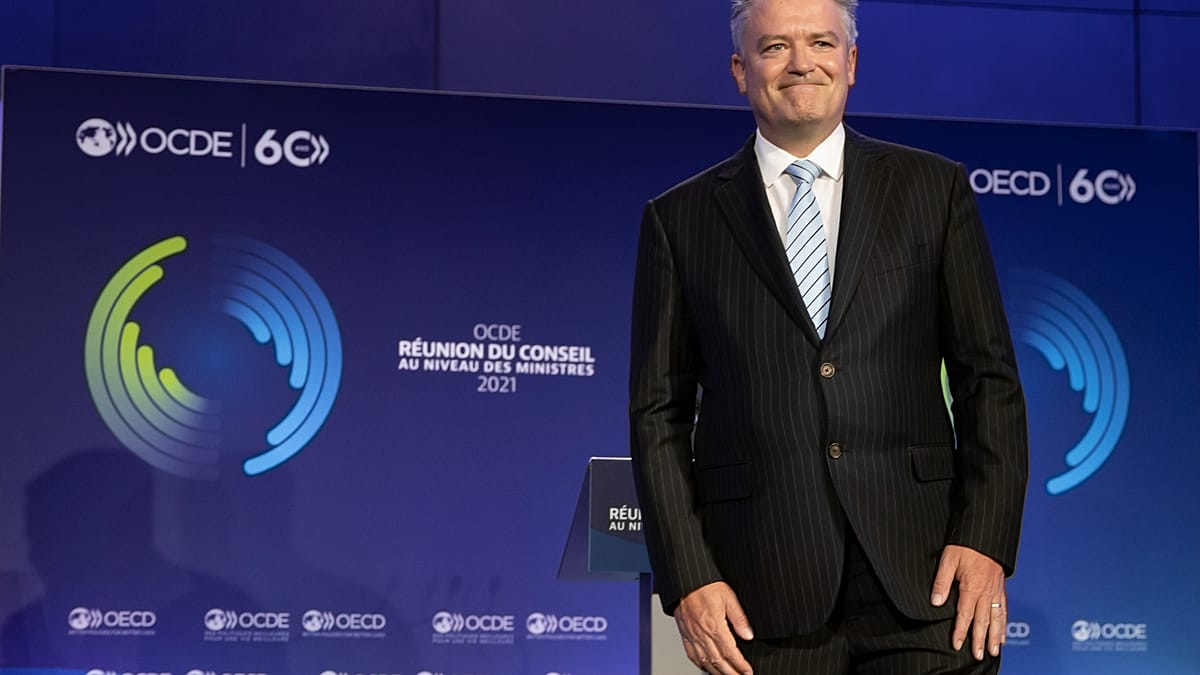
Mathias Cormann is the OECD Secretary-General and recently took part in the Eurogroup and informal ECOFIN meetings in Dublin on productivity and on future proofing the economy – the impact of AI.