



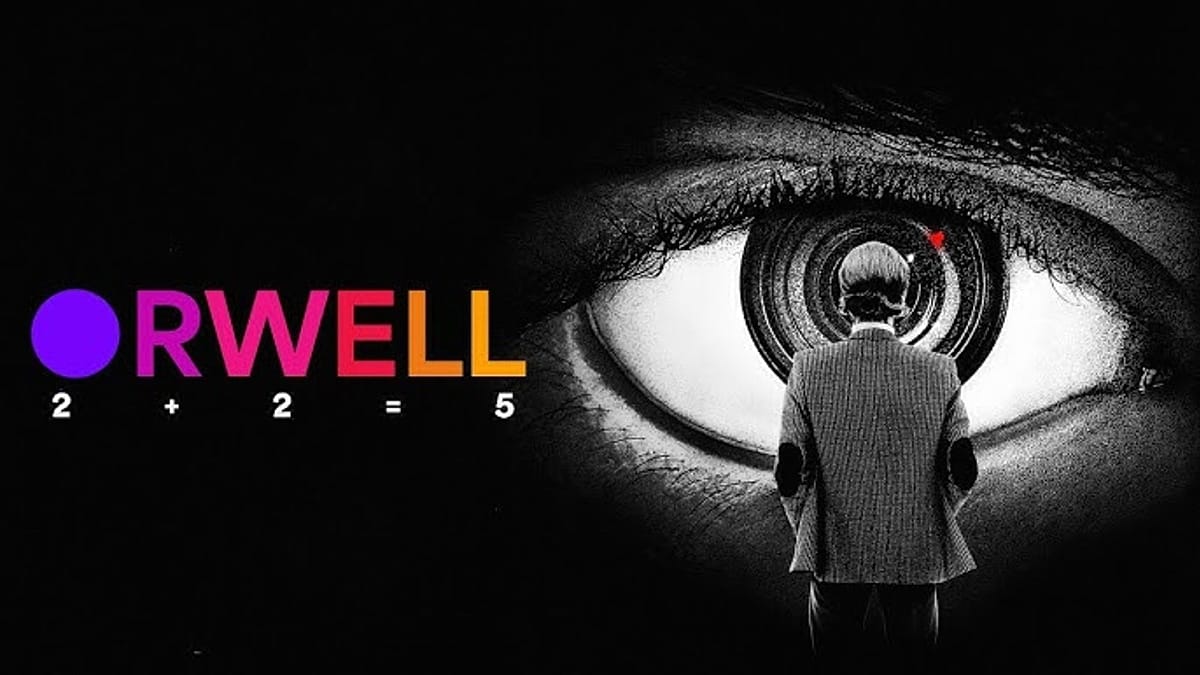
“Big Brother is watching you.”
Unless you’ve been in a blissful state of comatose, you’ll have noticed that the ubiquitous slogan at the heart of George Orwell’s dystopian novel “Nineteen Eighty-Four”, as well as the author’s concepts of “newspeak” and “doublethink”, have gone beyond the realm of popular culture. They have gained increasing relevancy in our reality.
With his new documentary Orwell: 2+2=5, renowned filmmaker Raoul Peck intertwines the life and words of Orwell with archival footage and ripped-from-the-headlines clips to make viewers realise that while Orwellian terms have become household phrases, we may be failing to still fully appreciate how the nightmare of “Nineteen Eighty-Four” has come true.
Much like he did ten years ago, when he took the words of the late James Baldwin to create a layered chronicle of the history of racism in the US (I Am Not Your Negro), Peck here plays with chronology to reinforce the timeless and prescience of Orwell’s prose. A voice from the past which resonates in our present. The director connects the dots between Orwell’s private diary entries, writings and letters – narrated by Homeland star Damian Lewis – and archival photographs, film clips and modern-day news reports to show how the past can inform the present. More alarmingly, Peck highlights how we’ve been given the playbook for totalitarianism, which has been used (and continues to be implemented) as a blueprint by governments all over the world over the past century, and we’re still being duped.
Haiti. Myanmar. Russia. Israel. The United States of America. Orwell: 2+2=5 exposes not only how history repeats itself but how present-day leaders like Donald Trump, Vladimir Putin, Victor Orbán and Benjamin Netanyahu have all adopted similar tactics to feed the machinery of oppression.
Peck’s film covers a lot of ground, blending past and present, fiction and reality – so much so that the documentary frequently feels dizzying.
World War II and the dismantling of institutions; the bombed-out streets of Ukraine; book bans through history; MAGA indoctrination; the role of the media and social media in allowing lies to spread faster than facts; unregulated AI which threatens objective truth; surveillance capitalism… It creates a blur which is disorienting by design, and the message is both clear and chilling: Orwell speaks to our troubled times just as much as he did to his era.
Some of the film’s post powerful moments are the brilliantly edited sequences which pull no punches.
We hear Trump rewriting the narrative of January 6, with Peck superimposing his lies (“so much love in the air”) over footage of the true violence that occurred – giving weight to Orwell’s words, “From the totalitarian point of view, history is something to be created rather than learned”.
We witness Orwell’s warnings about political language in clips of “newspeak” – ubiquitous euphemisms that reveal twisted words gutted of meaning. “Collateral damage” over scenes of Berlin in 1945; “Clearance operation” in Myanmar in 2017; “Peacekeeping operations” over footage of Mariupol in 2022; “Admirable profits” over clips of Animal Farm; “Antisemitism 2024” – translated as: “Weaponised term to silence critics of Israeli military action”.
We are issued further warnings through cinema. Much like Peck used Hollywood against itself in I Am Not Your Negro, illustrating through film clips how the image projected by the cultural exports of Hollywood clashed with social realities, the director carefully includes extracts of 1984 adaptations as well as snippets of films by Terry Gilliam, Steven Spielberg, Lauren Greenfield and Ken Loach to better emphasize how art reflects our times but can also serve as warnings.
While Orwell: 2+2=5 may sound like a dense educational exercise, Peck’s direction elevates the film and makes it personal. By focusing on the last years of Orwell’s life and discarding any other voice but the author’s, he manages to avoid dry didacticism.
At its heart, his documentary is about the man Orwell was – something foretold by the opening animation of tubercular bacteria. The repeated visual motif signifies the growing infestation of autocrats polluting the bloodstreams of global politics, but serves to remind us of the central figure’s advancing illness. Peck keeps the author front and centre, and never portrays him as a prophet. Instead, he shrewdly elects to show a human being in all his contradictions. From Orwell’s time as an imperial police officer in Burma to his wrestling with the British class system, the sins of the empire and his own personal complicity in a system he grew to hate, there are emotionally charged layers throughout.
Like Orwell did with “Animal Farm”, Peck manages to fuse his political preoccupations with an artistic – and therefore emotional – intent, and the film is stronger for it.
Orwell: 2+2=5 may not be as galvanizing as I Am Not Your Negro but it is no less indispensable.
It is immersive as the portrait of a man’s personal and political struggles. It is disturbing and urgent in the way it could continue to be updated with fresh footage that would establish even more direct resonance between Orwell’s words and what is happening in the world today. (“Board of Peace”, anyone?) It is fascinating as a reminder that we already have everything we could possibly need to recognise the tools of authoritarianism.
76 years after the author’s death, Raoul Peck allows Orwell to speak to us once more in one of the most essential documentaries of the 21st century. We need to listen. Better 76 years late than never.
“The further society drifts from the truth, the more it will hate those that speak it.” – George Orwell –
Click here for Euronews Culture’s exclusive interview with director Raoul Peck.
Orwell: 2+2=5 premiered in Cannes last year and is out in the US, Denmark and Portugal. The film is released in more European cinemas – France and Spain – this month.


