
Close Menu
Daily Guardian EuropeDaily Guardian Europe
  • Home
  • Europe
  • World
  • Politics
  • Business
  • Lifestyle
  • Sports
  • Travel
  • Environment
  • Culture
  • Press Release
  • Trending
What's On

NATO stronger than ever after Greenland crisis, Rutte says – POLITICO

February 14, 2026

France’s Macron hammers message of European strength – POLITICO

February 13, 2026

A Europe that spends more on defense but can stand up to the US – POLITICO

February 13, 2026

Rubio skips Berlin Format talks on Ukraine in Munich

February 13, 2026

Europe needs cyber weapons, says EU tech chief – POLITICO

February 13, 2026
Facebook X (Twitter) Instagram
Web Stories
Facebook X (Twitter) Instagram
Daily Guardian Europe
Newsletter
  • Home
  • Europe
  • World
  • Politics
  • Business
  • Lifestyle
  • Sports
  • Travel
  • Environment
  • Culture
  • Press Release
  • Trending
Daily Guardian EuropeDaily Guardian Europe
Home»Europe
Europe

EU member states back Mercosur deal, French MEPs vow fight in Parliament

By staffJanuary 9, 20263 Mins Read
EU member states back Mercosur deal, French MEPs vow fight in Parliament
Share
Facebook Twitter LinkedIn Pinterest Email

Published on
09/01/2026 – 12:10 GMT+1

A qualified majority of member states backed the Mercosur agreement on Friday, ending more than two decades of difficult negotiations between the European Commission and a group of Latin American countries – Argentina, Brazil, Paraguay and Uruguay – as well as years of internal EU division.

France, Poland, Austria, Hungary, Ireland voted against, while Belgium abstained, according to diplomats familiar with the matter who spoke to Euronews.

The decision is a blow to French efforts to rally a blocking minority.

The backing came after member states adopted a safeguard allowing tighter monitoring of the EU market to prevent serious disruptions from Mercosur imports.

The agreement, clinched by Commission President Ursula von der Leyen in December 2024, would create a free-trade area of more than 700 million people. European companies would gain access to a market of 280 million consumers in Latin America, where some 30,000 EU firms already operate.

Supportive states, led by Germany and Spain, have long argued the agreement will open access to new markets; the deal’s opponents, led by France, warned it would expose EU farmers to unfair competition from Latin American agricultural imports.

The vote now needs to be formalised in a written document expected before 5 p.m. on Friday. While changes remain possible, the likelihood is minimal, as the vote signals the deal will be signed and what remains is largely a formality.

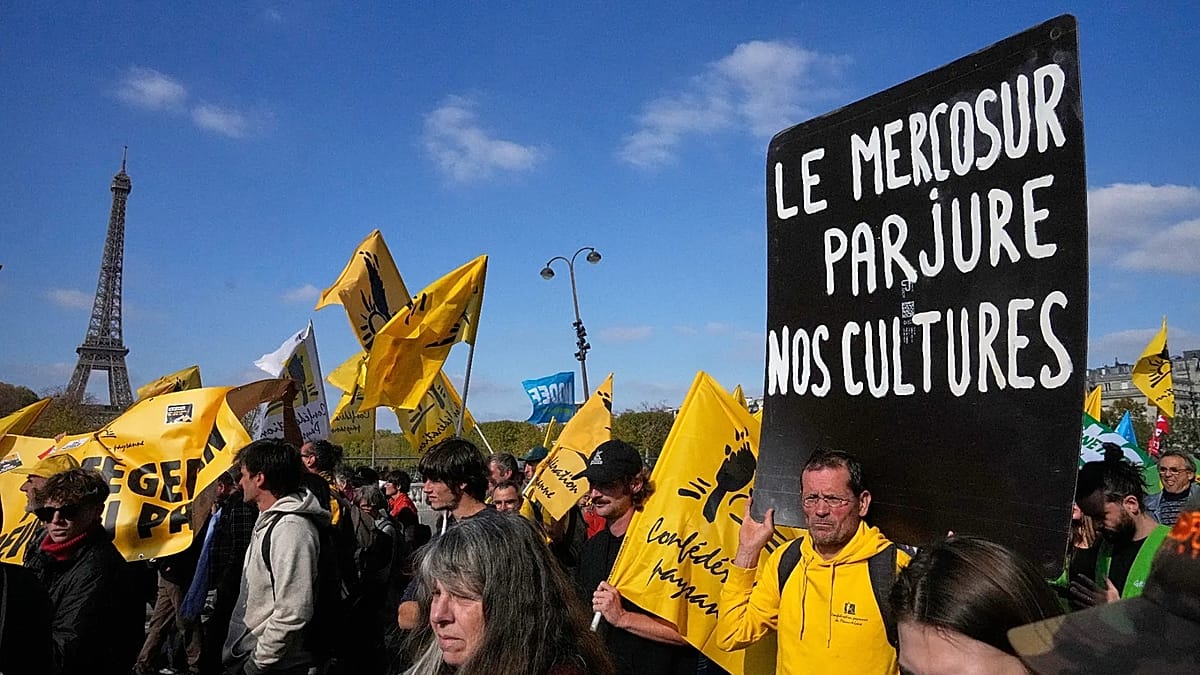
Famers fight back

Opposition to the deal from EU farmers has been fierce. While duties will gradually be eliminated for most products once the agreement enters into force, quotas would remain in place to protect competition-sensitive agricultural products such as beef, poultry and sugar.

Several member states have resisted the deal for years. In 2019, a draft text was blocked by several governments, with France leading opposition over environmental and agricultural concerns.

In recent months, the Commission has added concessions aimed at mollifying farmers and securing the crucial support of Italy, including early access to €45 billion in Common Agricultural Policy funds from 2028 and a freeze of the EU’s carbon border tax on fertilisers.

To address environmental concerns, negotiators also made compliance with the 2016 Paris climate agreement an “essential element” of the deal, allowing for partial or full suspension if commitments are breached.

Nonetheless, on Thursday night, President Emmanuel Macron announced on X France would vote “No” to the agreement.

Friday’s vote opens the way for the EU to sign the agreement, with von der Leyen expected to travel to Latin America soon. The EU conclusion procedure, however, also requires the consent of the European Parliament.

Late on Thursday, the French delegation of Renew said the Cyprus EU presidency had used a legal manoeuvre to enable the provisional implementation of the agreement without a parliamentary vote.

French opponents are now pinning their hopes on blocking the deal in Parliament.

Share. Facebook Twitter Pinterest LinkedIn Tumblr Email

Keep Reading

Rubio skips Berlin Format talks on Ukraine in Munich

Watch the video: Love is all around us — but babies are not?

Ukraine’s call to join EU in 2027 forces major re-think of enlargement rules

Italian court convicts 12 CasaPound members for attempting to revive fascist party

Live – Munich Security Conference 2026: Global leaders gather as transatlantic ties dominate talks

Hungarian opposition leader Péter Magyar files police report over ‘honey trap sex tape’ scandal

Europe Today: Roberta Metsola, Glenn Micallef, and Hadja Lahbib join us for an interview

Leaders embrace two-speed Europe to break impasse as Macron sets June deadline for economic reset

French Defence Minister questions whether Russia ‘really wants peace’ with Ukraine

Editors Picks

France’s Macron hammers message of European strength – POLITICO

February 13, 2026

A Europe that spends more on defense but can stand up to the US – POLITICO

February 13, 2026

Rubio skips Berlin Format talks on Ukraine in Munich

February 13, 2026

Europe needs cyber weapons, says EU tech chief – POLITICO

February 13, 2026

Subscribe to News

Get the latest Europe and world news and updates directly to your inbox.

Latest News

Ukrainian skeleton racer fails to overturn Olympics ban at top court – POLITICO

February 13, 2026

EU defense chief lays out ideas for a European military force to replace US troops – POLITICO

February 13, 2026

French and German voters balk at sending peacekeepers to Ukraine – POLITICO

February 13, 2026
Facebook X (Twitter) Pinterest TikTok Instagram
© 2026 Daily Guardian Europe. All Rights Reserved.
  • Privacy Policy
  • Terms
  • Advertise
  • Contact

Type above and press Enter to search. Press Esc to cancel.