
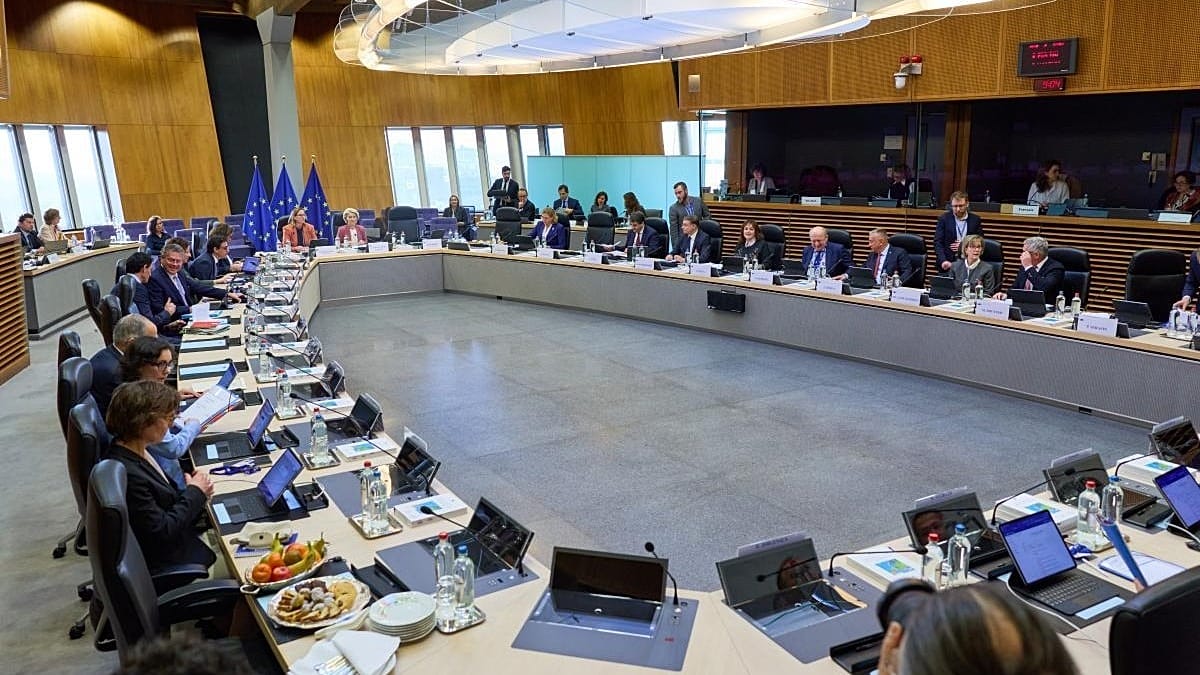
Representatives of EU institutions took the stage at a flagship conference in Brussels to push European governments to agree an ambitious long-term budget, including with new own resources.
During the Annual EU Budget Conference, the Commission’s flagship event, European Commissioner for Budget Piotr Serafin took an opportunity to push back against so-called “frugal” countries.
“We need to be mindful of the link between having a frugal budget and having a modern budget,” Serafin said at the event. He stressed that a too-small EU budget would not necessarily be cheaper for taxpayers, as money that won’t be spent on the EU budget would be taken from national budgets, with risks of overlapping and inefficiencies.
A major focus of the discussion has been the aspect of so-called own resources – EU-wide taxes meant to finance the bloc’s budget, as opposed to national contributions coming from European governments.
However, member states have still to make any tangible progress on the politically sensitive part of the file, and with key countries like France, Italy and Poland heading toward elections in 2027, pressure is mounting to conclude the negotiations by the end of the year.
The European Commission first tabled a nearly €2 trillion budget in July 2025, prioritising economic competitiveness and defence while scaling back funding for agriculture and regional programs.
Since then, the discussions have seen EU countries split into two opposing camps: the frugals, pushing to reduce the overall size of the budget and refocusing on new priorities, and the so-called “friends of cohesion”, who are advocating for increased agricultural and regional funding.
With the next high-stakes discussion set to take place at the next European Council in October, the Commission is trying to shift the mood in favour of an ambitious budget to finance strategic priorities such as defence.
“Are we serious about a potential war?” European Commissioner for Defence Andrius Kubilius asked provocatively from the stage on Thursday, calling on member states to match Europe’s growing security needs and ambitions with the upcoming EU budget.
For this reason, European Commission President Ursula von der Leyen, together with Serafin, has in recent months called on member states to make progress on own resources.
Generally speaking, EU countries are either in favour of or against a specific own resource depending on whether its impact on their economies would be better or worse than their current national contribution. Thus, various diplomatic sources involved expect a solution to the deadlock might be found in the form of a package capable of balancing different national interests.
In its initial proposal, the Commission proposed revenue streams from the Emissions Trading System, the Carbon Border Adjustment Mechanism, non-collected e-waste, tobacco excise duties and a corporate tax. However, all of these proposals have faced significant opposition from European governments.
During the negotiations since, the European Parliament has proposed additional sources of revenue, notably a gambling tax, a digital levy and a capital gains tax on cryptocurrency assets. The Commission estimated these taxes might yield up to €11 billion per year.
For now, frugal countries remain hesitant about the proposed revenue measures. Particularly leery is Sweden, which is against any kind of own resources, arguing that a move in that direction would oblige the EU’s wealthiest member states to shoulder a disproportionate financial burden.
Nonetheless, senior EU figures are pushing back.
“This time, if our leaders want to be ambitious across the European budget, they will have to bite the bullet and really approve a new basket of own resources,” European Investment Bank President Nadia Calviño, said at the budget conference.
“Own resources, I am confident, will be part of the picture so that we can ensure that our budget matches our expectations and ambitions,” she said.
EU lawmaker Danuše Nerudová, who has a track-record working on own resources, said on Thursday that “We must continue to support our traditional priorities while also addressing new ones, such as competitiveness and defence.”
Investing in new priorities while keeping funding the traditional ones, such as agriculture and fisheries, is “precisely the role of our own resources,” she said.