

Published on •Updated
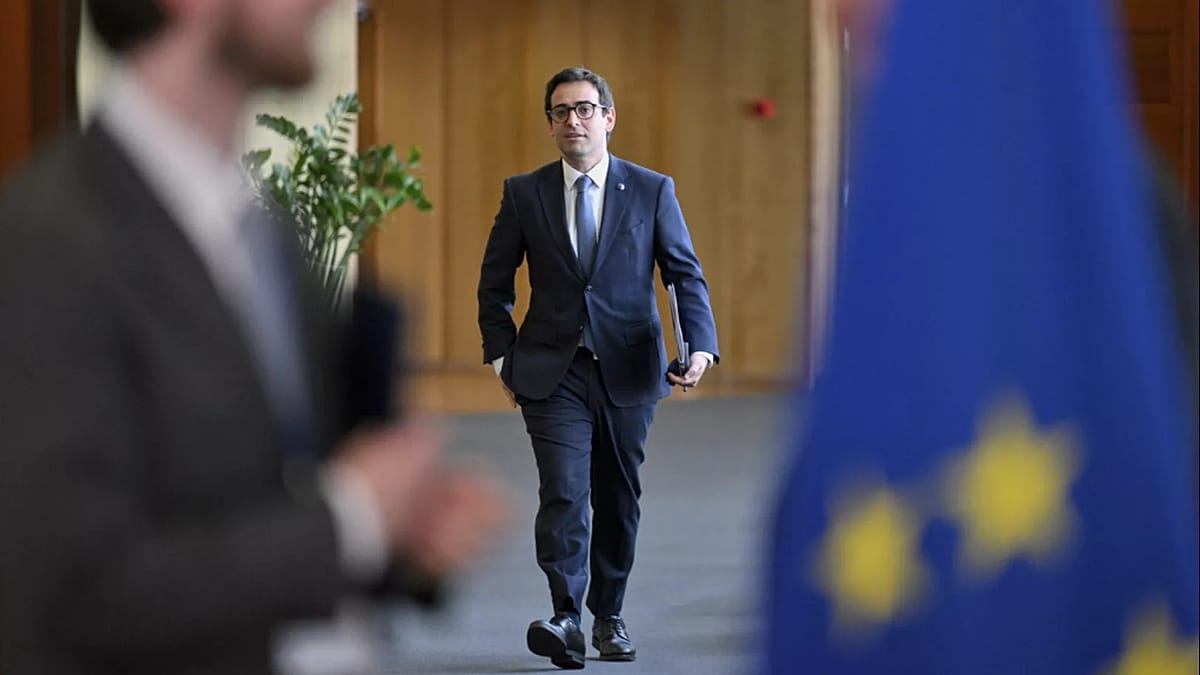
European Commission vice-president and industry commissioner Stéphane Séjourné on Monday urged the European Union to adopt a “European preference” within the single market to counter intensifying competition from China and the US.
The proposal, which would favour products containing “made in Europe” components in public procurement, has been under discussion for months within the Commission and among member states. It has, however, exposed growing fault lines in the bloc, with some countries warning it would disproportionately benefit the EU’s largest economies.
The “Made in Europe” push is set to feature prominently at next week’s EU leaders’ retreat on boosting competitiveness, where divisions run are expected to come to the fore.
In an op-ed signed by 1,141 business leaders, Séjourné framed competitiveness as central to Europe’s geopolitical strategy, arguing that a European preference is needed to shore up industry against global rivals.
“We must establish, once and for all, a genuine European preference in our most strategic sectors,” he wrote. “It is based on a very simple principle : whenever European public money is used, it must contribute to European production and quality jobs.”
Séjourné said other major economic powers already deploy national preferences to protect strategic assets. Under his proposal, companies benefiting from public procurement, state aid or other financial support would be required to produce a substantial share of their output within the EU. The same logic, he said, should apply to foreign direct investment.
The debate is expected to trigger tense exchanges at EU leaders’ 12 February retreat in Alden Biesen, Belgium, convened by European Council President António Costa to shape the EU’s competitiveness strategy.
Germany and Italy are backing the Commission’s drive for overall regulatory simplification, while France and its allies are pressing for joint borrowing and increased investment across the single market. France has championed the “Made in Europe” agenda for years, as have Germany and Commission President Ursula von der Leyen.
But smaller member states remain wary, arguing the single market must stay open and warning that a European preference could stifle innovation and favouring mainly larger economies.
EU countries divided
Disagreements over “Made in Europe” will compound broader divisions over how to revive the bloc’s economy.
Italian Prime Minister Giorgia Meloni and German Chancellor Friedrich Merz unveiled a joint plan 10 days ago calling for regulatory simplification, including a challenge to EU climate rules under the Green Deal, which they see as an excessive burden on the car industry.
By contrast, French President Emmanuel Macron on last month renewed his call for greater investment in innovation through national and EU budgets, reviving France’s push for joint borrowing – an idea backed by former Italian Prime Minister Mario Draghi in a landmark 2024 report.
Macron argued that the report is already outdated thanks to the last year’s geopolitical turmoil, in particular Chinese “aggressiveness” and American tariffs.
“The Draghi report, which we did not fully apply, is already obsolete, partly because it did not take into account this acceleration of the world,” Macron said at the annual French Ambassadors’ Conference.
Draghi and former Italian Prime Minister Enrico Letta, who also authored a key report on reforming the EU single market, are expected to attend the February meeting.
According to a European Policy Innovation Council report published in September, only 11% of the Draghi report’s recommendations were implemented during the Commission’s first year.
“We need to create renewed momentum and give a new impetus” to the reform agenda, Costa told Euronews in an exclusive interview.
“I expect leaders to give clear political guidance to the Commission and the Council as they did last year on defence and security,” he added. “This time, for the single market.”