

The European Commission has deployed a team of migration experts to the Spanish enclave of Ceuta, two weeks after around 80,000 migrants crossed into the territory from Morocco triggering an unprecedented humanitarian and political crisis, and amid reports that further large-scale attempts to cross into the enclave could be imminent.
Speaking on Thursday, a spokesperson for the Commission said the mission was intended to “understand the first-hand needs on the ground” and how the EU can bolster its support for the Spanish authorities.
Yet, the executive declined to say whether the visit would also cover preparations for a potential fresh influx, amid reports that a “forward call” is circulating on Moroccan social media urging migrants to make the journey again on the night of 14-15 August.
“For us it’s not about a specific date. It’s about reinforcing our borders and ensuring returns every day of the year,” another European Commission spokesperson said.
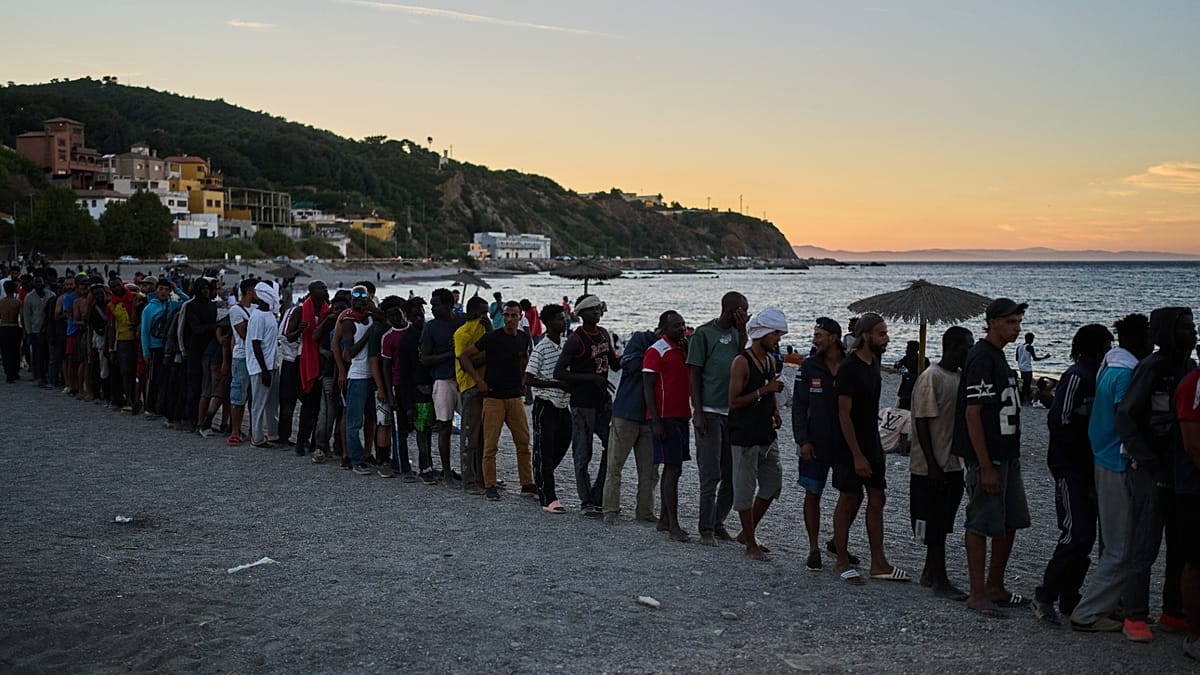
As many as 80,000 migrants are estimated to have entered Ceuta – the Spanish enclave home to just 83,000 people – by swimming across from neighbouring Morocco during the last two days of July, with around 100 people reported to have lost their lives.
The Spanish government says around 70,000 have since been returned to Morocco, and has hailed productive cooperation on returns with the government in Rabat.
The incident also triggered an unprecedented crisis for Madrid and exposed deep rifts between European nations.
Governments, notably Giorgia Meloni’s in Italy, found in the Ceuta crisis an opportunity to denounce Spanish Prime Minister Pedro Sánchez’s more lenient, more tolerant migration policies which, according to critics, undermined EU efforts to project solidarity and unity.
The tit-for-tat escalation between Rome and Madrid continues, with both sides now imposing exceptional border controls on each other. The Italian government has said it will continue to temporarily suspend the border-free Schengen arrangement with Spain until at least 15 August, citing expectations that Ceuta will be hit by a “new wave of migration”.
EU cooperation with online platforms ‘bearing fruit’
The Moroccan Interior Ministry said Wednesday it was working to prevent a potential fresh wave and had increased security along its borders with both Ceuta and Melilla, the second of the Spanish territories located along Morocco’s northern coast.
The Spanish Civil Guard has already installed a maritime barrier, similar to that used along the sea border with Morocco off the coast of Ceuta, at Melilla’s southern breakwater.
The precautionary measures are in response to several reports that a coordinated online campaign is disseminating a call for another mass crossing on Friday evening.
Golden Owl, a digital intelligence company linked to the University of Alicante, has scoured social media platforms and identified an organised online operation behind the calls for further crossings. Spain’s Civil Guard has also produced a six-page report examining the possibility.
The increased vigilance of social platforms is believed to have somewhat suppressed the call, with Golden Owl saying that the “15 August date has effectively disappeared from Facebook, driven by Meta enforcement”.
Both TikTok and Meta have activated a crisis protocol to set up a cooperation mechanism with fact-checkers, following calls by the EU’s tech chief, Henna Virkkunen, for enhanced monitoring and collaboration.
The European Commission confirmed that it would meet again with representatives from social media platforms on Thursday afternoon, adding that it was engaging with the platforms on a “daily basis” to streamline the work.
“Bringing in the fact-checkers will, in our view, make this work even more targeted and even more streamlined and coordinated in the context of this concrete crisis,” the spokesperson explained. “And what we hear is that this cooperation is proving highly effective and action is being taken by the platforms on this basis.”
The Commission also held a separate meeting earlier on Thursday that allowed an “exchange of information and discussion on the online dimension of the current crisis in Ceuta”, with Spanish representatives also taking part.