
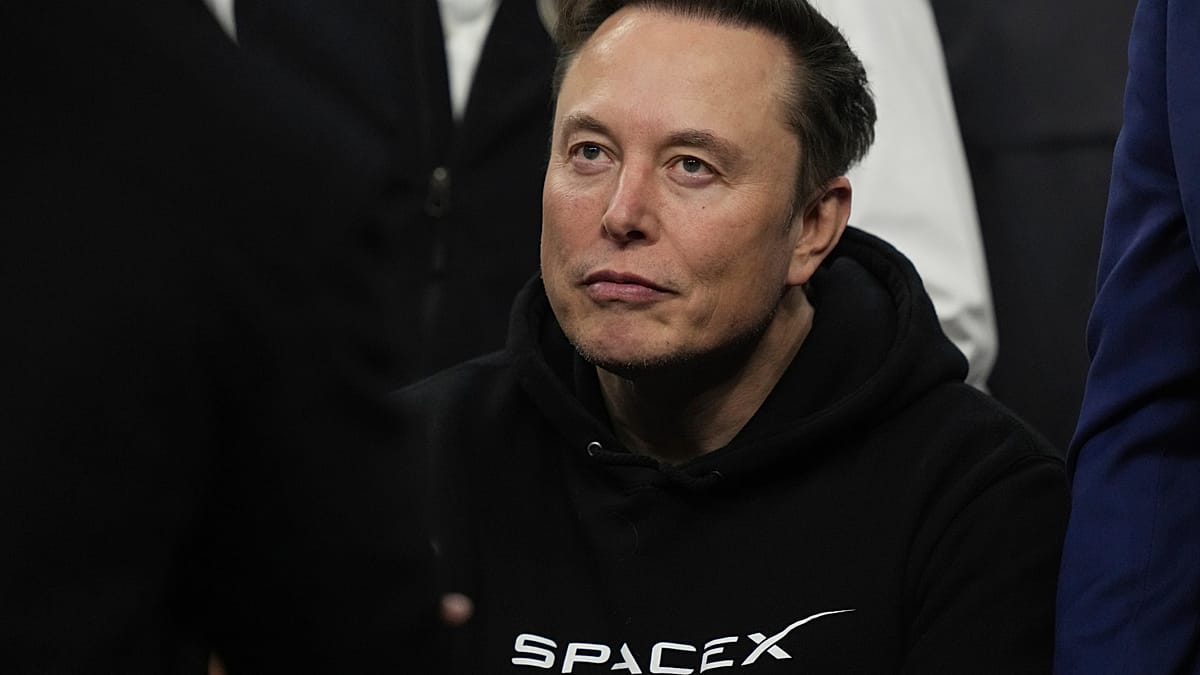
Dubbed by the press as the “real-life Tony Stark”, Elon Musk has spent decades building companies designed to disrupt established industries. More than once, those ventures came close to financial collapse before emerging as some of the world’s most valuable businesses.
Electric vehicles. Brain implants. Underground tunnels. A social media platform once known as Twitter. And a rocket maker that began trading on Wall Street this week.
Over time, more and more of these ventures have come under the same umbrella.
Today, Musk, the world’s richest man and the first person to amass a trillion-dollar fortune, controls a sprawling network of businesses.
According to Forbes, Musk became the first person to surpass a net worth of $500bn in October 2025. His first commercial success earned him $500. His first company brought him a payout of $22m, and his second roughly $176m.
By the age of 31, Musk had realised nearly $198m from businesses he had built and sold.
Yet the vast majority of the fortune that later made him the world’s richest person did not come from cashing out. Instead, it was built by retaining large ownership stakes in SpaceX and Tesla as their valuations soared.
Here’s a look at Musk’s vast business empire.
Early days
Elon Musk was born in Pretoria, South Africa, in 1971.
His first commercial success came at the age of 12, when he sold the source code for a video game called Blastar to a computer magazine for about $500 (€430).
Musk’s first major business venture was Zip2, an online publishing and business-directory company he co-founded with his brother, Kimbal Musk, in 1995. The company helped newspapers bring local business listings and maps online, with Musk writing much of the software himself.
Zip2 was sold in 1999 for more than $300m (€260m), earning Musk about $22m (€19m).
He used that money to launch X.com, an online banking start-up founded in 1999. The company later became part of PayPal, which was acquired by eBay in 2002 for $1.5bn (€1.3bn). Musk reportedly received around $176m (€152m) from the deal.
The sale provided the capital for the ventures that would define the next phase of his career.
In 2002, Musk founded SpaceX, investing roughly $100m (€86m) of his own money into the rocket company and taking on the roles of chief executive and chief engineer.
In 2004, he joined a new electric car company, Tesla, and invested approximately $80m (€69m) in the company. He later became the chief executive in 2008.
In 2006, he also helped launch solar energy company SolarCity alongside his cousins, Lyndon and Peter Rive. This company was later acquired by Tesla.
SpaceX, a company valued at more than $2 trillion
When Elon Musk founded SpaceX in 2002, he believed the company had less than a one-in-ten chance of success.
At the time, the venture was little more than an attempt to break into an industry dominated by government agencies and established aerospace contractors. Musk later recalled warning friends and investors that failure was the most likely outcome.
More than two decades later, the company has become one of the world’s most valuable businesses. Its stock market debut this month was the largest initial public offering ever recorded, valuing the company at about $1.75tn (€1.5tn). After just a few days of trading, its market capitalisation had comfortably surpassed $2tn, reaching $2.43tn (€2.1tn) on Friday.
Musk’s flagship company has grown far beyond rockets in the meantime.
It owns satellite internet provider Starlink, which generated $4.4bn (€3.8bn) in operating income last year. SpaceX also sits at the centre of Musk’s growing artificial intelligence ambitions through its ties to xAI and social media platform X.
Not all of those businesses are profitable. xAI reported operating losses of $6.4bn (€5.5bn) last year, while SpaceX itself posted an overall operating loss of $2.6bn (€2.2bn).
Supporters argue the valuation reflects the company’s leadership in space technology, satellite communications and artificial intelligence. Critics, however, say much of that value depends on ambitious long-term goals, including plans for data centres in orbit and the eventual colonisation of Mars.
Tesla: Betting on autonomy and robotics
Musk has led Tesla since 2008, overseeing its rise from a niche electric vehicle maker to one of the world’s most valuable companies.
The company has faced growing competition in recent years. In 2024, Tesla lost its position as the world’s largest electric vehicle manufacturer by sales to China’s BYD. Deliveries were also hit by consumer boycotts linked to Musk’s political activities, although sales have since recovered somewhat.
Musk has consistently argued that Tesla’s long-term future extends beyond selling cars. Instead, he has focused on autonomous driving technology, with plans to deploy fleets of self-driving robotaxis.
The company is also expanding into robotics through its Optimus humanoid robot programme, which Musk says could eventually be used in homes and workplaces.
Beyond transport, Tesla has been active in solar energy and battery storage since its acquisition of SolarCity in 2016. Tesla went public in 2010 and later joined the ranks of trillion-dollar companies. Its market capitalisation currently stands at around $1.5tn (€1.3tn).
Neuralink: Connecting brains and computers
Musk is also chief executive of Neuralink, a brain-computer interface company he co-founded in 2016.
The company is developing technology designed to connect the human nervous system directly to computers. Neuralink is one of several firms working in the emerging field and has launched clinical trials involving people with spinal cord injuries, ALS and other neurological conditions.
In recent years, the company has announced a series of successful brain implant procedures. In January, Neuralink said it had 21 trial participants worldwide.
The technology remains at an early stage, but supporters believe it could eventually help restore communication and mobility for people with severe disabilities.
The Boring Company: Musk’s underground transport vision
Founded in 2016, The Boring Company is Musk’s tunnel construction and underground transport venture.
The company is best known for the Vegas Loop, a network of tunnels beneath Las Vegas that uses Tesla vehicles to transport passengers between destinations. The first section opened near the Las Vegas Convention Center in 2021.
The Boring Company says its tunnelling technology could help reduce traffic congestion and lower the cost of underground transport projects. It has also outlined plans for future developments in cities, including Dubai and Nashville.
The business has faced criticism, however. Regulators and campaign groups have raised concerns about environmental and safety issues linked to some projects, while parts of its proposed Las Vegas network remain under construction.