
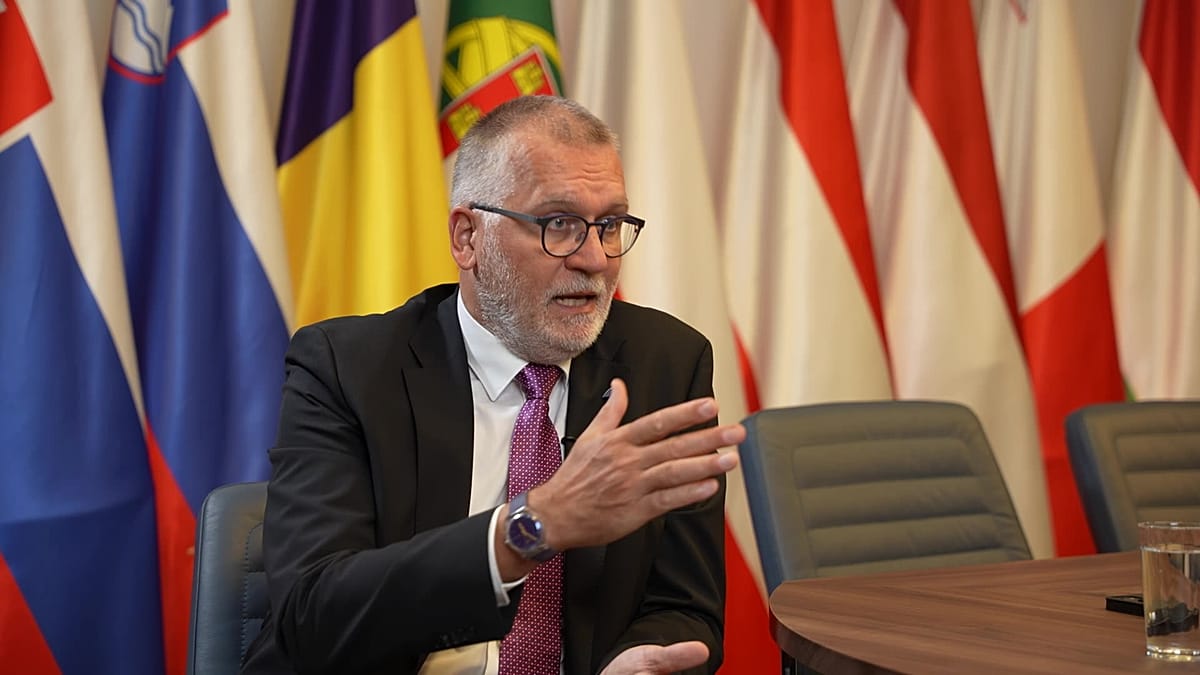
The European Investment Bank (EIB) is looking to expand its financing of cross-border infrastructure projects in Central Asia as it seeks to support economic development across the region.
“We would be, of course, very much interested not only in financing the individual country projects, but if there was a cross-country project, it would be even more interesting for us because we would also see a potential for development of the whole region,” EIB Vice-President Marek Mora told Euronews during his visit to Astana.
Interstate hydropower plant
One of the most prominent examples of interstate cooperation that the EIB supports in Central Asia is the construction of the Kambar-Ata-1 hydropower plant in the Kyrgyz mountains.
The project is being jointly developed by Kyrgyzstan, Kazakhstan and Uzbekistan, and the EIB allocated €900 million to the three countries for water management projects and the construction of energy grids.
The plant, which is expected to be completed around 2035, will be able to generate 5.6 billion kWh of electricity per year. It will greatly contribute to energy security in the region.
According to Mora, Europe could also benefit from this project.
“We heard some ideas about energy or electricity interconnector between Kazakhstan under the Caspian Sea to Azerbaijan, which could then further continue to Europe,” he said.
The water management aspect of this project is important too. The power plant is being built on the biggest river in Kyrgyzstan — the Naryn River. The Naryn merges with the Kara Darya River in Uzbekistan to form the Syr Darya River.
The Syr Darya flows through Uzbekistan and Kazakhstan and empties into the Aral Sea. For both countries, it is one of the major rivers supplying water to agricultural land and providing drinking water.
The power plant will regulate the seasonal flow of the Naryn River, storing water during periods of snow and glacier melt and releasing it during the dry months. This will provide a more stable and predictable flow of water into the Syr Darya River.
Kazakhstan could build industries around transit routes
Transport projects are also of great interest to the EIB. The bank recognises the importance of Central Asia’s role as a transport corridor between Asia and Europe.
Mora highlighted that Kazakhstan has potential beyond being a transit country.
“We have a firm conviction that Kazakhstan does not have only potential as a transit country. We think that around this whole transit industry, there could be its own industry built around it, be it logistics, be it services,” Mora said.
When it comes to transport investments, there is already a €150 million loan to KazAvtoZhol, Kazakhstan’s national road management operator, to improve roads.
The project covers key transport routes in Kazakhstan, including access roads to international border crossings, the Caspian route, corridors to China, the southern transit route, and important interregional highways.
There is a similar €200mn loan to the Development Bank of Kazakhstan, aimed at both transport and energy.
“And this was even then enlarged by a letter of intent to increase this amount by €120 million,” Mora added.
What does a project need to secure EIB funding?
But projects need a lot of preparation to qualify for financing, says the EIB vice-president. They have to be predictable, have clear objectives and methods, and follow transparent procurement rules before the bank is ready to put money on the table.
“There are two groups of conditions, which a project would need to fulfil if we were ready to finance it. One is the already mentioned environmental and social standards, to which we put a lot of attention,” said Mora.
This means projects linked to the coal industry, coal technologies or gas technologies are excluded from the list of potential investment opportunities. The bank is more interested in green technologies, such as the autonomous truck project, which Mora discussed with Kazakh Minister of Transport Nurlan Sauranbayev during his visit.
“We had a very good meeting today with the minister of transport. He mentioned to us one of the possible future projects: that Kazakhstan would build special roads for autonomous trucks, which could cross Kazakhstan. And these trucks could be even electric and maybe of European origin,” Mora explained.
The second condition for the EIB to finance a project is a “win-win situation”.
“A win for Kazakhstan, but also a win for the European economy or the European industry. We would like to see that if we finance a project in Kazakhstan, that, of course, it’s there to support the Kazakh industry. But if possible, if there was a European content, it’s really something we would be very much interested in,” Mora noted.
At the same time, he highlighted that the general development of the region is one of the bank’s priorities.
“I think water management is, I would say, a global public good. So, the better we do in Kazakhstan, the better we contribute to the world management of this resource, which will become more scarce in future everywhere. And it’s already quite scarce in Kazakhstan,” he said.
In June, the EIB opened a representative office in Tashkent, Uzbekistan, highlighting the strategic importance of the region.