
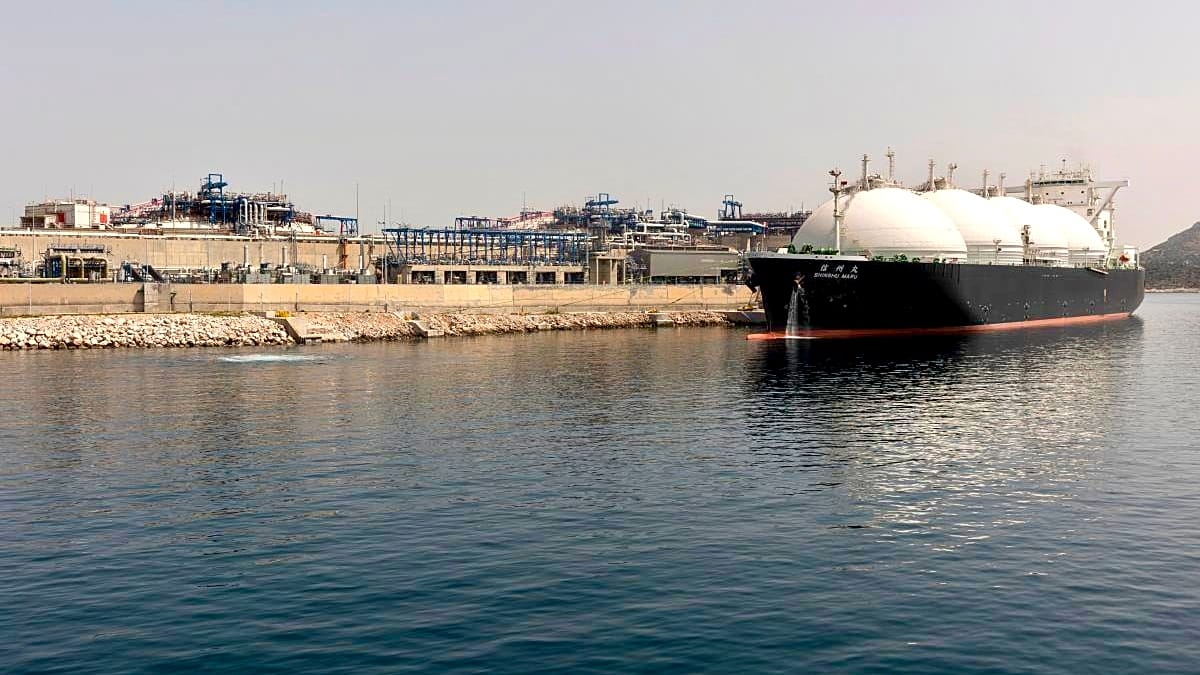
Egypt, Greece and Cyprus have renewed their backing for plans to send Cypriot gas to Europe through Egyptian export facilities, with Greece offering a possible onward route into southeastern and central Europe.
The plans come as disruption to Gulf liquefied natural gas (LNG) supplies due to the ongoing Iran war and the blockade of the Strait of Hormuz continues to put pressure on European buyers to find alternatives.
Egyptian President Abdel Fattah el-Sisi, Greek Prime Minister Kyriakos Mitsotakis and Cypriot President Nikos Christodoulides met in El Alamein on Egypt’s Mediterranean coast on Tuesday.
In a joint declaration, they called for work connecting Cyprus’ offshore gas fields to Egyptian infrastructure to be completed as soon as possible.
Cronos, Cyprus’ first gas development, is expected to start producing gas in 2028, according to Eni.
New contract for Cypriot gas project
On the same day as the summit, engineering company McDermott announced that Eni’s Cyprus subsidiary had awarded it a contract worth between $500m (€429.6m) and $750m (€644.4m) for work on Cronos.
McDermott said it would provide engineering and installation support and help manage the offshore development.
The contract follows Eni and TotalEnergies’ approval of the project on 28 July. The Italian and French companies each hold a 50% stake.
Cronos is to be developed through four offshore wells, with gas carried by an undersea pipeline to Egypt. It will use existing processing facilities linked to Egypt’s Zohr field before being sent to Damietta, where it will be liquefied and exported by ship.
The Italian energy group said in July that using existing Egyptian facilities would reduce costs and speed up development. It also said the project would help restore regular LNG exports from Egypt.
At its planned production level, Cronos is expected to supply the equivalent of around 2.8 million tonnes of LNG a year. The field contains more than 3 trillion cubic feet of additional gas, according to Eni. The two companies will each market half of the output.
“This new gas route in the Mediterranean will contribute to Europe’s energy security by diversifying its LNG supply sources,” TotalEnergies chief executive Patrick Pouyanné said when the project was approved.
Where Greece fits in
Mitsotakis outlined a route through Greece’s Revithoussa and Alexandroupolis terminals, where LNG would be turned back into gas and sent to southeastern and central Europe through the Vertical Corridor.
He said the gas “could, in theory” enter Europe through Greek facilities.
Greece would therefore be one possible gateway rather than a compulsory stop. Eni said it would sell the gas primarily in Europe and other international markets, rather than send it exclusively to Greece.
The Vertical Corridor is not a single pipeline. It links existing gas networks running north from Greece through countries including Bulgaria and Romania towards Moldova and Ukraine, allowing LNG arriving at Greek terminals to reach markets further into Europe.
The proposed route would keep shipments from Egypt to Greece within the Mediterranean, avoiding Hormuz and the Red Sea. It would carry newly produced Cypriot gas rather than reroute existing Gulf cargoes.
In its July outlook, the International Energy Agency estimated total LNG supply losses of 140 billion cubic metres between 2026 and 2030, with the biggest impact on supply growth expected in 2026 and 2027.
Europe is also preparing to end its remaining Russian gas imports. EU rules provide for a full ban on Russian LNG from the beginning of 2027 and pipeline gas from autumn the same year, with Europe looking for alternative suppliers.
Wider energy ties and regional tensions
The cooperation extends beyond gas. El-Sisi and Mitsotakis discussed plans to connect their countries’ electricity systems during bilateral talks on Tuesday, according to the Egyptian presidency.
The proposed GREGY undersea power cable would carry renewable electricity from Egypt to Greece, with a planned capacity of 3,000 megawatts.
Developer Elica Interconnector said the electricity could supply Greek industry and be exported to other European markets.
All three leaders renewed their backing for the project in the summit declaration.
The trilateral partnership dates back to a first summit in Cairo in November 2014. The latest declaration also addressed maritime boundaries, saying agreements should comply with international law, including the UN Convention on the Law of the Sea.
Greece and Egypt signed an agreement covering part of their maritime boundary in 2020. Turkey rejected it at the time, arguing that the area covered overlapped with Ankara’s claimed continental shelf.
Mitsotakis said on Tuesday that the partnership between Egypt, Greece and Cyprus was “not directed against any country”.