
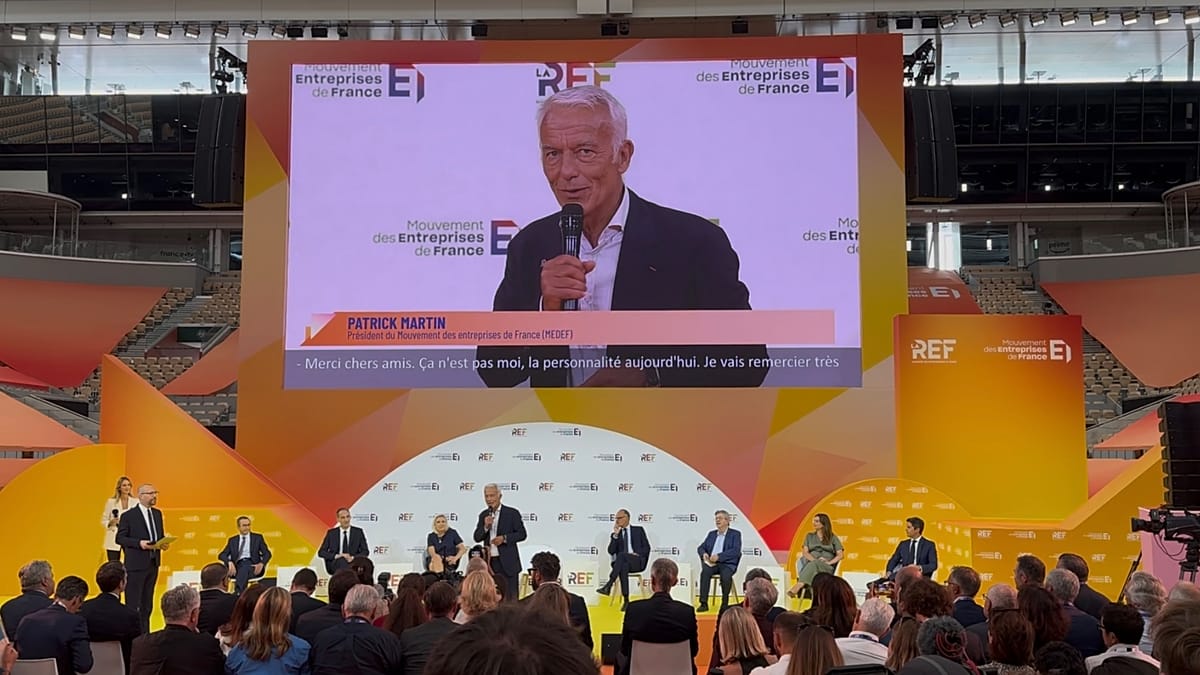
Seven key candidates from across the political spectrum vying to become France’s next president clashed in a debate hosted by the MEDEF, the country’s largest employer federation, on Thursday.
Less than eight months ahead of the presidential election, the economy, pensions and public debt dominated the debate held at Roland-Garros, the home of the French open.
The seven candidates included two of French President Emmanuel Macron’s former prime ministers, centrist Gabriel Attal and centre-right figure Edouard Philippe.
Divisive figures such as hard-left leader Jean Luc Mélenchon, as well as far-right politician Marine Le Pen were present, alongside centre-left MEP Raphaël Glucksmann, conservative Bruno Retailleau and Green party leader Marine Tondelier.
With no tennis rackets in sight, candidates went to differing lengths to win over the business leaders in the room, while also staunchly defending their political platforms and projects.
Divided stances on Europe
Candidates presented distinct plans for France’s relationship with Europe.
Mélenchon boldly stated that he planned to “disobey anything coming from Europe that conflicts with the interests of the French people.”
“We must therefore amend the treaty that forms the basis of the European Union, because otherwise we will perish politically, socially, and industrially, since we are not in a position to resist,” he added.
Meanwhile, Le Pen told business leaders that spending needed to be slashed at the level of the state, but also of the European Union, pledging to reduce France’s current contribution to the bloc — which stands at nearly €29 billion for 2026 — by €5 billion.
Le Pen also favoured getting rid of thousands of European norms, “every time the European Union sets a minimum norm, we go above and beyond — we want to be the top student in the class.”
Meanwhile, Philippe warned that China’s competitive advantage was negatively impacted France, supporting the idea of setting quotas to oblige Chinese companies trading with France to produce a certain number of goods on French soil.
“We must convince our European partners to speak the language of power to China and the United States”, he said.
Yet, he also argued that France’s neighbours such as Germany, Italy and Spain were plugging France’s lacking industry competitiveness.
Countering these claims, Glucksmann responded “I’ve never met any French entrepreneurs who’ve told me that the main threat comes from German or Dutch competition. Everywhere you look, people are talking about China. The main challenge for the next president of the Republic is to bang his fist on the table in Brussels.”
During the debate, Glucksmann also called out what he described as Le Pen’s “anti-Europe ideology.”
Tackling France’s debt
Although the candidates agreed that France — which has one of the highest budget deficits in the Eurozone — finds itself in a challenging economic situation, they clashed when it came to laying out how they would fix the issue.
Philippe described Mélenchon’s proposal to cancel a large chunk of France’s public debt as “dangerous.”
His comments came after the hard-left candidate renewed his call for France’s central bank to cancel its holdings of French government debt during remarks made on the campaign trail.
Sharing his view on the policy, Attal commented “you’re proposing to cancel out debt, but you still want to keep raising taxes — is that pure sadism?”
The hard-left leader reacted to the critiques by arguing there was room for “manoeuvre”, accusing his rivals of “caricaturing” his proposals. Mélenchon also told business leaders that a failure to raise wages would lead to a recession in France. “That is your responsibility”, he said.
Le Pen said she would present a €125 billion cost-cutting plan to address France’s debt “before the budget debate”, which is set to begin once the draft finance bill is tabled in coming weeks.
France’s ongoing pension debate
Candidates were also divided on the hotly contested issue of pension reform.
Mass protests across the country and a political backlash against French President Emmanuel Macron’s plan to raise the pension age from 62 to 64 years old led the National Assembly to vote in favour of suspending pension reform until January 2028.
This means that the issue will be back on the table after France’s next President is sworn in.
Tondelier staunchly opposed Macron’s proposal to push up the retirement age, while Mélenchon defended retirement “initially at age 62” and then, “as soon as possible,” at 60 years old.
Le Pen backed reverting the retirement age to 62 years old for the majority of the French population, while supporting retirement at 60 for those who held their “first significant job” at 20 years old or younger.
Bruno Retailleau, leader and candidate for the right-wing party Les Républicains, said he would lay out his plans for retirement in coming days, suggesting that retirement age should be tied to “life expectancy”. He also said that France worked three weeks less per year than many of its European neighbours, stating that working more was necessary for the state of the economy.
Philippe argued that in order to plug its deficit and debt, France needed to do “what all the other countries in Europe whether right-wing or left-wing have agreed to do, work longer.”
On Wednesday, Patrick Martin, the MEDEF’s leader, called for the “shatter[ing of] the straitjacket” that is “suffocating” France.
“How can we not be exasperated by the heavy-handed control imposed by a government obsessed with micromanagement?”, he added.
Martin also criticised the EU, including for its handling of negotiations over tariffs with US President Donald Trump, arguing that the bloc “failed to live up to its standing and did not take the necessary steps to do so.”