
The sound I most associate with death is silence. Not just the obvious one, in that the dearly departed will never speak, never yell, never cry, never laugh again.
Smaller silences, like post-funeral, when the last guest is gone and all you’re left with are your thoughts and an inordinate amount of food shared by well-wishers. Or when weeks have passed and you go to call or text them about your day before you stop yourself because you can’t do that any more.
Even years later, it lingers in that awkward pause when you reveal someone close to you has passed away and the other person doesn’t quite know what to say in response.
Drums and bells, it is not. Music, beyond the songs chosen for the service, feels incongruous. The loud, chaotic energy of a festival? Never.
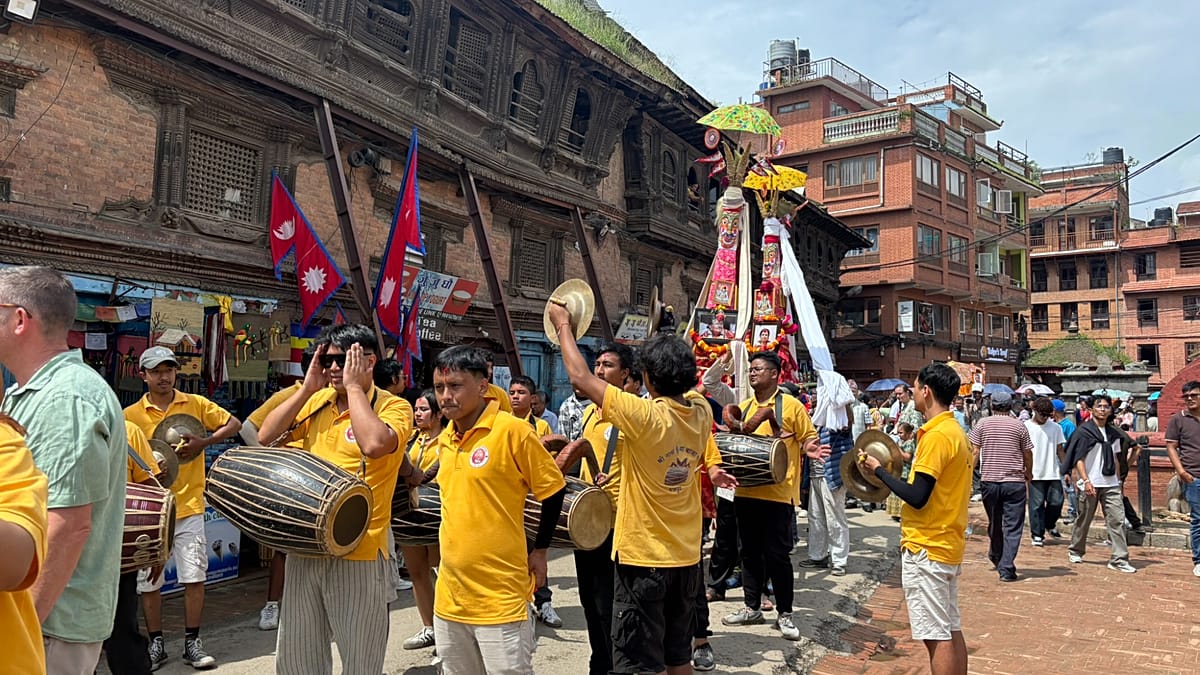
Yet that’s exactly what Sa: Paru, an annual festival honouring those that have died in the past year, is all about, as I discovered on my recent trip to Nepal’s Bhaktapur.
Celebrated across the Kathmandu Valley by the Newar people, the festival turns the western idea of grieving on its head, giving the dead a joyous farewell as they head towards salvation.
“When people pass away in western societies, people wear black. They grieve in silence – it’s a very somber moment,” says Ajay Bahadur Pradhanang. “But in Nepal, everybody comes together and it’s turned into this carnival, a real joyous moment of farewell.”
A community coming together
While the festival also takes place in other cities like Lalitpur as well as the capital Kathmandu, which is around 13 kilometres away, the celebration in Bhaktapur takes its own unique form.
Prior to the festival’s main day, which takes place after the full moon during the 10th month of the country’s lunisolar calendar in August or September, neighbours – whether they’ve lost someone or not – gather to create taha: sa.
The bamboo structures, which replaced the cows that would traditionally have been used as part of the procession, are wrapped before a painting of the sacred animal is placed at the top.
It takes skill, and manpower, to complete the whole affair. After the cloth (generally red for women, and white for men) and cow portrait are added, various decorations follow, like a photograph of the deceased, depictions of Shiva, and, finally, an umbrella to shield them from sun and rain – a sign of respect.
“For Sa: Paru, we have to have certain rituals, and these would be impossible if it was just me, or just my family, without the wider community to help us,” Ajay notes.
It might take a village to raise a child, but the celebration in Bhaktapur goes to show that it takes a community to mark the other end of somebody’s life, too.
I’m here at the invitation of The Nanee, a boutique hotel near the city’s centre. Ajay, the hotel’s chairman, lost his mother this year, which means I can see the work underway in the neighbouring courtyard, but any visitor to the city will easily be able to find taha: sa being constructed throughout the day.
The festival starts early the following morning, with a steady stream of taha: sa passing through the streets accompanied by music, drums, bells and the sound of sticks clashing together as pairs take part in the Ghintang Ghisi dance.
The procession follows a set route, and at the beginning, it seems each troupe is moving to its own beat – some rush, causing the structures to sway, giving the effect of a drunken cow passing by; others march slowly, pausing to dance together. It’s only as the streets begin to clog up and movement reaches a snail’s pace that they move as one.
While some attendees don traditional wear, or modern interpretations of it, you’re just as likely to see people wearing football kits and Hawaiian shirts. Come as you are – you’re welcome to get involved in the festivities, provided you don’t mind crowds.
After taking a pause to catch my breath, I get chatting to Mano Dhaubhadel, a Nepali living in the US who recently lost his younger brother and has returned for the festival.
“This is something you don’t see anywhere else in the world,” he told me. “The culture here is just magnificent, and it’s there for everyone to enjoy, not just Newars. The best way to learn is to get involved.”
Of course, you can also attend the festival with a guide. I’m joined by The Nanee’s curator, Peepul Subedi, a priest and PhD student who is more than happy to explain the meaning behind the festival’s various elements, and its importance.
“The whole city comes together for this festival, and every household who has a family member who has passed away in the past year will take out this sort of structure,” he tells me.
“It represents the message that everyone has to die, and all of us are going through the same sort of sorrow – that’s life. We’re not celebrating death by dancing and singing, we are celebrating the fact that the departed soul is moving towards salvation.”
Celebrations in most of the valley last just a single day – here in Bhaktapur, the festival continues on for eight, with different dance performances throughout the city.
The exact origins of Sa: Paru, which is also known as Gai Jatra, aren’t precisely known, but historians believe that the tradition may have started in the 14th century.
The name most commonly associated with the festival is King Pratap Malla, who is said to have expanded the festival to cheer up his wife following the death of their son Chakravartendra Malla with the inclusion of satirical elements, which today sees people don satirical masks of political figures like US president Donald Trump and Russian president Vladimir Putin.
A reason to linger in Bhaktapur
Travel itineraries for tourists visiting Kathmandu often include a detour to Bhaktapur – but they typically only mention a visit to the Durbar Square, with its various temples and the 55 Window Palace.
Similar to the cruise ship tourists who swarm cities in Europe for a few hours in the summer months, climbing back on board having contributed nothing to the local economy beyond the cost of an ice cream and a fridge magnet, these visitors will spend an hour or two in town before heading back to the capital.
It’s a real shame – not just for the locals, who fail to see the financial benefit, but for the tourists themselves, who miss out on the best Bhaktapur has to offer.
Life is slower here, and the city is best experienced in the early mornings, when you’ll see folks milling about, praying at the Hindu and Buddhist temples, or buying produce at the market.
Aside from the Durbar Square, you can see ceramics drying under the sun at Pottery Square, give pottery a go yourself at one of the workshops, or pick out some pieces to add to your homeware collection.
The Peacock Shop is another must visit, where the chatty owner is more than happy to talk, and walk you through the traditional Lokta paper making process.
The Nanee was founded by Ajay and Shailaja Pradhanang with a view to encourage people to linger longer while enjoying the comforts of a luxury boutique hotel.
“Bhaktapur is a living heritage site, and we wanted that to continue,” Ajay tells me.
“With The Nanee, we offer guests a small oasis in the beautiful city of Bhaktapur while ensuring that the community, which has done so much to preserve and conserve its heritage, benefits from their stay.”
Experiences offered by the hotel are in partnership with locals, like the morning walk with a housewife, or the evening dinner with an artisan.
Aside from Sa: Paru, there are numerous festivals throughout the year, including the famed Bisket Jatra, celebrated for eight nights each April.
A note on the recent floods
Just hours before landing in Kathmandu for the festival, a series of flash floods near the border with Tibet saw the loss of at least 1,369 lives, with some 5,000 people missing.
Naturally, many people have cancelled or are thinking about cancelling their trips to Nepal as a result, which will have a serious impact on a tourism industry that is already dealing with the impact of the Iran war on flight routes to the country.
Popular tourist spots like the Kathmandu Valley, as well as Mount Everest and other trekking trails, were unaffected by the tragedy, and your tourism dollars are more needed than ever.
Dianne Apen-Sadler was hosted by The Nanee during the Sa: Paru festival. You can reach out to the hotel directly to enquire about your potential stay in order to align your trip with one of Bhaktapur’s many festivals. For more information about Bhaktapur, visit the official tourism board website.