


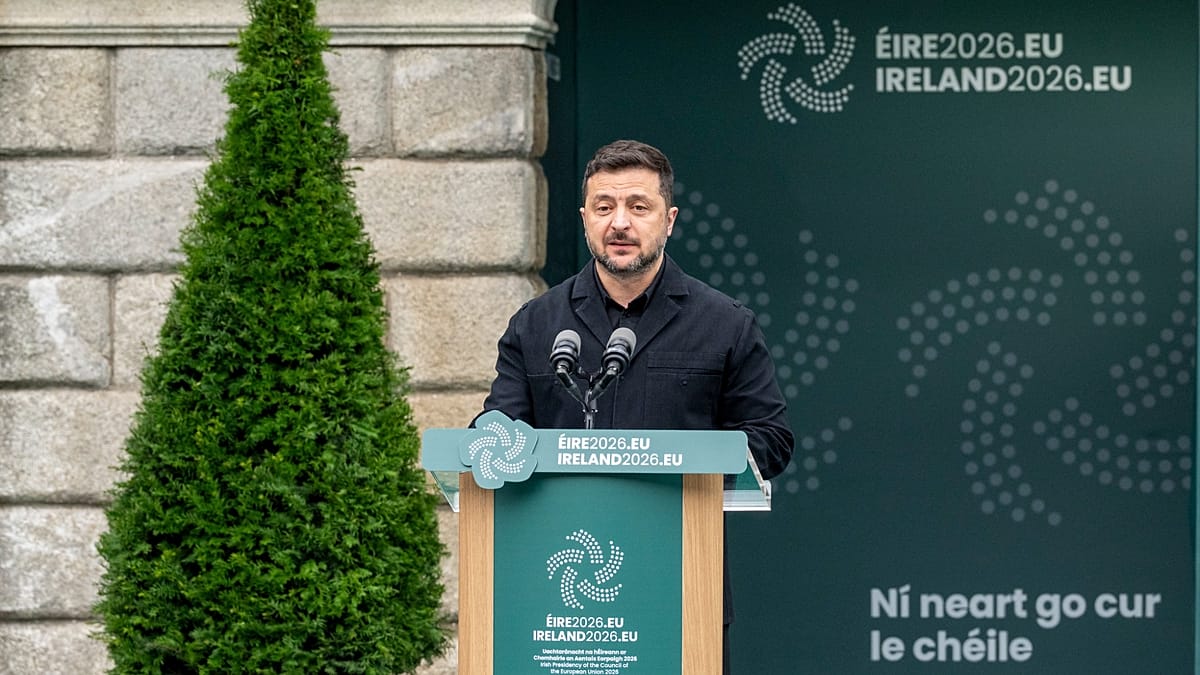
Enlargement dominated the start of Ireland’s six-month presidency of the EU Council, with President Volodymyr Zelenskyy declaring that Ukraine has done “everything” needed to open all the clusters of negotiations.
“It’s in the interest of all the countries to have Ukraine in the EU as quickly as possible,” Zelenskyy said on Wednesday at Dublin Castle, where the inaugural ceremony took place.
Ukraine has so far opened just one cluster, titled “Fundamentals”, and is keen to unblock the remaining five before the summer break.
But the ambitious timeline has been called into serious question after Hungary’s new prime minister, Péter Magyar, voiced fresh concerns about Kyiv’s accession process and tempered expectationsof a broader, faster breakthrough.
At the same time, Zelenskyy’s decision to name a military unit after the Ukrainian Insurgent Army (UPA) has sharply deteriorated relations with Poland. A recent poll found that 60% of Polish citizens oppose Ukraine’s entry into the bloc.
The UPA is admired in Ukraine for its resistance against the Soviet Union and the pursuit of an independent state. But in Poland, the UPA is held responsible for the massacres of Poles in Volhynia and Eastern Galicia, which Warsaw considers genocide.
Zelenskyy attempted to ease tensions during his trip to the Irish capital while insisting that his war-weary country deserved to take the next steps.
“From our side, we did everything what the Council, what all the leaders asked us to do. Even with some difficulties with the (Viktor) Orbán government, we did everything,” Zelenskyy said in response to a question from Euronews.
“So I hope that Peter Magyar will support, and I hope that also Poland’s government will support. I think it’s important (that) when we all have rules, it’s not just political emotions,” he went on.
“It was not simple for us to do all these issues during the war, and I think this is also an important moment that we are saving and defending (…) of course, first of all, Ukraine, yes, but also other countries of Europe.”
Zelenskyy admitted there were “some internal questions” between Ukraine and Poland linked to “difficulties in our history” but urged the two sides to close ranks against Russia’s expansionism and live more “in the future than in the past”.
“Now we have one aggressor,” he said. “We are defending the EU, and we have to think about security for our people for the future.”
Ukraine, he added, is “ready to find answers”, a remark that suggests an increasing willingness to resolve the spiralling dispute over the UPA, which prompted Polish President Karol Nawrocki to strip Zelenskyy of Poland’s highest honour.
Standing by his side, Irish Prime Minister Micheál Martin said the debate over enlargement, one of the bloc’s most sensitive policies, required the understanding of “different traditions, culture and language” from a position of “mutual respect”.
“It’s not the first time that bilateral issues have been problematic for accession. We’ve had it several times in the Western Balkans, for example,” Martin said.
“Given what has happened in Hungary after the election and so on, it’s been a breath of fresh air in terms of the approach to Europe. We hope that follows through in terms of the opening of the clusters,” he added.
Ireland has made EU enlargement a central priority of its six-month presidency, with the issue taking centre stage on the opening day in Dublin. At the same time, Irish officials say they are mindful of the changing political landscape and plan to pursue the agenda with a pragmatic approach.
As things stand, the most realistic objective in Brussels is to open one or perhaps two clusters before the summer break, with the others tackled gradually afterwards.