
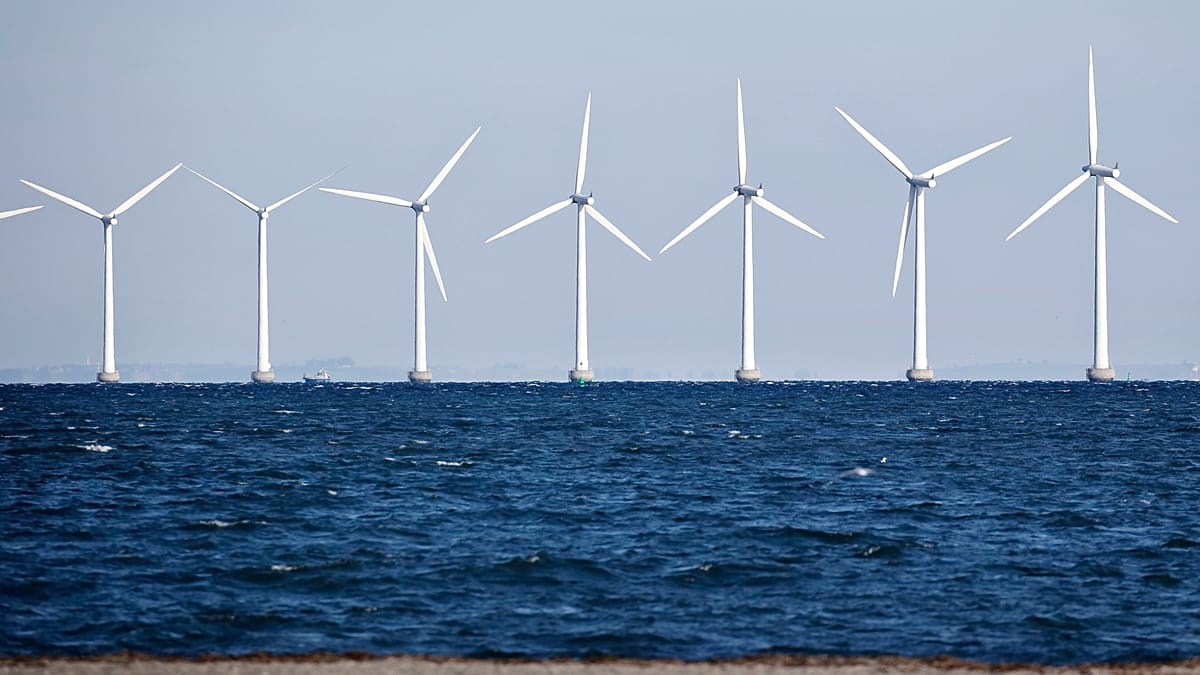
Germany’s offshore wind energy expansion is progressing only slowly. Yet after phasing out nuclear power, the country has effectively put all its eggs in one basket. For too long, Germany remained dependent on imports of fossil fuels. However, Russia has now been ruled out as an energy supplier due to its full-scale war against Ukraine, while the conflict involving Iran and the disruption of shipping through the Strait of Hormuz have placed Germany’s energy-dependent economy in an increasingly precarious position.
Jan Tombiński: ‘A Good Crisis Should Not Be Wasted’
“A good crisis should not be wasted,” says Jan Tombiński, Poland’s ambassador to Germany. He cites a Chinese proverb that carries a powerful message: every crisis also presents an opportunity.
That opportunity was the focus of discussion on Tuesday at the 4th German-Polish Energy Transition Forum in Berlin. Diplomats and business leaders from Germany and Poland gathered at the Polish Embassy to explore joint solutions to emerging challenges.
According to Tombiński, Poland has now become an even more important economic partner for Germany than the United States. The economies of both countries are deeply interconnected. Closer German-Polish cooperation in offshore energy offers significant opportunities to strengthen Europe’s overall energy sovereignty.
The Baltic Sea is the key area for this cooperation. Yet Germany has so far been hesitant to expand offshore installations there, potentially missing a major opportunity to increase energy independence through cross-border collaboration.
Warsaw has also recognized that it became overly dependent on energy imports. “We put ourselves in this position, and we must get ourselves out of it,” says Jacek Kostrzewa, President and CEO of the National Energy Conservation Agency (KAPE).
Poland’s economy is thriving. While many major European economies are stagnating, Poland has consistently grown faster than the EU average for years. Real GDP growth of approximately 3.3 to 3.5 percent is expected in 2026.
How Poland’s Strategy Works
Konrad Wojnarowski, State Secretary at Poland’s Ministry of Energy, explains the country’s approach. Russia is no longer considered a reliable partner, while war continues to destabilize the Middle East. As a result, Poland is pursuing a strategy based on “diversification of energy sources.”
Onshore and offshore renewable energy must continue to expand, while energy storage infrastructure must be developed. At the same time, Poland intends to continue investing in nuclear power. “Strengthening security and ensuring supply” is the guiding principle.
The costs of inadequate preparation, Wojnarowski warns, would be enormous. “A nationwide blackout would cost Poland €9.5 billion per day.” Therefore, Poland’s objective is “as little dependence on Russia as possible.”
Poland has significantly accelerated the expansion of wind energy. The country’s installed onshore wind capacity surpassed the 2,000-megawatt mark years ago and has now exceeded 11 gigawatts (11,000 megawatts), enough to supply approximately seven to ten million households annually.
Poland’s first offshore wind farm is already under active construction and is expected to become fully operational in the second half of 2026.
Which Direction Will Europe Take?
But where is Europe heading?
“Cross-border cooperation is extremely important,” says Piotr Wiśniewski, Deputy Chairman of the Board of the Polish Chamber of Renewable and Distributed Energy (PIGEOR) and Chairman of the Supervisory Board of EnercoNet.
“We need the right infrastructure. In twenty years, it will work very well,” Wiśniewski says.
Germany’s offshore wind activity in the Baltic Sea remains significantly smaller than in the North Sea. The Baltic 1 and Baltic 2 offshore wind farms off the coast of Mecklenburg-Western Pomerania feed electricity into the German grid but remain part of a relatively limited regional expansion effort.
By contrast, Poland is pursuing a much more dynamic development strategy in the Baltic Sea region and is rapidly expanding its capacity. In addition to Baltic Power, projects such as Baltic 3 and Baltic 9+ are currently under development. German companies are increasingly involved as suppliers and project developers.
Dr. Elmar Stracke, Strategy and Policy Advisor at the German Association of Energy and Water Industries (BDEW), confirms that Germany’s offshore wind sector faces challenges.
“Things are moving better in Poland than they are here,” Stracke says. Germany needs more efficient spatial planning and greater efficiency in achieving its offshore expansion targets.
According to Stracke, the future lies neither in Germany nor in Poland alone, but offshore—in the Baltic Sea and the North Sea.
“The sea is the space that matters, not the individual coastline,” he says.
However, this vision requires major investments in energy infrastructure. “The infrastructure of the energy system must be resilient enough not to throw us off course.”
Hybrid Threats in the Baltic Sea: Taking Responsibility
The Baltic Sea presents not only opportunities but also significant challenges.
The region has become a central stage for hybrid threats. Russia has increasingly relied on signal interference, sabotage, and provocations aimed at critical Western infrastructure and at increasing political pressure on European supporters of Ukraine.
Undersea telecommunications cables, data links, and gas pipelines face constant threats. At the same time, growing interference signals over the Baltic Sea are disrupting the navigation systems of both ships and aircraft.
Wojnarowski’s response is straightforward: Europe must assume greater responsibility from both a military and an energy-security perspective.
Poland is the largest recipient of the European SAFE (Security Action for Europe) defence financing program. The initiative is helping modernize the country’s armed forces while strengthening its domestic defence industry, which also contributes to securing the Baltic Sea region.
Will Germany Unlock the Baltic Sea’s Potential?
Dr. Dirk Biermann, Chief Operating Officer of transmission system operator 50Hertz, emphasizes that the company feels a responsibility to make greater use of the Baltic Sea’s potential.
50Hertz operates the high-voltage electricity transmission grid in north-eastern Germany and is already making significant efforts to develop the region’s still largely untapped opportunities.
According to estimates by the European Commission from 2019, the technical offshore wind potential for all EU countries bordering the Baltic Sea exceeds 90 gigawatts.
The initiative also coincides with the upcoming 35th anniversary of the German-Polish Treaty of Good Neighbourship, providing a symbolic boost for future cooperation.
Several projects are already in development to advance this vision. Among them is the Bornholm Energy Island concept, designed as a central offshore energy hub in the Baltic Sea region.
Additional plans include cross-border subsea cable connections linking offshore wind farms with power grids in Germany, Denmark, Poland, and the Baltic states, enabling the exchange of renewable electricity between countries.
A joint subsea interconnector between Lithuania, Latvia, and Germany—the Baltic-German PowerLink—is also under consideration. The project aims to strengthen cross-border electricity trade across the Baltic Sea region and facilitate the integration of up to 2 gigawatts of offshore wind capacity.
Overall, the trend is clearly moving toward diversification and resilience—toward a more interconnected and integrated energy market in the Baltic Sea region.