

Serifos is one of the most beautiful islands in the Cyclades. Behind its major tourism development lies a history that most people know nothing about. The island was an important mining centre as far back as antiquity. Its subsoil is rich mainly in haematite and magnetite, with the result that to this day half of Serifos is perforated with galleries and shafts after many years of mining.
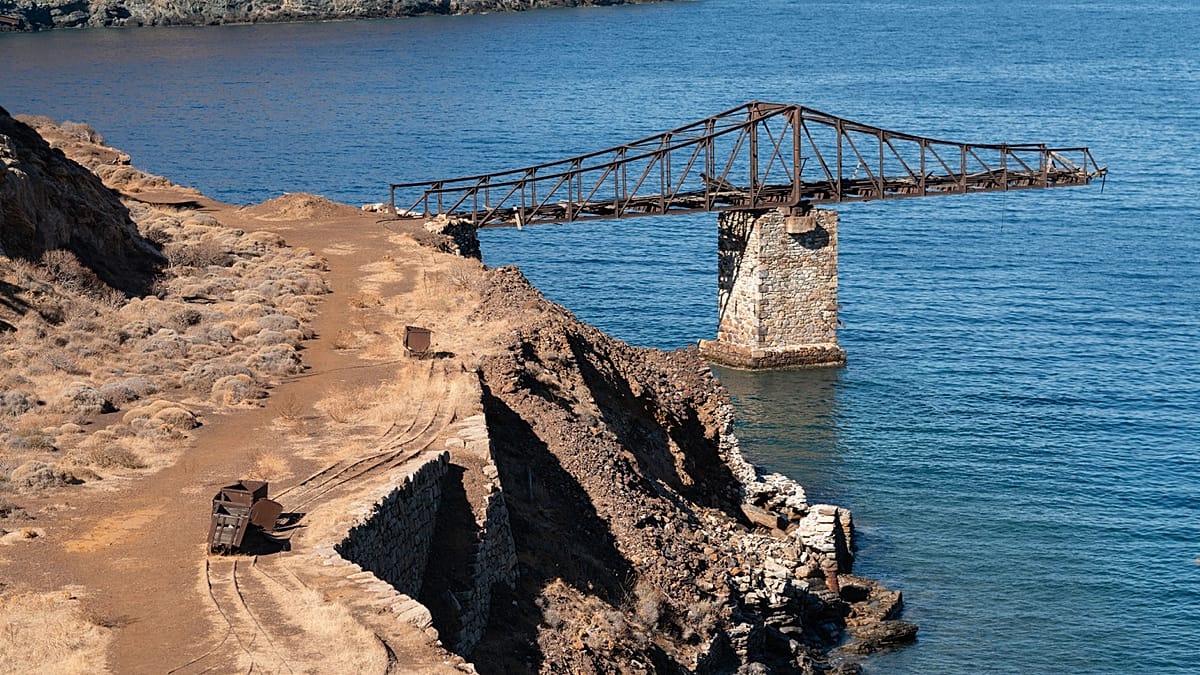
In the south-west, mainly at Mega Livadi and Koutalas, visitors can still see rusted rails, machinery, tools, wagons and loading piers. These are the visible traces of the intensive mining activity that shaped the island until the mid-20th century.
In more recent times, iron ore extraction began in 1870 and became more systematic from 1885 onwards. Annual production often reached 200,000 tonnes. Mining was not only a livelihood for locals; many others arrived from different parts of Greece to work on the island.
In 1963, the mines closed for good, forcing most workers to migrate and change profession. The mining sites were abandoned. Their story, however, remains deeply etched in the soul and identity of the islanders.
To highlight and preserve these memories, the Friends of Serifos Association launched the project “The living history of the mines of Serifos”, with the support of the Cycladic Identity initiative of the Museum of Cycladic Art. The research, interviews and documentation of material lasted a year. The result is a journey into the past, a moving exploration of residents’ memories and the history of the mines, captured in a printed and a digital album.
Digital underground
The digital archive (source in Greek)contains more than 250 photographs, rare documents, press clippings from the period and 10 first-hand testimonies by miners and their descendants who are still alive. This was deemed necessary because for decades the history of the Serifos mines survived mainly through the oral accounts of those who had lived and worked there.
As generations pass, these testimonies had to be recorded before they disappeared forever. At the same time, information panels with QR codes were installed at the mining sites, allowing visitors to read the miners’ interviews on the spot.
Earlier this month, the Friends of the Cultural Heritage and Environment of Serifos Association presented the project to local residents, organised a round-table discussion with miners and their descendants, and held a guided tour of the mining sites at Mega Livadi, led by Thodoris G. Livanios.
Katerina Papathoma, Vice-President of the Friends of Serifos Association, was the Programme Manager. Although she is not originally from the island, she has been living here for years and has grown deeply attached to it.
_”_The aim of the Friends of Serifos Association is twofold. First, to save and preserve this living history of the mines of Serifos. This was done through recordings and live interviews given to us by the miners and their descendants on the island. The second aim is that we want to share this story. The fact is that even we who live here in Serifos do not really know this history,” explained Papathoma.
“I realised this when all the material was brought together and I saw that many aspects of this place’s history are completely unknown. So first we ourselves have to learn, to answer questions we may have and to understand what happened with the mines.
“The second reason is to have a structured body of information so we can pass it on to young people. It is the young who will very soon be called on to deal with Serifos’s issues. They need to know these places in order to become attached to them and, if possible, to protect them.”
Miners’ strife
Serifos was the largest mining centre in Greece after Lavrio. The mines at Mega Livadi are a listed historic site. This was where the bloody miners’ strike of 1916 took place. They demanded the introduction of the eight-hour working day and more dignified working conditions from their employers, the German company Grohmann.
The uprising was universal. It was driven by starvation wages, punishing working hours, appalling living conditions and the total lack of safety measures, which often led to deaths and crippling injuries.
The strike ended in bloodshed, during which four strikers lost their lives (Th. Kouzoupis, M. Zoilis, M. Mitrofanis, I. Protopappas) and two members of the gendarmerie were also killed (Ch. Chrysanthou and I. Triantafyllou). Konstantinos Speras (1893–1943) was the leading figure in the strike. Born in Serifos, he became a key figure in Greece’s workers’ and trade union movement.
The Municipality of Serifos has for several years been trying to turn the area at Mega Livadi into an open-air mining museum that will showcase the history of the mines, the area’s unique identity and offer a different kind of development for this abandoned region.
Konstantinos Revintis**,** The mayor of Serifos, spoke to Euronews at the site of the strike: “We are standing in the historic place where the miners’ strike for the first eight-hour working day and for better working conditions took place, on 21 August 1916. It is a historic site that we want to highlight by creating here an open-air mining museum that will tell the story without a voice, simply through traces.
“Everything that still exists here must be restored. We have formed several partnerships with various bodies of recognised standing that have the necessary technical and management expertise, such as the National Technical University of Athens, the University of the Aegean, the Hellenic Society for the Environment and Cultural Heritage, Europa Nostra, the World Monuments Fund, the World Monuments Watch and other organisations. The Mega Livadi Association is a local body that shows particular sensitivity on this issue.
“And of course, we as the Municipality are playing the leading role. If the Ministry of Culture can support us, that would be ideal, as well as the Ministry of Finance, because we are in a coastal zone here,” said Revintis. “Our aim is to complete this project and return the site to public use so that people can visit it and so it can become an attraction, both for permanent residents and for visitors.“
The project “The living history of the mines of Serifos” was funded by Cycladic Identity, an important initiative run by the Museum of Cycladic Art since 2022.
Its goal is to safeguard the intangible cultural heritage that has shaped the island’s history over the centuries. To date, the museum has supported 26 projects in total on 15 Cycladic islands and will soon announce ten more for 2027:
“The Cycladic Identity initiative is essentially our concrete way of saying thank you to the islands. In practice, we support organisations active on the Cycladic islands in the fields of culture, biodiversity and intangible cultural heritage,” explained Theano Agalloglou, Project Manager of the Cycladic Identity initiative at the Museum of Cycladic Art.
“We want to engage as many residents as possible. We want them to feel proud of their unique cultural and natural heritage, but also to raise their awareness. We believe it is extremely important that the oral testimonies of the miners, or ‘Metalliotes’ as they were called on the island, are documented, digitised and preserved as a legacy for the new generation,” added Agalloglou.
The project and the album were presented at the Theatre of the Serifos Association in Chora. There, former miners and descendants of mining families shared their stories and memories with the audience.
The testimony of Andreas Livanios (Katsafouris)
_”_I went to work in the mines around 1956–57. I was still a child. I went because at that time everyone, the whole of Serifos, worked in the mines. The mine meant great hardship, because those from Mega Livadi and Koutalas lived nearby. I am from Kallitsos, in the north. To leave home and reach Mega Livadi, it took us three hours on foot. We had to get up at 2 in the morning, get ready and leave at about twenty to three so that we would be at the worksite at ten to six or a quarter to six. If we arrived at one minute past six, we were sent to the office and lost the day’s pay.
“It was exhausting because it was night and there was no road. We walked without light, in the cold and rain, along a path through the fields. I worked on compressors that pumped air. I went in the morning because these compressors ran on dynamite. I would put a small stick of dynamite inside, tap the detonator with a hammer and the machine would start up.
“What was left from the mines was only damage and hardship. They have eaten away all the guts of Serifos. There are galleries in the mountains where, if you go in, you get lost. Even now, when I think about it, I can hardly breathe. All the wealth left this place. Nothing was left for the island, which could have become a little Paris if the resources had been used properly.”
The testimony of Alexandros Livanios
“On both my mother’s and my father’s side, they were miners. My mother’s father survived, although he was very seriously injured. He spent a couple of years in hospital but pulled through. He survived and even kept all his limbs, but for two years he had lost his mind. My other grandfather on my father’s side, Alexandros Klaos, was killed. His body is still inside a mine at Aspros Kavos. My father never met his own father. My grandmother was pregnant with him when her husband was killed. There is no mining family in Serifos that does not have either someone injured or someone dead.
“The mines were both a blessing and a curse for the island. They kept people here, because mining was the main occupation and farming was a sideline. These people worked from night to night in the mines. Only Sundays were left for them to go and work their fields. Usually it was the woman who replaced the man because he was tied up with work. If you think that he had to leave from Chora and walk two hours to Mega Livadi, he had to get up in the middle of the night and return again at night.
“The school at Mega Livadi had 150 children when I was a pupil there. Gradually it was deserted and became a necropolis. In winter there are almost no residents at all. After the mines closed, there was both internal and external migration. I went to sea. I started out as a lathe operator and then went into the maritime sector because the pay was better, much better.”
The testimony of Thodoris G. Livanios
“I am an amateur researcher and folklorist. I have recorded dozens of people who worked in the mines and are unfortunately no longer with us, including people who experienced the 1916 strike. These are unique testimonies that I keep in my archive.
“We are children of miners, children of workers. We are descendants of the victims, not of the German exploiters. I have countless memories, because I experienced a lot in the mines both as a child and later through recording powerful testimonies that, unfortunately, have not yet been fully used. I have made several documentaries, television and radio programmes, and I have documented the popular culture of Serifos.
“Serifos is an empty shell. It was exploited by the Grohmanns and the successive employers who extracted the ore, drank the workers’ sweat, drank the workers’ blood and, in the end, left them unpaid.”