
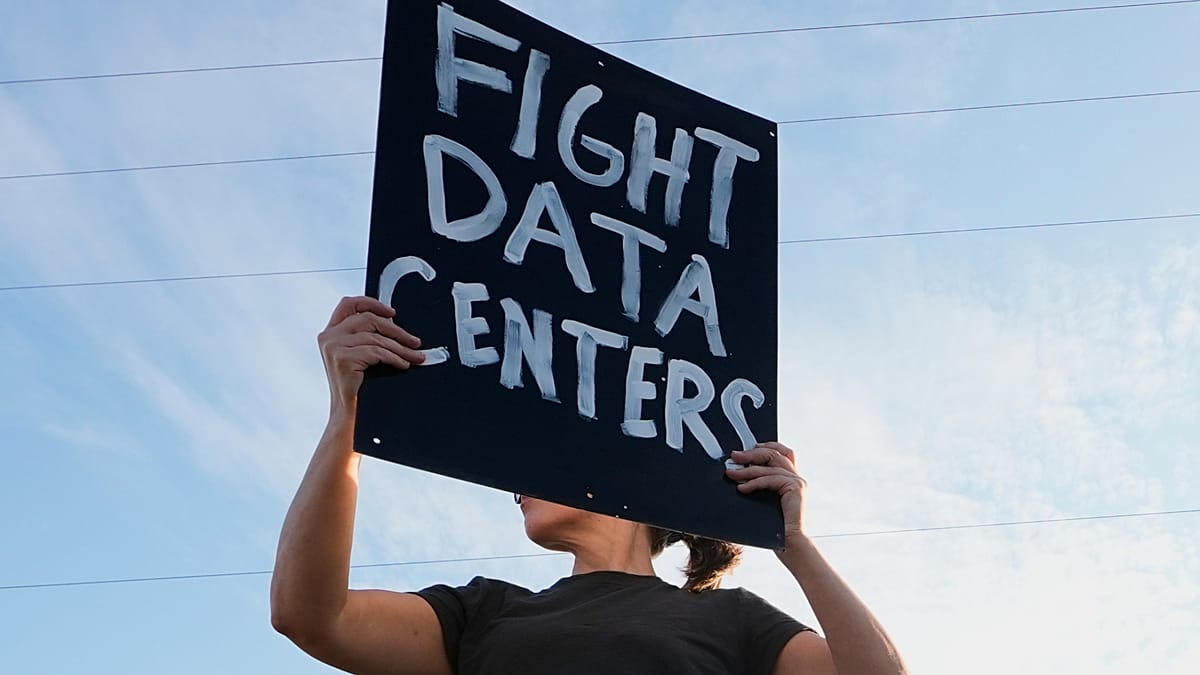
Data centre backlash in the United States became a deciding factor for voters in the US midterm elections this week, as the Democrats won control of Congress and key state governorships in Texas, Georgia, and Ohio, on the promise of restrictions on the artificial intelligence build-out.
Senator Bernie Sanders wrote on X, “Americans don’t want Big Tech oligarchs wrecking the environment, gutting jobs and threatening humanity’s future” and called for a “national data center moratorium now”.
Tech companies have taken a big hit on the stock market this week as investors fear the Democratic wins could have a real impact on data centre construction.
These are some of the companies that have been affected and how they have reacted.
OpenAI
OpenAI has launched a charm offensive in the US, announcing new commitments to the “communities where we build, along with policy proposals for responsible AI infrastructure”.
The company published a policy blueprint that proposes policies “to help ensure that compute campus development gives communities a meaningful voice, protects families from new costs, and broadly shares the economic gains of AI”.
It also published a compact that says what “communities can expect from OpenAI at future campuses that we own and operate”.
In September, OpenAI began calling its data centres “computer campuses”.
What the commitments mean is unclear, but they will apply to future sites the company owns and operates. It is also unclear what will happen to the company’s data centre infrastructure that is held by partners like Oracle.
OpenAI has also said it would cover the cost of electricity and grid updates in areas affected by its data centre sites, and disclose construction plans, noise studies and water usage data to the public.
Meta
Meta also saw its stock price shed some 4% on Thursday 5 November. The company had pledged to spend $1 billion (€890m) to build a massive data centre in Ohio. They currently own data centres in 23 US states.
The company’s president, Dina Powell McCormick, said the midterm results will make it harder for companies to build data centres.
She told the Wall Street Journal Tech Conference on Wednesday, “The visible sort of manifestation of AI is a data centre, and it’s something that people can say, ‘I don’t want this in my community’.”
“I think there’s an underlying bigger issue, which is how people feel about AI in general.”
She added that the industry has “not done as good a job as we needed to explain the benefits of these investments.”
“The stakes for who builds the technology that cures cancer, that gives access to education, that is also a very fundamental difference,” Powell McCormick said.
“And that’s what we mean when we say the future is for everyone. That people should not be left behind. But the way to ensure that is that this technology is democratised, that people have access to it in a very fair and transparent way,” she added.
Elon Musk
Elon Musk, who spent $474 million (€420 million) backing Republican candidates in the midterms, has been one of tech’s biggest losers.
Musk has been building his “Colossus” — a massive cluster of AI-native data centres and supercomputers in Memphis — and wrote on X “data centres in space looking pretty appealing right now”, following Tuesday’s US midterm election result.
Shares in his SpaceX fell almost 4%and Tesla dropped 2% this week.
Semiconductor companies worldwide
Chip designer and AI infrastructure company Nvidia saw shares plunge 9%, resulting in its founder and CEO, Jensen Huang, losing his spot in the top 10 of Bloomberg’s Billionaires Index, falling from ninth to 13th place among the world’s wealthiest individuals.
Nvidia is the world’s top supplier of high-performance microchips that are used to develop and power artificial intelligence in facilities such as data centres.
Chip companies globally were also affected, with German firm Infineon seeing its shares slide by 8%.
Meanwhile, ASML, the only company in the world that makes Extreme Ultraviolet (EUV) lithography machines to produce advanced chips, also saw its shares drop by 6%.
The Dutch company is critical for Nvidia, as it manufactures the firm’s advanced Grace Blackwell AI chips. It is also vital for companies developing next-generation semiconductors.
Finally, Taiwan Semiconductor Manufacturing Company (TSMC), which is the maker of most of the world’s chips for Nvidia, Apple, AMD, and Qualcomm, also saw its shares drop 10%.
Will anything change?
While companies may pay more attention to how they market data centres and offer to foot energy bills, data centre projects that are already under construction or allowed will likely continue, one expert previously told Euronews Next.
President Trump has previously dismissed a safety crisis in AI as a “hoax” and that “the only control or ‘guardrails’ that AI needs is a STRONG AND SMART (High IQ!) PRESIDENT”.
Republican lawmakers will now need to decide whether they stick with Trump or discuss with the Democrats on AI safety policy.