
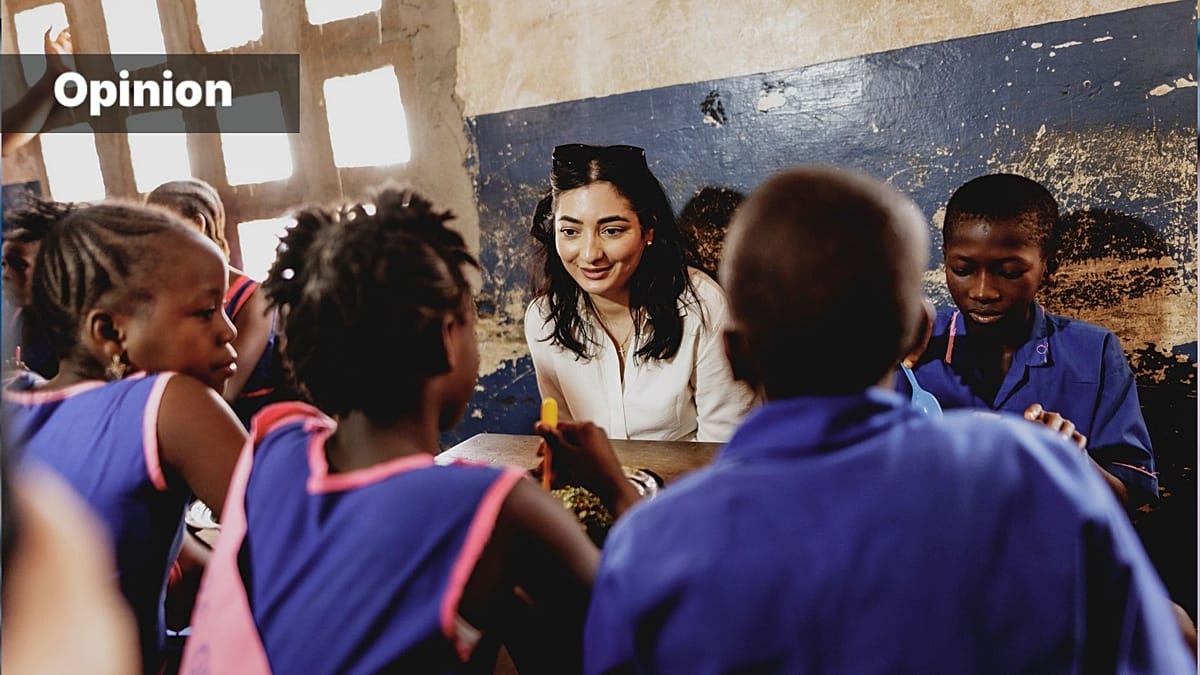
By Reem Alabali Radovan, Germany’s Federal Minister for Economic Cooperation and Development, Social Democratic Party of Germany (SPD)
Published on •Updated
The opinions expressed in this article are those of the author and do not represent in any way the editorial position of Euronews.
In the flood-swept valleys of Nepal, children are sleeping in the very classrooms where they used to learn. In Sudan, more than five thousand schools have been closed, leaving an entire generation cut off from education, waiting for peace.
In Ukraine, in Gaza, in the Sahel, children caught in the world’s conflicts ask for remarkably little: a classroom, a teacher, a desk.
Today, the education of 258 million school-aged children worldwide is disrupted by crises. For these children, missing out on quality education means missing out on chances in life.
Global spending on education aid could fall by 24 per cent this year
Meanwhile, the aid the world provides for education is projected to fall by 24 per cent this year. In the very emergencies where education matters most, it is being neglected.
This is a political failure before it is a financial one. With major consequences: When we fail to educate children in crises, we do not merely postpone their futures – we mortgage our own. Children that are denied the opportunity to learn are more vulnerable to violence, recruitment into armed groups, exploitation and early marriage.
Girls are often the first to be denied access to education – and the last to return to school. And the societies that lose a generation to illiteracy do not exist in quiet isolation; they export instability, forced displacement and conflict across borders. Excluding children from school today will deepen the security, economic and social challenges of tomorrow.
In the short term, school is the most effective lifeline for children. A classroom is a place of safety, of meals, of psychosocial support, of normality amidst the abnormal. Getting children back to learning within days of a disaster makes the difference between trauma and recovery – and it is also the difference between hope and the loss of it.
The global fund for education in emergencies is very important
In the long term, school is the most effective development policy there is. It is essential for peace and stability. Every additional year of education makes a lasting difference: for literacy, for livelihoods, for raising girls who marry later and lead sooner, for training teachers to educate the next generation, for creating communities that can survive a flood or a war and rebuild.
That is why the work of Education Cannot Wait (ECW), the global fund for education in emergencies, is so important. In a decade of action, ECW and its partners have enabled education for more than 16 million crisis-affected children across 33,000 schools, even in the toughest places.
Nearly 300.000 teachers – over half of them women – have been trained. And ECW has an ambitious goal: to improve access to education for another 10 million of the world’s most crisis-affected children over the next four years.
As an international community, we can make it happen if we all contribute. That is why, at a time when others are stepping back from multilateralism, Germany is stepping forward. We have made a commitment of €20 million euros per year to ECW for 2027-2031 – contributing to its 600 million US dollar replenishment target.
Germany is sending a clear message
Budgets are tight. And still we are making this commitment. . Because the evidence is unambiguous: there is no more effective way to build peace, no faster way to restore dignity, and no smarter investment in our own security than a child in a classroom.
With this commitment, Germany is sending a clear message: we strongly believe in multilateral partnerships. And we are and will remain a reliable partner. Only through collective action can we find solutions to global challenges and ensure stability worldwide. So we ask our partners in the G7, in Europe and beyond to do the same.
We must not let education become the silent casualty of our times. Together, we can make a difference – so that every child, everywhere, has the chance to learn and build a better future.