
Published on
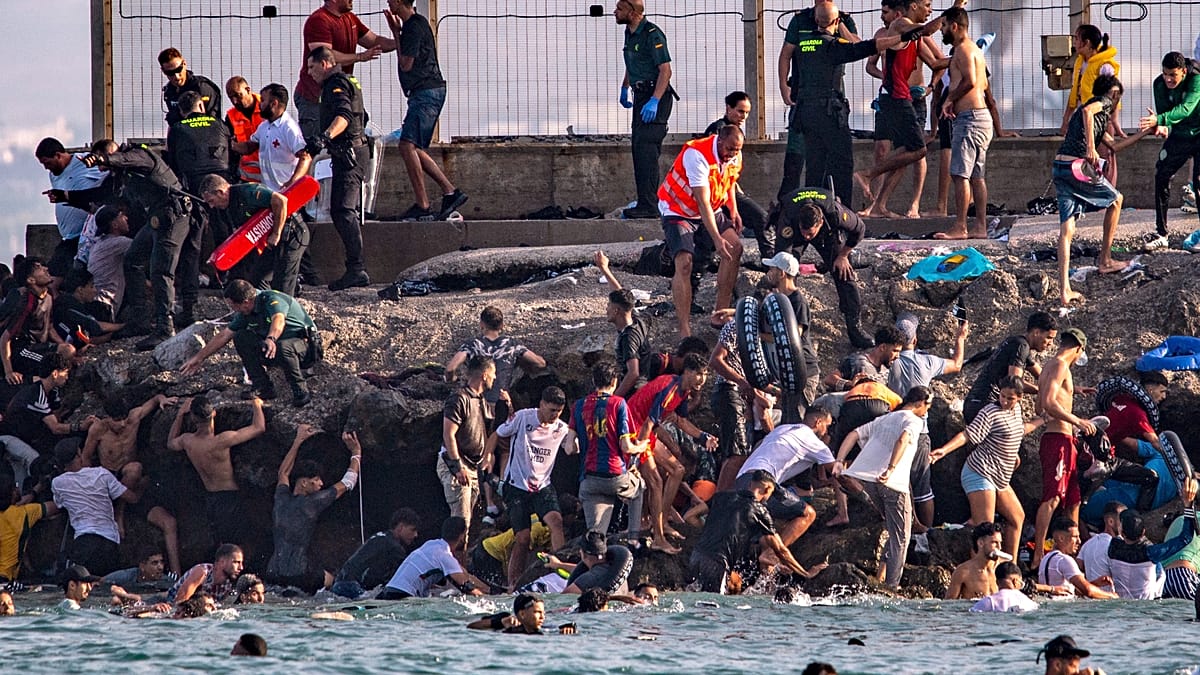
As around 60,000 migrants irregularly entered the Spanish enclave of Ceuta, Several EU countries are asking for Spain to be temporarily excluded from the free-movement Schengen area, a last-resort measure that could only be used in exceptional circumstances.
The largest surge of irregular arrivals ever recorded on EU territory in a single day sparked concerns among European governments, despite the fact that Ceuta is located on the African continent, offering migrants no easy route to mainland Europe.
Italian Prime Minister Giorgia Meloni was the first to raise the possibility on Thursday, announcing “extraordinary measures” to defend Italy’s borders.
Italy subsequently reintroduced air and maritime border controls with Spain on Friday, after a meeting chaired by Interior Minister Matteo Piantedosi.
Finnish Interior Minister Mari Rantanen backed Italy’s request, calling on other European countries to follow suit, and Denmark Prime Minister Mette Frederiksen suggested considering the option. The call was alsoechoed by leading right-of-centre figures across Europe.
Can Spain be suspended from Schengen?
According to the Schengen Borders Code, the EU could recommend suspending a country’s participation in Schengen as a last-resort measure, to be used only in cases of “persistent serious deficiencies relating to external border control.”
In such a case, the European Commission would need to propose the suspension, which would then have to be approved by the other EU member states.
The concerned country would then be recommended to reinstall controls at its internal borders with other member states.
There is no indication that this procedure will happen anytime soon.
“There are regular evaluations and in case there are serious deficiencies detected at the border crossing point, we issue a report which is then discussed with the member state [concerned] first,” a EU official said, without further speculation.
The Commission also signaled that special rules apply to Spanish enclaves of Ceuta and Melilla under the Schengen system, which make them de facto external territories when it comes to free movement.
“There is already border control between Ceuta and Melilla and the rest of the Schengen area,” a EU official said.
Any EU country can temporarily reintroduce checks at its internal borders with Spain, for renewable periods of up to six months, as Italy just did for one month.
France already has controls in place at all its land borders, with a decision predating the Ceuta crisis and based on different reasons, including persistent jihadist threats, a rise in antisemitic attacks and rising violence among migrants.
French Interior Minister Laurent Nuñez announced increased controls at the border after the outbreak of the crisis.
Portugal, the other EU country sharing a land-border with Spain, has not adopted this measure so far, while it said in a press release that “integrity of the Schengen system depends on tight external border controls.”