
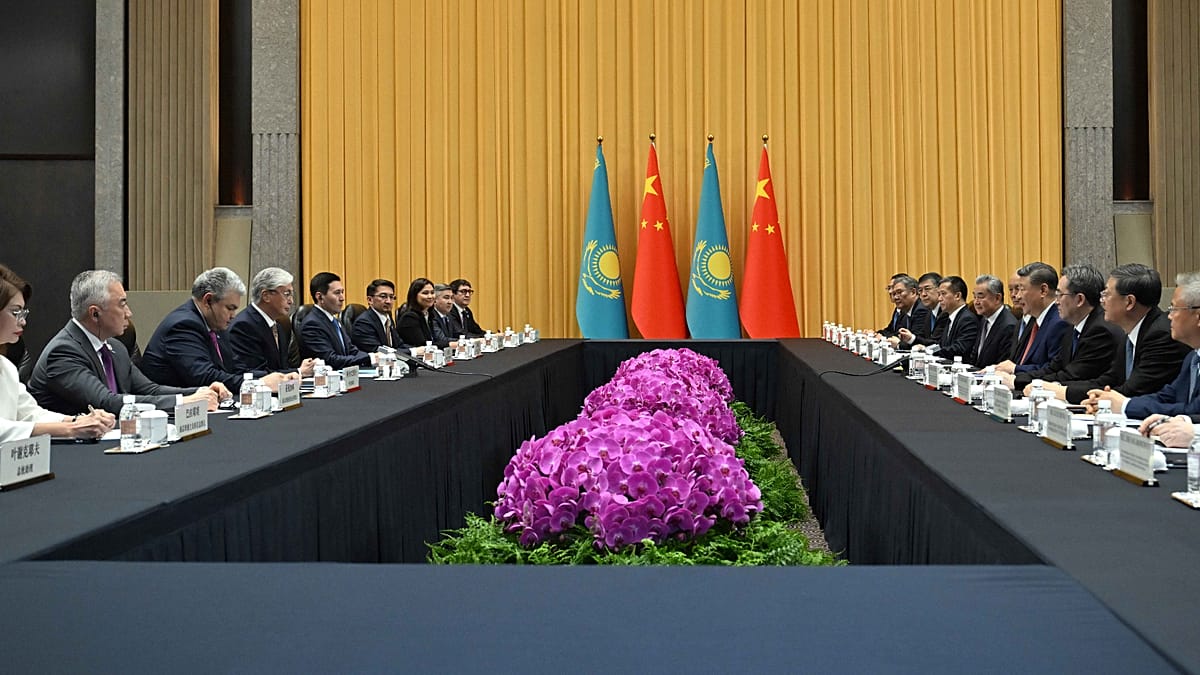
Kazakhstan’s President Kassym-Jomart Tokayev’s recent visit to China attracted considerable attention worldwide, especially within business communities.
Negotiations with his Chinese counterpart Xi Jinping, a speech at the World Conference on Artificial Intelligence (WAIC 2026), and more than 70 commercial documents worth over $15 billion (€13.2 billion).
The visit came at the time of booming cooperation between China and Kazakhstan. According to data cited by Tokayev at his meeting with Xi, bilateral trade last year reached a record €42.9 billion ($49 billion), cumulative Chinese investment reached €26.3 billion ($30 billion), and more than 8,500 Chinese-owned companies operate in the country.
The All China Review concludes that Kazakhstan accounts for over a third of all Chinese investment in Central Asia.
The two countries have completed 62 joint projects worth €7.6 billion ($8.7 billion) that created 11,000 jobs. Another 55 projects worth €11.8 billion ($13.5 billion) are in different phases of development.
Given the excellent cross-sector cooperation, the latest agreements at first felt less like a breakthrough and more like business as usual, a logical next step, or maybe a phase.
Yet Tokayev called this new phase a new “golden 30 years” of relations as the two sides signed a programme for trade and economic cooperation through 2030.
Along with that programme, around 70 documents were signed. So far, Akorda — the Presidency of Kazakhstan — has published 17. The reason is not secrecy. The total number of documents typically includes documents of varying weight: investment agreements, commercial contracts, memoranda, framework agreements, licenses and joint development plans.
Between the memorandum and the commissioning of the plant lies a long chain — financing, site, permits, construction, and ramp-up. Serious governments will not rush to declare a memorandum of understanding a massive success.
However, the more emerges, the more apparent it becomes what is different this time around, as additional analytical texts are being written in both countries.
So, what is new?
For the past 20 years, China has come to Kazakhstan primarily for oil, metals and uranium, as well as transit.
During the Shanghai meetings, Astana presented itself as an infrastructure platform for the new economy. This is a different level of positioning, and it is this that determines the significance of the visit more than the sum of the contracts.
It elevates the traditional trade in materials to the level of building complementary chain economy in which Kazakhstan has to offer much more than just raw material.
It can house entire processes, from raw material to final high-tech products and even logistics for their distribution to distant markets. Chinese investors would have full service to make their investment worthwhile, while Kazakhstan would benefit from added value.
Since battery production was the largest deal signed, the portal RD Media in Kazakhstan wrote in its explainer that “the map proposed by Kazakhstan is coherent.”
“Critical minerals fuel battery production. Batteries are used in electric vehicles and energy storage systems. Energy supplies data centers. Data centers host AI computations. Logistics corridors deliver products to foreign markets. Each element strengthens the next,” RD Media wrote.
And Kazakhstan has or is about to have all the elements.
Case study: Batteries
The most comprehensive business deal reached in Shanghai can paint the best picture of the new economic deal.
The world leader in car battery production, China’s Contemporary Amperex Technology Co Limited (CATL), confirmed its readiness to build a car battery plant in Kazakhstan. It should be the largest such operation in Central Asia.
The reason all analysts declared that agreement the most significant is not just its scope or CATL’s exit from China — it already has similar plants in Germany and Hungary.
Kazakhstan’s president proposed a full cycle — from minerals and ore processing to final production — something that neither the German nor the Hungarian plants do.
“This is where the line between the two models lies,” writes RD Media. “A ‘battery plant’ can mean assembling modules from imported cells, or it can mean producing the cells themselves, cathode and anode materials, and chemically processing minerals,” the outlet added.
“The economic value of these differs dramatically. With the assembly model, Kazakhstan gains jobs and a tax base, but the added value and technology remain with the supplier.”
“A full cycle — with raw material processing, material production, and engineering expertise — establishes the industry itself in the country, while assembly leaves only a platform.”
Why does Beijing accommodate this approach now?
In the past, China would have been all too careful about this apparent loss of added value and displacement of the economy. But it is reacting to the new circumstances. Domestic consumption is falling.
The demand for Chinese goods in the US dwindled after President Donald Trump imposed tariffs. Chinese companies exported €113 billion ($130 billion) less goods to the US in 2025 than in the year before. The solution was focusing on other markets: South-East Asia, Africa, Europe and Central Asia.
The shift paid off. Massive demand for affordable Chinese products emerged in countries seeking to restrain inflation.
Chinese trade turnover with the world grew by 17% since last year. A trade surplus was achieved with every region of the world, and overall it reached €109 billion ($125.6 billion) by the end of June. According to some statistics, it is the second-best result in China’s history.
To be competitive in other markets, Chinese companies are increasingly entering not only with finished goods but also with production facilities, digital platforms, and technological standards.
Kazakhstan is becoming one of the first locations where this model can be deployed comprehensively: close to the market, with resources and transit access to Europe.
Transit is one of the major advantages. As many as 13 international corridors run through Kazakhstan and, after the geopolitical changes of recent years, as many as 85% of land-transported Chinese goods bound for Europe travel through the country.
Kazakhstan has invested $35 billion in transport infrastructure over the last 15 years.