
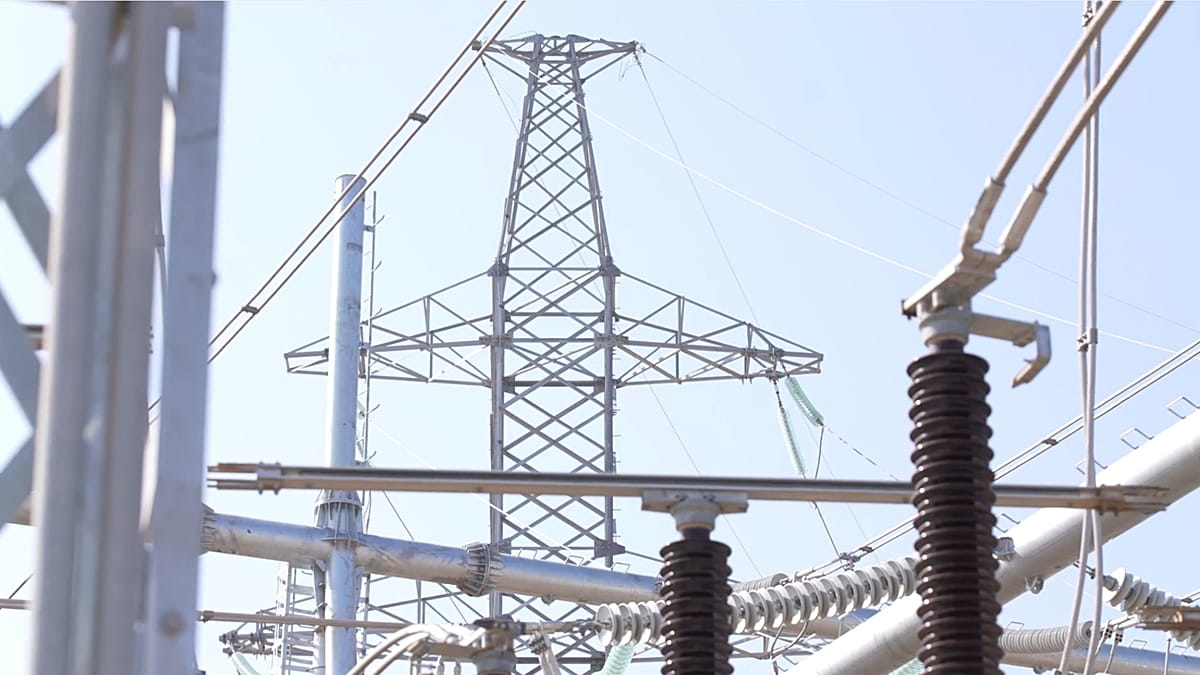
Uzbekistan plans to increase electricity generation from 82 billion kilowatt-hours to more than 120 billion kilowatt-hours within the next five years, turning the power sector into one of the country’s biggest investment tests.
The target reflects rising demand from industry, population growth and the development of new sectors, including digital infrastructure, as Uzbekistan seeks to expand electricity supply while reducing reliance on fossil fuels.
Speaking at the Tashkent International Investment Forum (TIIF), President Shavkat Mirziyoyev said renewable energy is expected to account for 54% of electricity generation by 2030. He said the country had already attracted nearly $6 billion (€5.3 billion) in foreign investment into green energy projects and plans to invest a further $4 billion (€3.5 billion) in electricity transmission networks.
Mirziyoyev also called for investment in solar and wind power plants, energy storage systems, grid modernisation and data centres powered by green energy, linking the country’s electricity plans to its broader industrial and digital agenda.
Building the financing roadmap
International financial institutions are already helping to finance that expansion.
In 2025, the European Bank for Reconstruction and Development (EBRD) invested almost $2 billion (€1.8 billion) across 120 projects in Central Asia and Mongolia. More than $1 billion (€880 million) of that total went to projects in Uzbekistan.
More than half of the EBRD’s regional investments were classified as green, while around one-third supported sustainable infrastructure projects.
In Uzbekistan, EBRD financing has included large-scale renewable energy and storage projects. These include a $142 million (€125 million) package for a combined 1GW solar photovoltaic and 1,336MWh battery energy storage plant developed with ACWA Power.
The bank also arranged financing of up to $195.5 million (€171 million) for a 300MW solar plant and 75MWh battery storage facility developed by Masdar in the Kashkadarya region.
In an interview with Euronews on the sidelines of TIIF, Huseyin Ozhan, the EBRD’s Managing Director for Central Asia and Mongolia, said increasing energy capacity requires both financing and regulatory reform.
“We need to look at it from two angles. Number one, investments. And number two, policy engagement,” Ozhan said.
According to Ozhan, governments across the region have adopted long-term decarbonisation strategies, with international financial institutions helping to develop roadmaps and sector-specific plans designed to reduce dependence on fossil fuels.
“Most of the countries in Central Asia have already committed to full decarbonisation in 2050 or 2060,” he said. “There is a long-term decarbonisation plan and roadmaps accompanying these decisions.”
The EBRD has also worked with Uzbekistan on low-carbon pathways for the energy sector as part of those efforts.
Renewables move from targets to projects
For the EBRD, renewable energy remains the main investment route for reducing the region’s dependence on fossil-fuel infrastructure.
Central Asian countries continue to rely heavily on fossil fuels, particularly through ageing electricity and heating systems, according to Ozhan. At the same time, governments are expanding renewable energy projects while updating regulations intended to support private investment.
“If you were to say how we are going to do it in one word, that’s renewables,” Ozhan told Euronews.
In Uzbekistan, that approach is already visible in projects that combine solar generation with battery storage, showing how financing is moving beyond new power plants alone and towards systems able to absorb more renewable electricity.
For investors, the shift makes renewables part of a wider infrastructure story: generation capacity, storage, grid connection and regulation all need to advance together.
Nuclear joins the energy mix
Renewables are central to Uzbekistan’s power expansion plans, but they are not the only technology being added to the country’s energy system.
In June, Uzbekistan marked the start of construction of its first nuclear power project in the Jizzakh region, moving another part of its power expansion plan from planning to implementation.
The planned plant is expected to include two large reactors of around 1,000MW each, alongside two small modular reactors of around 55MW each, adding a new source of low-carbon baseload capacity to the country’s future electricity mix.
In a separate interview with Euronews on the sidelines of TIIF, Sama Bilbao y León, Director General of the World Nuclear Association, said Uzbekistan’s decision reflects a broader trend among growing economies looking for reliable sources of electricity to support development.
“These are countries with enormous resources, but a desire to grow and develop. And you are going to need energy to do that,” she said.
Bilbao y León said Uzbekistan’s nuclear plans reflect both growing electricity demand and the country’s desire to reduce the share of natural gas in power generation.
“In the case of Uzbekistan, this is a country with 75% of its electricity coming from natural gas and with a desire to use that natural gas for other applications. This is where nuclear energy is going to take a very important role,” she said.