
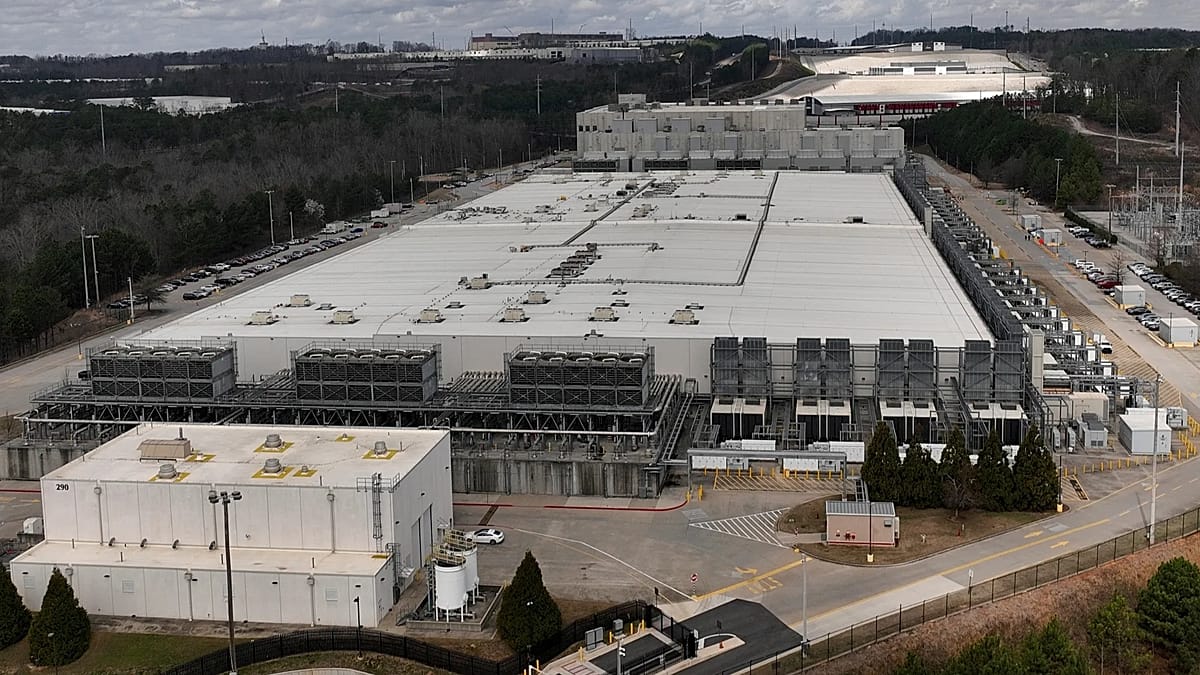
AI’s boom has a water problem.
Data centres are facing growing public anger in the United States over the amount of water and electricity they use. The technology giants spending billions of dollars on them say the water problem, at least, can be addressed.
Data centres are warehouses filled with computer servers that power the internet and, increasingly, artificial intelligence.
Those computers generate heat, and keeping them cool can require large amounts of water.
Data centres worldwide consumed 222 billion litres (59 billion gallons) of water for cooling in 2025, according to consultancy Rystad Energy.
Without measures to reduce consumption, that figure could nearly triple to 644 billion litres by 2030, Rystad estimates. It says steps to curb water use could keep the increase below 100%.
US chipmaker Nvidia said in a report published in June that its newest system for designing and managing AI data centres, known as DSX, could almost eliminate water consumption at some facilities.
It is a bold claim – and one the industry is under growing pressure to deliver on.
Nvidia’s system uses closed-loop cooling, with liquid flowing directly through servers and as close as possible to the chips, which can reach temperatures above 80°C (176°F).
But reducing water consumption can come at a cost.
“There’s a pretty direct trade-off between how much water is used and how much energy is used” to control temperatures, Andy Masley, an independent researcher covering AI and data centres, said.
Using less water usually requires more electricity because the liquid circulating through sealed pipes still has to be cooled, often by blowing air over it.
Nvidia gets around some of this by letting the liquid enter the servers warmer than usual, at 45C.
Most other closed-loop systems ran at about 32°C in 2024, according to the Uptime Institute, which certifies data centres.
By starting with warmer water, Nvidia does not need to pump in cooled air year-round.
“Simple fans circulating the air” are often enough, though sometimes a mix of methods is needed, Josh Parker, Nvidia’s head of sustainability, said.
At sites in extremely hot climates, or during heatwaves, chilled air or evaporative cooling may still be needed.
Public pressure over water use
Microsoft, Amazon Web Services (AWS) and Meta told AFP that they also use closed-loop cooling systems, which they said do not result in any net water loss.
Microsoft and AWS, two of the world’s largest cloud-computing companies, used more water overall between 2022 and 2025 as they expanded their data-centre operations.
However, their water-use efficiency improved by 25% at Microsoft and 37% at AWS, according to their latest sustainability reports.
Comparisons are difficult because there is no industry-wide standard governing how companies report their environmental, social and governance efforts.
Elon Musk’s SpaceX, which became a major data-centre operator after acquiring his artificial intelligence company xAI, has never published an ESG report.
In June, ratings agency MSCI gave SpaceX its lowest ESG score.
“Because water is generally much cheaper than electricity,” companies have less incentive to cut water use on cost grounds alone, Shaolei Ren, an engineering professor at the University of California, Riverside, said.
“There are incentives,” Ren said, adding that these are driven more by public relations as opposition to data centres grows across the United States.
Another problem is the cost of upgrading older data centres with newer technology that uses less water.
However, older facilities are generally smaller and less powerful than the enormous data centres now being built, meaning they require less cooling in the first place, according to Minh K. Le, who leads research on data centres and hydrogen at Rystad Energy.
The water used directly by data centres is also only part of their overall footprint.
Water is also required to generate the electricity that powers them and to manufacture their chips and servers.
In the United States, this indirect water use can be twice as high as the amount consumed by data centres themselves.