
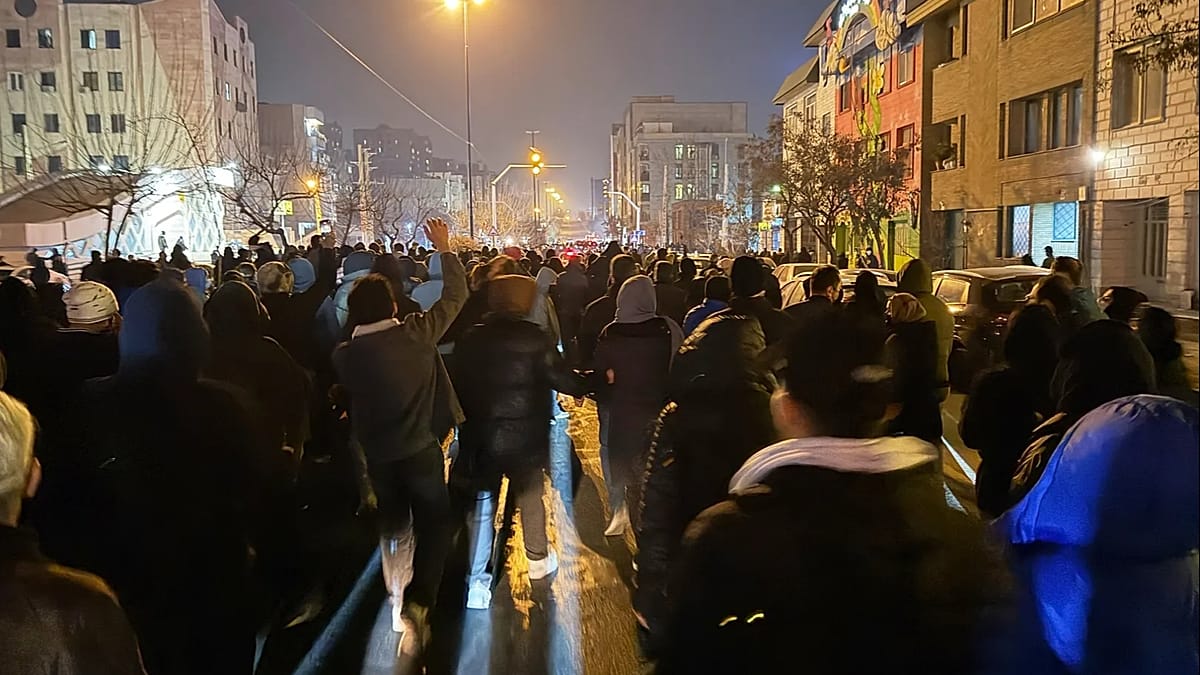
Revolutions throughout history have often had a charismatic central figure at their core, such as Lenin, Mao or Castro.
But beginning in the late 20th century, a wave of protests and revolutions emerged that neither began with concrete leadership or had an emerging central figure as the revolution proceeded.
This phenomenon, described in political science literature as horizontal movements or leaderless resistance, is one of the most important developments in contemporary political history.
But can leaderless revolutions be victorious? And if so, how exactly do they succeed?
What is meant by a “leaderless revolution”?
A leaderless revolution does not necessarily mean there are no influential figures connected to the protests, it means that decision-making is not centralised.
There is no formal hierarchy and, most importantly, the legitimacy of the revolution comes from below via collective action rather than from a specific figure or party.
Moreover, coordination of activities in such revolutions is carried out mainly through social networks or other groups.
This model of revolution is usually a reaction to historical distrust of charismatic leaders who, after victory, have themselves become a source of repressive power.
Tunisian Revolution: Rifts within security forces
Tunisia’s revolution, the first such protests in the wider Arab Spring movemet, is a classic example of a leaderless uprising. During events in the North African country that had begun in December 2010, protests were not initiated by a specific political party or led by a recognised leader.
The revolution was sparked by the self-immolation of a street vendor Mohamed Bouazizi in protest against the confiscation of his fruit, government corruption and unemployment. In a short time, a network of young people, trade unionists, lawyers and social media users joined this popular uprising.
Popular protests continued for 28 days, eventually forcing President Zine El Abidine Ben Ali, who has ruled the country for more than 23 years, to dissolve the government and parliament, relinquish power and flee to Saudi Arabia.
One of the key factors in the success of the protesters in overthrowing the regime, alongside deep and pervasive social discontent, were deep rifts within the security forces. Furthermore, not having a single leader for the revolution was considered a concession to the revolutionaries because it did not give the government the opportunity to act to remove them.
Despite the absence of a leader, the role of unions including the General Syndicate of Tunisian Workers (UGTT) was crucial during the protests.
Although the revolution was a success, the absence of a leader and a clear plan for the post-Ben Ali era caused ideological rivalries, economic crises and institutional weakness that plunged Tunisia into a period of instability that eventually led to the return of a kind of authoritarianism.
The events in Tunisia showed that although a leaderless movement can bring down the ruling regime, a new system cannot be built without a clear political project for the future.
Egyptian Revolution: Different groups, single goal
The Egyptian Revolution consisted of a series of protests, marches and civil disobedience, inspired by the success of the Tunisian Revolution and within the framework of movements dubbed the Arab Spring.
Beginning in January 2011, the protests in Egypt were also inspired by the student-led “Atpur” (Resistance) in Serbia; a movement that started peaceful protests in 2000 which, with the support of the army, led to the fall of Slobodan Milošević’s government.
Egypt’s protest movement, propelled by widespread use of Facebook and Twitter, eventually led Hosni Mubarak to resign the presidency after 30 years and cede all authority to the Supreme Council of the Armed Forces, made up of top army commanders.
This revolution had two key features. First, during the revolution, the Egyptian military did not support Hosni Mubarak, and Egyptian Prime Minister Ahmed Shafiq Zaki was also forced to resign less than a month after Mubarak stepped down.
Second, the protests, although lacking any collective leadership or charismatic mouthpiece with which the protesters could relate, succeeded in bringing together disparate social groups with different agendas under a single goal.
Egypt’s strong point
With so many points of view and different groups at work, not having a specific leader from a particular intellectual perspective, which might have been a serious weakness for the continuation of the Egyptian revolution, became its strong point.
Ahmed Assili, an Egyptian blogger and television presenter, makes another point.
“The lack of leadership prevented the regime from dominating us,” he said. “In particular, leaders can be intimidated, placated or engaged in negotiations in which the regime makes concessions to save itself.”
In this way a leaderless movement was formed in Egypt, in the course of which, everyone was united around a very simple but radical demand: the immediate abdication of Hosni Mubarak.
Nevertheless, the protesters’ activities were disciplined and organised. Six groups – including the 6 April Youth Movement, the Raging Youth Movement and Mohamed ElBaradei’s Alliance for Change – consulted each other informally about how to organise the gatherings in Tahrir Square.
However, that lack of clear leadership eventually became a problem. After Mubarak’s fall, the organised forces that played a marginal role in this revolution, including the army and the Muslim Brotherhood, quickly filled the power vacuum.
The result is that although the revolution was successful, the revolutionaries were eliminated and an authoritarian system was once again installed.
Egypt serves as a warning that if one leaderless movement cannot quickly introduce political representatives, others will step in.
Ukrainian Revolution: Hope and violence in downtown Kyiv
The Euromaidan revolution in Ukraine is another example of a leaderless movement. The movement lasted for more than three months, from November 2013 to February 2014.
The revolution began with a journalist’s message calling for a rally on Independence Square (Maidan Nezalezhnosti) in central Kyiv to protest against the government’s refusal to sign an Association Agreement and free trade deal with the European Union.
This revolution, although leaderless, quickly and spontaneously saw organised activities among different groups, largely coordinated on social media.
Planning all the associated elements to keep the protest running, from food to healthcare, created a strong sense of community among the protesters.
The standoff reached a climax in February 2014, when police unleashed a brutal crackdown on the protests and dozens of people were slain between February 18-21, many by police snipers.
A European-mediated peace deal between the government and protest leaders envisioned the formation of a transitional administration and an early election, but demonstrators later seized government buildings and the Russia-friendly President Viktor Yanukovych fled to Russia.
Strengths and weaknesses of leaderless revolutions
One of the most important characteristics of such leaderless revolutions is their relative irrepressibility, because the removal of an individual does not destroy the movement.
The other characteristic is the wider participation of the people. In such revolutions even collective action moves ahead of organisation and leadership and in fact legitimacy comes from street presence, not from institutions or programmes.
The other advantage, at least in the short term, is that it reduces the risk of creating an individual dictatorship.
One of the most important weaknesses of leaderless revolutions is the lack of a central figurhead leads to an inability to make snap decisions at critical moments.
The other problem with such revolutions is the lack of political representation to negotiate or to participate in the process of transferring power and the danger of the revolution being hijaked by entrenched forces is always present.
For this reason, some revolutions failed not because of the protesters, but because of a lack of strategy in the post-revolution political arena.
The existence of a leader for the revolution or its emergence in the course of the revolution) can also somewhat guarantee the conditions after victory, preventing the return of authoritarianism or the creation of chaos after the revolutionary period.
But whether there is a leader from the beginning of the revolution or one emerges during it, one thing is clear: if the opposition fails to organise itself, the ruling power will quickly do so.
Leaderless revolutions are the offspring of an age of mistrust. They can shake and even overthrow the ruling regime, but if they cannot bridge the gap between people power and the post-revolutionary political structure, their victory will be shortlived.