



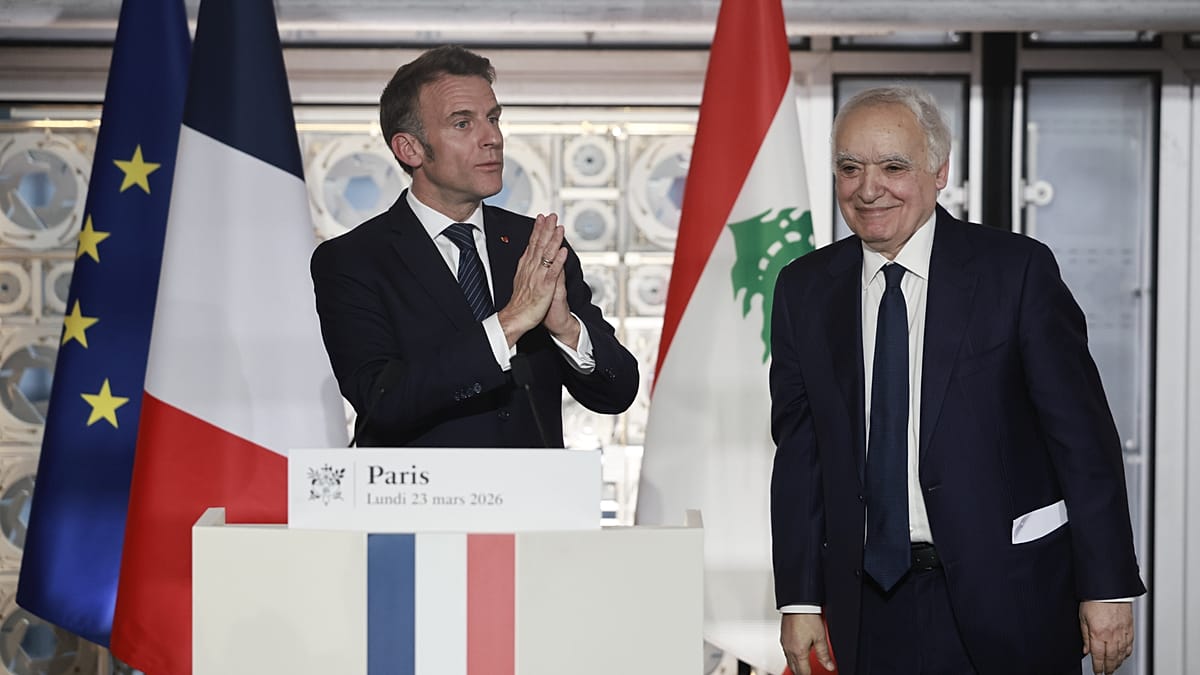
The French President Emmanuel Macron inaugarated a major historical exhibition in Paris about the ancient Lebanese city of Byblos.
Byblos: The Millennial City of Lebanon at the Arab World Institute, traces more than 7,000 years of history from one of the world’s oldest continuously inhabited cities.
But as Macron spoke alongside Lebanon’s Culture Minister Ghassan Salamé, the message moved well beyond archaeology to the unfolding war in Lebanon.
“At a time that certain people want to have us believe that security can only be achieved by invading a scary neighbour,” Macron said, “Lebanon reminds us of just one thing: the force of universalism.”
His remarks came amid Israel’s ongoing offensive in Lebanon, where airstrikes and a ground incursion into the south have intensified in recent weeks.
According to Lebanese officials, more than 1,000 people have been killed, with up to a million others displaced. There’s also reportedly been widespread damage to civilian infrastructure.
The escalation follows a broader regional conflict tied to the US-Israeli war on Iran, with Hezbollah launching rockets in retaliation.
Byblos, a Millennium-Old City of Lebanon
The exhibition is inextricably linked to both the past and present of the country.
Byblos, located on Lebanon’s Mediterranean coast and inhabited since around 6900 BC, is widely considered to be the world’s oldest port city.
For millennia, it served as a crossroads between Egypt, Mesopotamia and the wider Mediterranean, playing a central role in trade, language and early urban life.
It is one of Lebanon’s best-known historic cities, a UNESCO-listed place that has long helped define the country’s image abroad.
The exhibition in Paris brings together nearly 400 artefacts, from prehistoric tools and Bronze Age jewellery to sculptures and funerary objects, presenting a city whose past still shapes Lebanon’s identity.
However, the exhibition is still incomplete.
Originally scheduled for 2024, the exhibition was delayed as conflict made transporting artefacts increasingly difficult. Insurance costs surged, routes became unstable, and several key pieces never made it to Paris.
A shipment of large stone artefacts was cancelled after renewed military escalation, while other objects, including a third-millennium BCE obelisk, were deemed too valuable to risk and remained in Lebanon.
Some display cases now stand empty, marking those absences.
For curator Tania Zaven, that was intentional. The exhibition, she said, is “a form of cultural resistance”.
Visitors move through thousands of years of history while being reminded, repeatedly, of the conditions under which that history is being preserved.
Anne-Claire Legendre, the institute’s first female president, said, “[This is] An exhibition carried out with a great deal of determination, a great deal of courage and great trust between the teams, in a particularly complicated context.”
She further stated that the exhibition, “marks both the millennial history of Lebanon, and reminds us how much it is our duty to preserve this history and to protect this heritage from any erasure”.
France and Lebanon
France’s relationship with Lebanon gives the exhibition a meaning beyond cultural prestige.
The two countries are linked by long political, linguistic and intellectual ties, but also by decades of archaeological cooperation.
French scholars and excavation missions helped shape modern knowledge of sites like Byblos from the late 19th century onward, and that shared custodianship still echoes in how Lebanese heritage is presented in Paris today.
That institutional bond is written into the exhibition itself, which was developed with Lebanon’s Ministry of Culture and the General Directorate of Antiquities, making it not only a museum project but also a joint act of preservation at a time of war.
Macron described his presence at the opening as “first and foremost a mark of esteem, respect and friendship,” and used the ceremony to fold archaeology into a broader defence of Lebanese sovereignty.
His remarks made clear that this was not just about celebrating an ancient city, but about standing beside a country under attack.
The symbolism was sharpened by the presence of Lebanese Culture Minister Ghassan Salamé, who spoke on behalf of President Joseph Aoun and stressed the depth of Lebanese-French ties, thanking France for its steady backing and expressing hope that this support would continue in helping Lebanon rebuild its future.
Salamé has also been using his trip to Paris to gather international support for Lebanese heritage sites endangered by the war.
In recent days, he said he would attend emergency heritage talks dedicated to protecting archaeological sites in Lebanon threatened by ongoing strikes.
Byblos: The Millennial City of Lebanon is open until August 23, 2026 at the Arab World Institute.