
By Denys Glushko, Editor-in-Chief of Ukrainian news outlet “Apostrophe”
Published on
The opinions expressed in this article are those of the author and do not represent in any way the editorial position of Euronews.
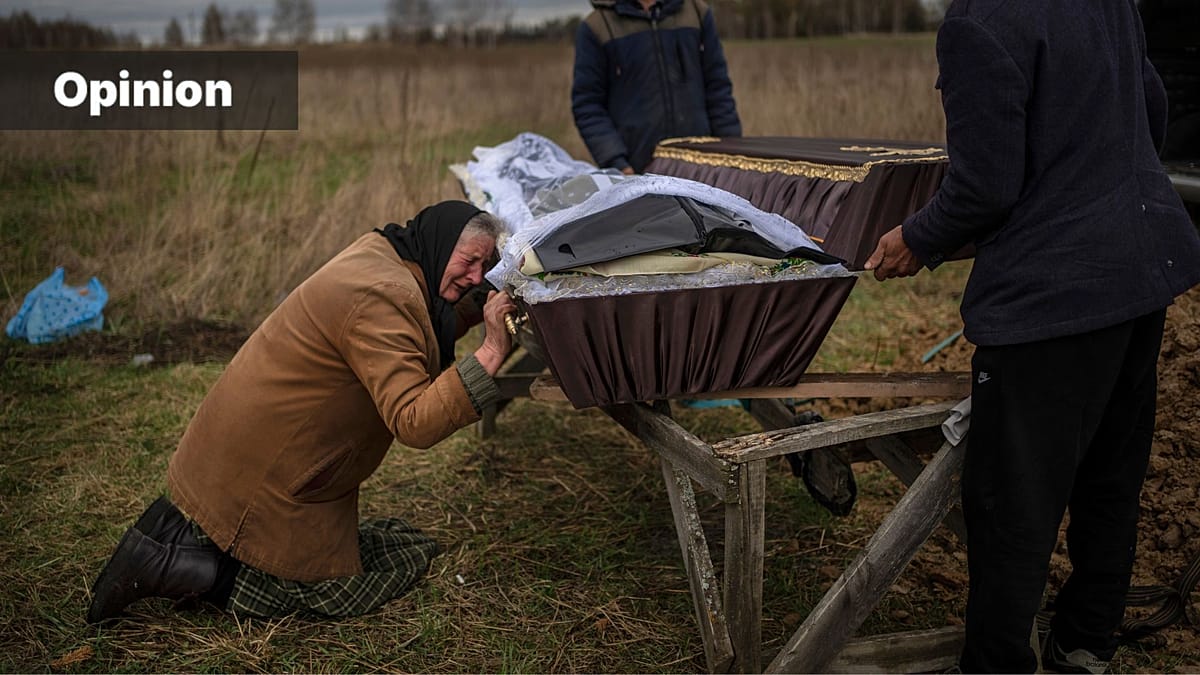
On March 31, Ukraine marks four years since the liberation of Bucha, the Kyiv suburb whose name became synonymous with the brutality of Russian occupation. For much of the world, Bucha remains one of the defining images of the early phase of the full-scale invasion.
For Ukrainians, it is a reminder of what Russian control means in practice.
The current diplomatic process, if it can still be called that, has brought together Ukrainian, American, and Russian representatives in different formats without producing a common framework or a credible route to ending the war.
These meetings have increasingly looked less like negotiations than parallel conversations with no destination.
This should surprise no one: Russia has no interest in a real settlement on terms compatible with Ukrainian sovereignty. Yet it still benefits from the appearance of diplomacy. Stalled talks buy time, ease pressure, and preserve the illusion that the war may still be resolved through patient engagement.
Ukraine, by contrast, cannot simply walk away. Kyiv understands how empty many of these meetings are, but refusing to participate would hand Moscow an easy propaganda victory and risk alienating partners whose support remains essential.
One exception worth noting
Prisoner exchanges and the return of civilians remain the only clearly meaningful outcomes of this process. Since the beginning of 2026, amid diplomatic efforts involving Ukraine, Russia, and the United States, 650 military personnel and seven civilians have been returned. For Ukrainians and the families involved, that is no small thing.
But humanitarian returns do not offer a path to ending the war.
In reality, an open-ended diplomatic process suits Russia well: it allows the Kremlin to keep fighting while encouraging the idea that some settlement may eventually emerge. Moscow’s basic terms, however, have not changed. Ukraine is still expected to surrender territory, accept limits on its sovereignty, and move towards a settlement shaped around Russian interests.
From Kyiv’s perspective, that is capitulation in slow motion.
The wider geopolitical environment has only reinforced this dynamic. Escalation around Iran has diverted Washington’s attention, unsettled energy markets and created precisely the kind of international distraction from which Russia tends to benefit. The less political bandwidth the West has for Ukraine, the more comfortable Moscow becomes.
Russian momentum can still be disrupted
That makes Ukraine’s internal resilience even more important. A country fighting a long war of attrition cannot afford institutional drift. Parliamentary turbulence and political fatigue matter because endurance in this war depends not only on weapons and external financing, but on the state’s ability to hold together under pressure.
The battlefield, meanwhile, looks less one-directional than it did a year ago. According to Commander-in-Chief Oleksandr Syrskyi, Ukrainian forces have restored control over roughly 470 square kilometres in the south.
More broadly, Ukraine has shown that Russian momentum can still be disrupted.
Part of that shift comes from Ukraine’s expanding strike capabilities. Alongside long-range attacks on Russian oil and military-industrial infrastructure, Ukraine has improved its use of mid-range drones, thanks to support from its European partners, enabling more regular strikes on targets 150 to 200 kilometres inside Russian territory.
These attacks do not produce the immediate symbolism of a frontline breakthrough; however, they alter the logic of the war in other ways: by stretching Russian air defences, complicating logistics, and raising the cost of aggression.
Russia, for its part, continues to absorb severe losses while pressing ahead with repeated assaults in Donetsk and on the approaches to Zaporizhzhia. At the current pace, and for as long as Moscow retains the manpower and financial resources to sustain the war, there is little reason to expect even a temporary halt in the fighting. The Kremlin still appears convinced that it can outlast Ukraine and outwait the West.
What would peace on Russian terms mean for Ukraine?
This returns us to Bucha. Four years on, its significance is not confined to remembrance. Bucha answers a question many abroad still treat as abstract: what would peace on Russian terms mean for Ukraine? Ukrainians have already seen enough to know that the issue is not simply territory. It is the survival of the state, the safety of people in the cities, and the right of the country to exist on terms other than those imposed by Moscow.
Kyiv therefore has little choice but to work on two tracks at once: continue to engage in diplomacy, however performative, while preparing for a war that will still be decided primarily by force, endurance, and state capacity.
For international audiences increasingly tempted by war fatigue, Bucha should still serve as a reminder that Ukraine is being asked, in effect, to trust its future to a power whose occupation has already shown what that future would look like.
Four years after Bucha’s liberation, that should be clear enough.
Denys Glushko is Editor-in-Chief of Ukrainian news outlet “Apostrophe”