
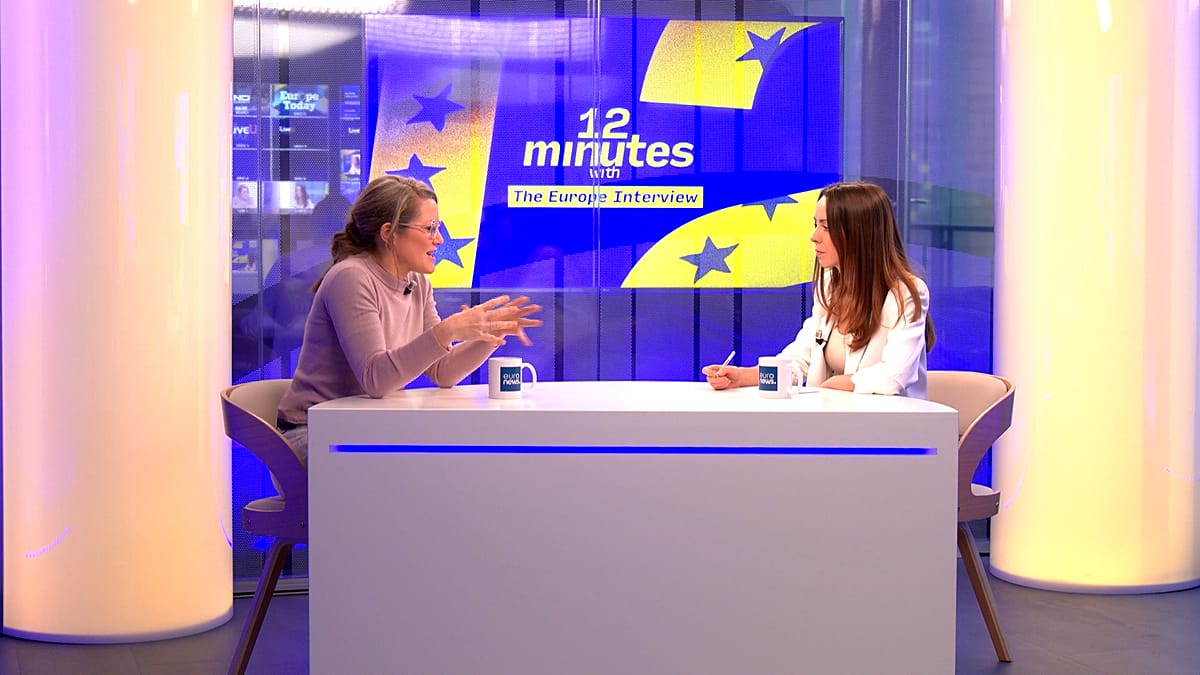
Belgium is looking to house foreign prisoners abroad as part of its crackdown on migration and is open to partnerships with countries in the Western Balkans and beyond, the country’s Minister for Asylum and Migration, Anneleen Van Bossuyt, has told Euronews’ interview programme 12 Minutes With.
Asked about her recent mission to Albania and Kosovo to explore renting or building prison space to house irregular migrants convicted of crimes in Belgium, Van Bossuyt said: “We are looking at every possible solution to increase the return rate. That’s one of the possibilities that we are looking into together with the ministry (of justice).”
She explained that talks with Albania are aimed at housing Albanian nationals currently held in Belgian prisons, while in Kosovo, her government is looking to house “people who are staying in Belgium illegally, but in our prisons,” regardless of their nationality.
The Danish government is already trialling such a plan, sending foreigners ordered to leave the country to complete their sentences in Kosovo, from where they are expected to be returned to their countries of origin.
The Western Balkans has emerged as something of an exploration ground for what the EU is describing as “innovative” solutions to migration, with Italy opening first-of-their-kind migrant detention centres on Albanian soil last year. The centres have, however, faced numerous legal challenges and human rights criticism.
Van Bossuyt also expressed openness to exploring partnerships beyond the Western Balkans.
“We have been there (to Albania and Kosovo), we have spoken with the responsible ministers, but maybe in future there will also be other possibilities or countries,” she said. “But it’s important to see where we can have this kind of solution.”
Pressed on whether her government would consider similar solutions for migrants staying in Belgium irregularly but not convicted of crimes, Van Bossuyt said Belgium could explore the possibility of using a new EU agreement allowing member states to send migrants to so-called “return hubs” in third countries.
The proposal, part of a push by the EU to speed up the returns of irregular migrants, could see people whose asylum claims are rejected being returned to camps in countries to which they have no connection but deemed “safe” by the bloc.
“That’s where we are looking at the European level with the return regulation and the possibility for return hubs. I think that there, there can be a possibility,” she said.
‘No one with right to reception’ should sleep rough
Van Bossuyt also defended what she described as a recent turnaround in Belgium’s asylum policy, which has been fiercely criticised in recent years by human rights defenders.
In October, a Brussels court issued an interim ruling against Belgium’s failure to provide shelter for an Afghan family seeking asylum. The family was then forced to sleep on the streets. Several similar instances have occurred in the past.
“The measures we are taking are literally to avoid these kinds of situations,” Van Bossuyt said, explaining that only people refused the right to asylum because they have already been granted protection in another member state are rejected from reception centres.
“But then what we offer these families is that they can receive shelter in a return centre in Belgium to return to the country where they have protection. But they don’t come to these return centres,” Van Bossuyt said.
“As of today, no person who has the right of reception has to sleep on the streets in Belgium, and that’s a big difference from the situation that we have seen in the past years.”
The government has also been ordered to pay multiple fines by courts and is estimated to owe millions in penalties for its handling of asylum seekers. Yet minister Van Bossuyt told Euronews she stood by her decision not to pay those fines despite the potentially dangerous precedent this could set.
“I indeed decided not to pay them. And why? Because I have to work with taxpayers’ money,” she said, adding that she isn’t the “first one who doesn’t pay the fines.”
In recent years, bailiffs seized furniture from the former State Secretary for Migration (Van Bossuyt’s predecessor’s) office to pay penalty fines as ordered by the courts. In a similar move, they blocked €2.9 million in bank accounts of the federal asylum agency, Fedasil.
Van Bossuyt said her government was delivering on one of its main priorities of cutting the number of asylum claims as a way of driving migration numbers down, which it has been doing by disincentivising asylum seekers from coming to Belgium through digital campaigns.
Belgium recorded its lowest level of asylum applications in November since mid-2023, a decrease the minister attributes to her tighter policies.
“For too long, we were seen as the land of milk and honey. So that’s why immediately we took measures,” she said.
You can watch the full interview on Euronews on Thursday, 8 January at 20.30 CET.