
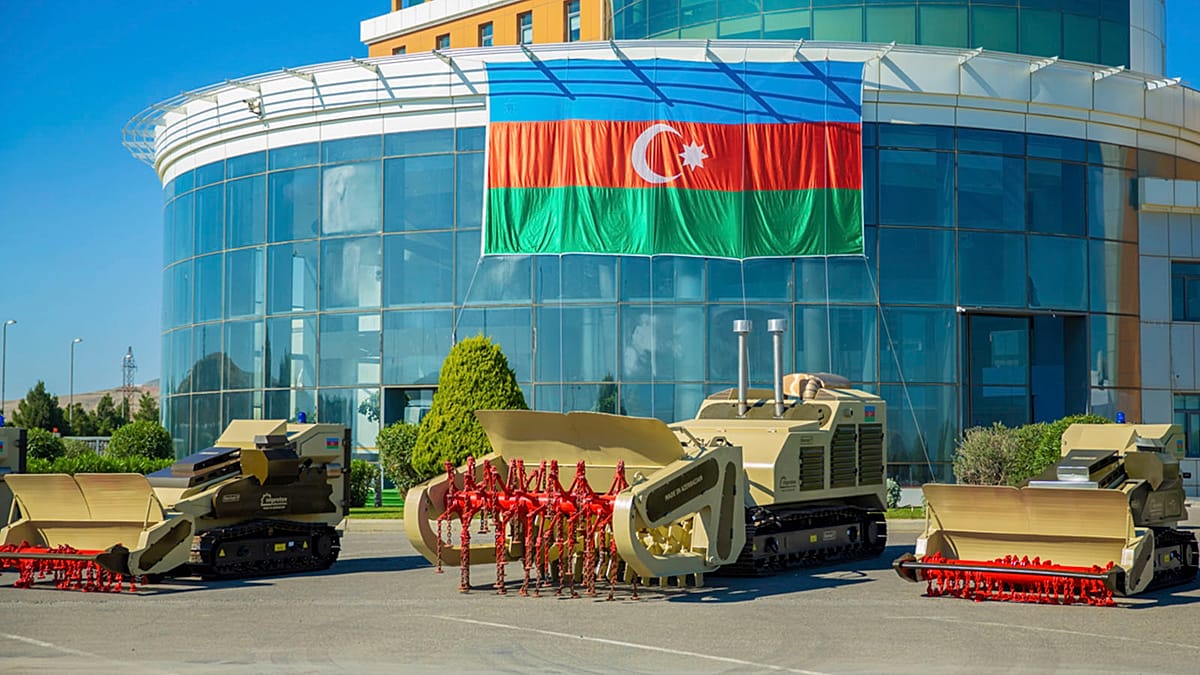
Azerbaijan is expanding the use of domestically developed remote-controlled demining machines to speed up humanitarian clearance in former conflict zones, contributing to global mine-action efforts.
The unmanned systems are produced by local engineering firm ImProtex and operated by the Azerbaijan National Agency for Mine Action (ANAMA).
Built for high-risk environments, the machines are deployed in areas where manual clearance remains slow and dangerous, in line with International Mine Action Standards (IMAS).
The scale of contamination makes technological solutions a priority for Baku.
“For Azerbaijan, the landmine issue remains a serious humanitarian and security challenge long after the end of the conflict,” Vice President of ImProtex Gunel Alakbarova told international TV channel AnewZ.
“Mines and explosive remnants of war placed during the occupation still cover vast areas, posing risks to human life and hindering the normal use of the land,” Alakbarova added.
Mechanised and remote-controlled platforms significantly reduce risks to deminers while allowing operations to cover much larger areas.
One of the latest models, the Revival T, is a heavy mechanised vehicle designed to neutralise both anti-personnel and anti-tank mines across rugged terrain.
“Manual demining remains the most precise but also the slowest method,” says Emil Hasanov, deputy chairman of ANAMA’s Public Council. “An individual deminer typically clears between 20 and 50 square metres per day.
Mine detection dogs, used for their speed and efficiency, can survey 200 to 400 square metres daily.
Mechanical demining machines achieve the highest throughput, ranging from 500 to 2,000 square metres per day, depending on terrain and equipment.”
Meanwhile, Alakbarova argued that automation is central to reducing casualties. “Robotic machines reduce the need for manual labour, enabling faster and more effective clearance of minefields.
Traditional demining methods carry a high risk of human casualties. Remote-controlled systems equipped with advanced sensors minimise this risk,” she said.
The increased use of mechanised clearance is helping to release land more quickly, supporting reconstruction projects and the return of displaced communities.
“This approach not only reflects technological innovation but also highlights Azerbaijan’s humanitarian mission and regional technological potential,” Alakbarova added.
“The equipment accelerates post-conflict recovery by enabling safe land clearance and allowing agriculture and infrastructure to resume operation.”
From domestic clearance to international showcase
Azerbaijan has also presented its remote-controlled demining technology at international defence and security exhibitions, including UMEX 2026 in Abu Dhabi.
Landmines and explosive remnants of war (ERW) remain among Azerbaijan’s most serious post-conflict challenges. Since the end of hostilities in 2020, ANAMA reports that more than 240,000 hectares of contaminated land have been cleared, with over 227,000 mines and ERW neutralised.
Despite this progress, contamination persists in several districts, continuing to slow development and pose risks to civilians.
To maintain momentum, the Azerbaijani government has allocated 74.9 million Azerbaijani manat (€39 million) for mine action in 2026 and has signed contracts with multiple specialised companies to expand clearance capacity.
The EU and embassies of the bloc’s member states are also strengthening their partnership with Baku in humanitarian demining, pledging around €23 million in assistance.
The funding supports clearance operations, risk-awareness campaigns and victim assistance, making mine action one of the largest ongoing engagement areas in the country.
Demining is essential for safe reconstruction, economic development and the sustainable return of displaced populations.
Azerbaijan has extended its expertise internationally, including to Ukraine, where it has supplied unmanned demining vehicles and provided training to specialists, as well as generators for the civilian population’s heating.
Large areas of Ukrainian farmland, infrastructure and residential zones remain affected by mines and ERW following Russia’s full-scale invasion in early 2022, with clearance seen as critical for civilian safety and economic recovery.
A global challenge
According to UN agencies and international monitoring groups, more than 6,000 people were killed or injured by landmines and ERW worldwide in 2024, one of the highest figures recorded in recent years.
Mines can remain active for decades, sometimes up to a century, continuing to endanger civilians long after conflicts end.
“Nations such as Egypt, Angola, Afghanistan, and Bosnia and Herzegovina continue to grapple with the long-term consequences of contamination,” Hasanov said. “Landmines restrict access to farmland, basic services and safe resettlement,” he added.
Hasanov stated that humanitarian organisations, including the UN’s Mine Action Service (UNMAS), UNDP development programme, UNHCR, Mines Advisory Group (MAG) and Norwegian People’s Aid, warn that mines remain a major obstacle to post-conflict recovery and the safe return of refugees and internally displaced people.
Alakbarova stressed that despite progress, the challenge extends far beyond any single country.
“Despite successes in global demining efforts, activities worldwide still face challenges such as resource shortages, political will, and technical difficulties,” she said.
“Mines remain a residual threat in more than 50 countries, demonstrating that addressing this issue requires long-term collaboration and sustained investment,” Alakbarova added.
Experts say the growing use of remote-controlled demining machines marks a shift in humanitarian mine action, reducing human exposure to hazards while improving efficiency.
For Azerbaijan, locally developed systems are both saving lives at home and enabling the country to play a more active role internationally, as global mine-action needs are rising.