
Will Viktor Orbán lift his veto on the €90 billion loan for Ukraine before or after Hungarians cast their ballots in the hotly contested elections of 12 April?
This is the burning question that officials and diplomats in Brussels are privately debating as the dispute over the Druzhba pipeline takes centre stage on the campaign trail, where opposition leader Péter Magyar has emerged as his most serious challenger to Orbán’s nearly 16 years of uninterrupted power.
“Orbán understands that he’s all the time testing the limits of how much the other member states are willing to put up with,” said a senior diplomat, speaking on condition of anonymity. “All eyes are on the elections and what that will bring.”
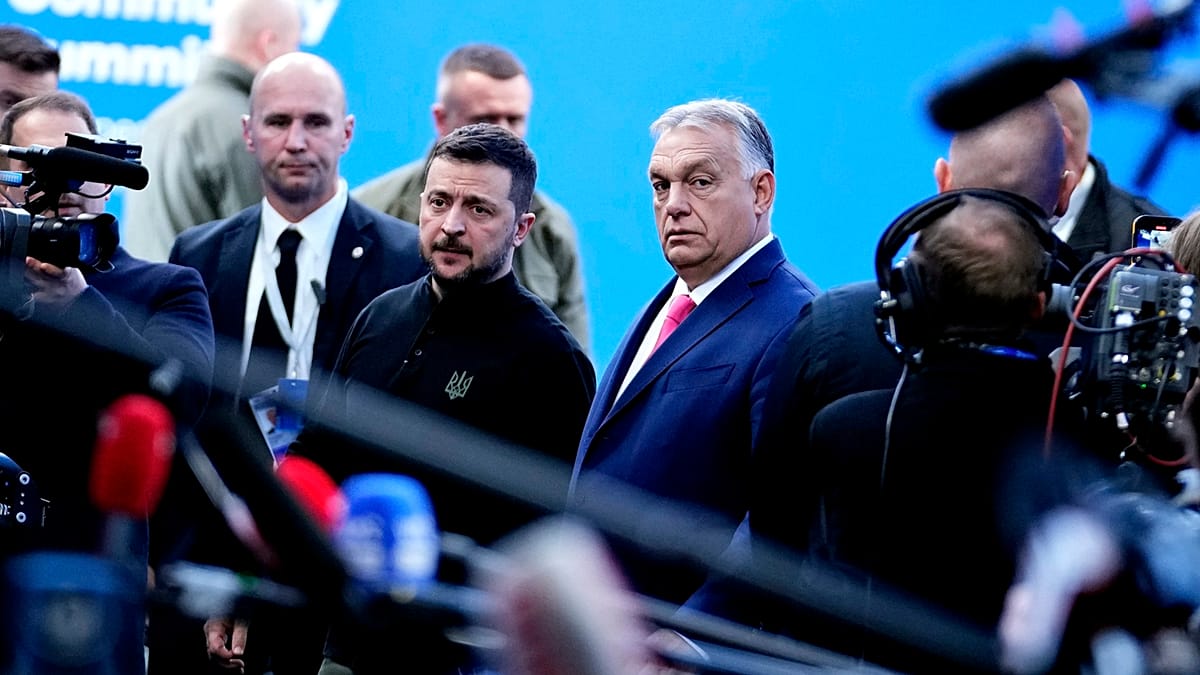
With opinion polls showing the incumbent trailing by double digits, Orbán’s messaging has turned increasingly combative and inflammatory, propelled by his acrimonious confrontation with Ukrainian President Volodymyr Zelenskyy, portrayed in campaign billboards as corrupt and money-grabbing.
Orbán also accuses Zelenskyy of deliberately shutting down the Soviet-era pipeline, which carries cheap Russian oil for “political reasons” to sway the election result.
Zelenskyy, whose patience with Orbán’s provocations appears to be wearing very thin, insists the pipeline was damaged by a Russian drone attack on 27 January and needs to be fixed before oil deliveries can be effectively resumed.
The Ukrainian leader was initially reluctant to commit to a specific repair timeline, arguing that technicians were at risk of being killed by Russian shelling. But after pressure from the European Commission, which is awkwardly caught in the middle of the rival camps, Zelenskyy has agreed to provide a date for the “possible reopening” of transit.
The Commission took a significant step this week by formally asking Kyiv to grant permission for a group of external experts to inspect Druzhba’s impaired section.
While the Ukrainian government has yet to confirm whether it will allow the fact-finding mission to go ahead, the overture has cautiously raised hopes that a compromise might be found before 12 April, given that Orbán himself has been pushing for the exercise.
“Hungary will accept the findings of such a mission,” he wrote in a letter last month.
Orbán will travel to Brussels next Thursday to attend an EU summit, marking the first time he faces his fellow leaders since imposing his veto on the €90 billion loan.
The reprimand is all but guaranteed: member states consider that Orbán has breached the principle of sincere cooperation by backtracking on a high-level agreement that the 27 leaders, including Orbán, had personally endorsed in December.
Hungary and Slovakia negotiated an opt-out from the €90 billion, freeing them from any financial obligation related to the loan, which adds to the bitterness.
“You can’t function properly if an agreement made by the leaders themselves is suddenly undercut by one of those leaders. If that’s the way we work in the EU, then we have a serious problem,” said a second diplomat, venting his frustration.
“A deal is a deal. If Orbán were to persist, he would be crossing a bridge that has never been crossed before.”
Still, for all the finger-pointing and fault-finding, many in Brussels believe Orbán has little to no incentive to give up his veto in the final stretch of a brutal re-election campaign structured principally around opposition to Zelenskyy.
At first, the prospect of prolonging the impasse until mid-April seemed unpalatable to other capitals because of the assumption that Ukraine could run out of foreign assistance in early April – and perhaps default. But that timeline has changed.
Privately, the Commission has concluded that Kyiv could sustain its wartime spending until late April, possibly early May, thanks to the pending payments of a G7 line of credit and a new programme by the International Monetary Fund (IMF).
The updated estimation enables a scenario in which either Orbán or Magyar could, in theory, lift the veto after 12 April without inflicting significant financial pain on Ukraine. (Slovakia’s Robert Fico, however, has warned he might inherit the veto if Orbán loses.)
At any rate, officials and diplomats agree that the solution, whether it arrives before, during or after the election, runs through Druzhba. Besides the experts’ mission, the Commission is considering financial assistance to accelerate the repair works.
The appetite for a Plan B has virtually disappeared. Resorting to the EU treaties to devise inventive shortcuts is seen as both unfeasible and undesirable so late in the legislative process. Meanwhile, the Adria pipeline has lost momentum as an alternative route after Croatia refused to carry Russian oil under Western sanctions.
The consensus in Brussels says that the €90 billion loan to Ukraine, as designed by the 27 leaders in December, must be preserved.
A senior EU official said: “We’re fully invested in Plan A.”