
Published on
With Tehran’s streets lined up with anti-American billboards and posters amid tensions in the Middle East, Iranians turned out to visit an anti-war exhibition at one of the city’s top museums.
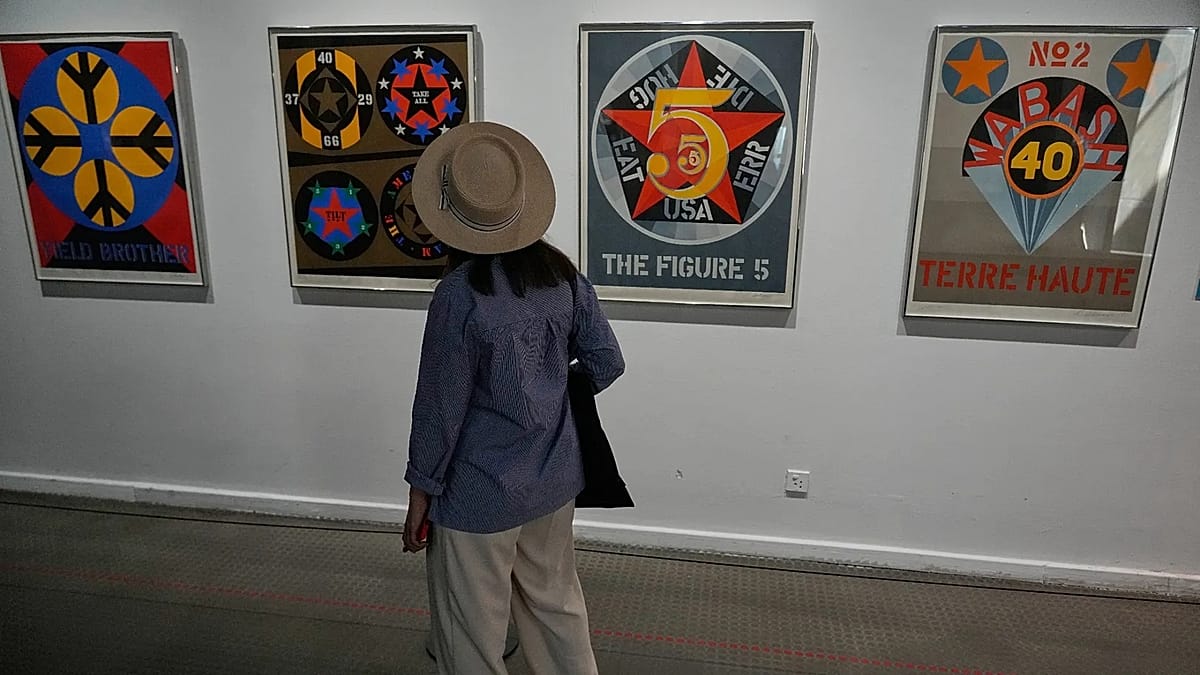
The exhibition, titled “Art and War”, features works by Roy Lichtenstein, Robert Indiana and James Rosenquist. These pieces, created in the 1960s pop art style, have all been selected for their anti-war themes.
The works on display come from the museum’s major collection of American and European modern art, which was acquired in the 1970s by Farah Pahlavi, the former shah’s wife, and has largely been kept out of public view since the revolution.
Amid war and confrontation, the works resonated with young visitors strolling the gallery. Some of them examined Rosenquist’s work “F-111”, a collage critiquing America’s military-industrial complex with images of a warplane’s fuselage, a nuclear mushroom cloud and a child’s face.
Nearby was “Brattata”, one of Lichtenstein’s characteristic comic-book-panel paintings of a fighter-plane pilot shooting down an enemy craft.
“American artists have always had a really interesting way of ridiculing war, and that’s always fascinated me in their work,” said Ghazaleh Jahanbin, a Tehran artist.
“Maybe part of it, I don’t know, comes from their geographical distance from war itself.”
Mohammad Sadegh Abbasi, one of the visitors, praised the staging of this exhibition in such uncertain times: “Despite the war and all the hardships people are enduring, art is a way of escaping the pressure everyone is under. In other words, art is a means of survival and a way of life.”
Exhibition, a response to “events unfolding around it”
Reza Dabiri-Nejad, the museum’s director, said the institution intended the exhibition to be a response to “the events unfolding around it”.
He told the media that this was why the works showcased “had either been shaped by the experience of war or created as a reaction to wars”.
During the 40-day war, museums and many other cultural activities in Iran were closed. But since the ceasefire, many of them have once again opened their doors to the public.
However, according to the museum director, the number of works on display has deliberately been kept low so that, should the war resume, they can quickly be moved to secure storage.
The museum’s collection of modern American and European art has a storied history. The government of Mohammad Reza Pahlavi built the museum and acquired the collection in the 1970s, when oil was booming and Iran was the closest US ally in the region.
The shah’s wife, former Empress Farah Pahlavi, largely picked the collection, including artists ranging from Picasso and Van Gogh to Mark Rothko and Francis Bacon.
But just two years after the museum opened, the 1979 Islamic Revolution ousted the shah, and theocratic rule by Shiite clerics was installed. The treasures of Cubist, Surrealist, Impressionist and Pop art were packed away in the museum’s vault, untouched for decades to avoid offending Islamic values and the appearance of catering to Western sensibilities.