
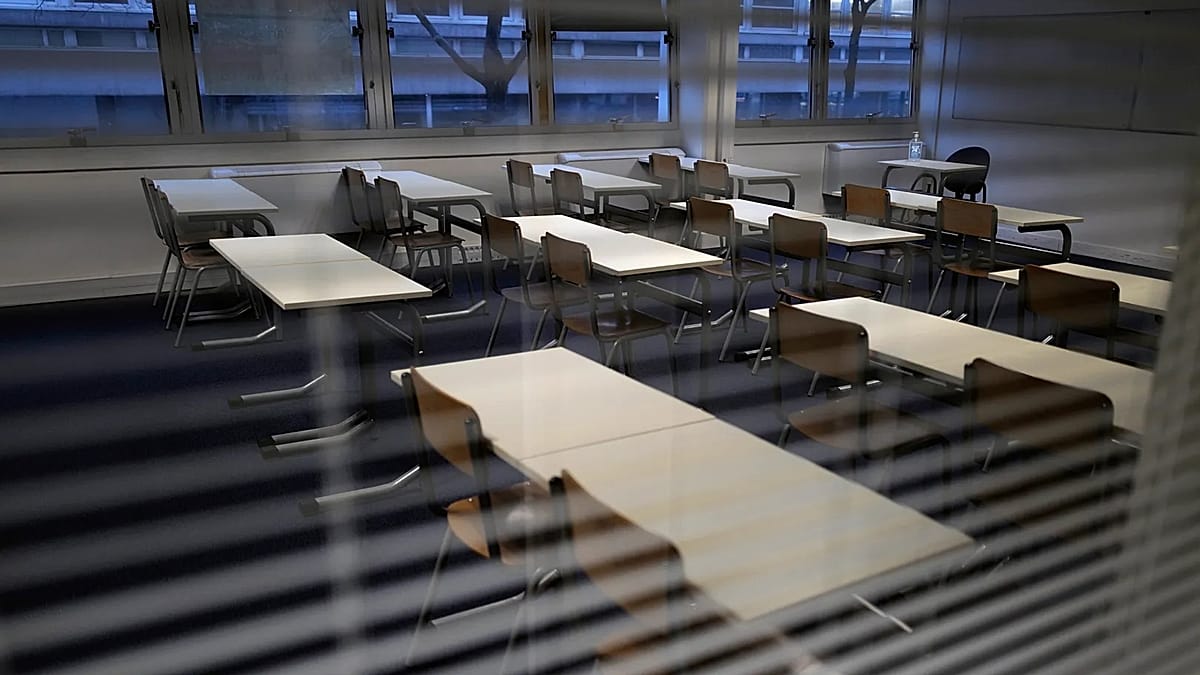
As many as 30% of teachers in France walked off the job on Tuesday to protest against job cuts planned for the start of the 2026 academic year, class closures and to demand pay rises.
This day of demonstrations is part of a”week of mobilisation” launched by an inter-union coalition comprising the FSU, UNSA Éducation, CFDT Éducation formation et recherches publiques, CGT Educ’Action and Sud Éducation.
In a press release, the unions called for “more resources” and denounced a “short-termist” 2026 budget that “ratifies an offensive against public schools,” which are already “bled dry.”
According to the SNES-FSU, the largest union in secondary education, 25% of teachers took part in the strike, including 20% in Paris and 30% in Lyon, Créteil and Normandy.
The strike action was even stronger at primary level, where one in three teachers took part, according to the FSU-SNUipp, the sector’s largest union.
The Ministry of Education reports that 9.68% of teachers took part in the strike, including 13.2% in primary education. In secondary education, the numbers were lower: 9.7% in middle school, 4.94% in general high school and 3.5% in vocational high school. Including other staff, the strike rate sits at around 7.56%.
Mobilisations were reported in several French cities, including Marseille, Lyon, Lille, Clermont-Ferrand and Saint-Denis de La Réunion. In Paris, protesters marched to the Ministry of Education.
Taking advantage of demographic decline
Some 4,000 job cuts are planned for the start of the 2026 school year, including 1,891 in primary education and 1,365 in secondary education.
According to a report by the Ministry of Education’s Department of Statistical Studies (Depp), the number of pupils in primary schools fell by 106,900 by the start of the 2025 school year, a fall of 1.7% over one year.
An analysis carried out in June 2025 by the Institut des Politiques Publiques (IPP) predicted that pupil numbers could fall by 30-35% between 2024 and 2034 in several departements in the Grand Est region, Paris and the Cher, among others.
During a visit to Lyon on Monday, Édouard Geffray, the French Minister for Education, lamented the “demographic fall” that France “has never experienced in its history.”
“We are doing everything we can to minimise the consequences of these class closures,” he stressed, adding that there were “still a few months to adjust.”
However, the unions say they want to “take advantage” of the demographic decline in France to improve learning conditions, particularly in rural areas, “because schools are doing too badly to lose these posts,” explained Aurélie Gagnier, spokesperson for the FSU-SNUipp, the main primary school teachers’ union, at the start of the year.
In primary education, there is “no guarantee of any improvement in pupil reception conditions,” warned the CFDT.
In secondary education, “job cuts are already leading to overcrowded classes: how, under these conditions, can we claim to be fighting against early school leaving or improving the school climate?”
The union also draws attention to the working conditions and salaries of some jobs in the sector such as learning support assistants for pupils with disabilities, education assistants and contract workers, which “reflect neither their skills nor their daily commitment.”
Additional sources • AFP