
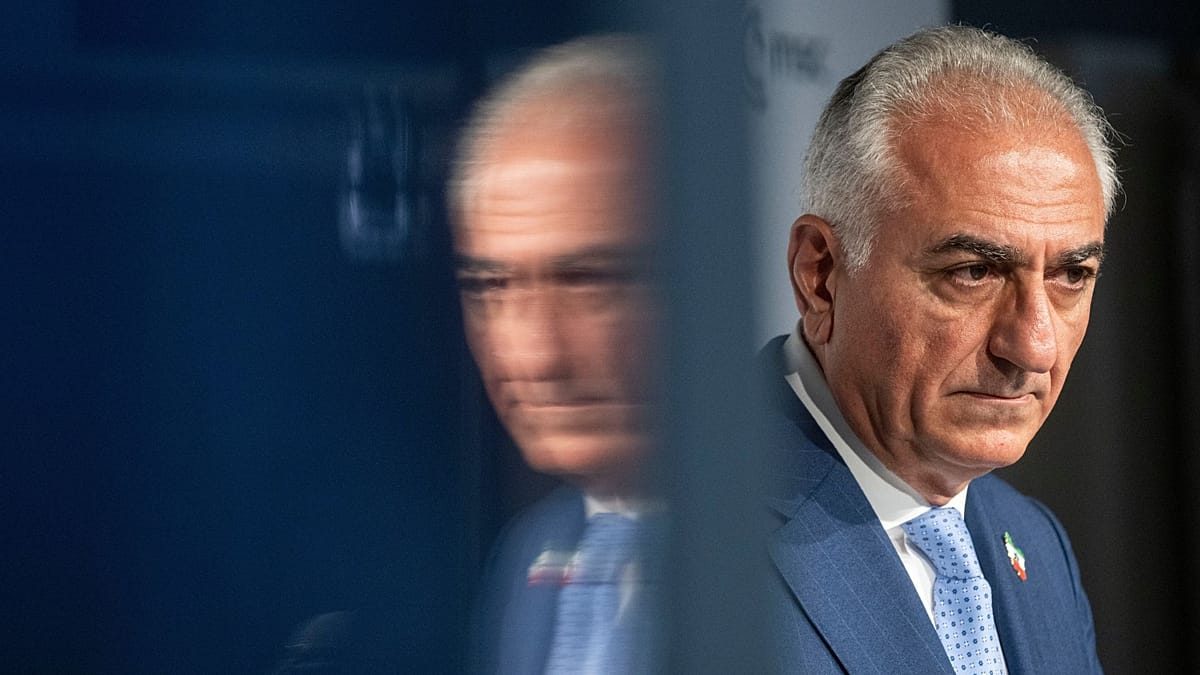
The existing US-Iran framework deal will only let the Tehran regime regroup and rearm, the son of Iran’s last shah and leader of the opposition in exile Reza Pahlavi said in an exclusive interview for Euronews.
“Any arrangement that keeps regime remnants in power is not a peace deal,” Pahlavi told Euronews. “It is a pause before the next war.”
The memorandum was signed on 17 June, three and a half months after US and Israeli strikes on Iran began, killing Ayatollah Ali Khamenei and several senior officials, and starting the war that expanded further into the region.
For Pahlavi, Tehran’s intentions became clear just hours after the framework deal was signed, when Iran executed Javad Zamani and Abolfazl Saedi, who had been detained during the protests that swept the country in January.
“The only winner from this memorandum is the regime,” Pahlavi said. “The day it signed this document for ‘peace,’ it executed two more Iranians for protesting on 8 and 9 January. That should tell you everything you need to know.”
To strike a deal with a regime he accused of murdering “more than 40,000 of its own people in two days” was “morally wrong and strategically misguided,” he said.
“It throws a life raft to a dying regime, and the regime will use the pause to regroup and rearm. It has done this before,” Pahlavi explained.
After large-scale protests sparked by sudden hyperinflation last December spread to the entire country the following month, the Tehran regime went on a bloody crackdown against the demonstrators, resulting in a death toll still impossible to independently verify.
Iranian authorities have put the figure at 3,117, while the rights group HRANA says it has verified 7,007 dead. Unofficial estimates have gone as high as 40,000.
According to Pahlavi, this clearly illustrates that the Islamic Republic’s leadership cannot be trusted.
“This regime lies and cheats, as it always has. It signs documents to buy time. A wounded regime is a dangerous regime, and it will lash out at the first opportunity.”
‘Stability is not swapping one dictator for another’
Under the framework deal, the ceasefire between Washington and Tehran has been extended by 60 days, during which both sides are meant to negotiate a final agreement on remaining issues, most notably Iran’s nuclear programme.
The US has suspended sanctions on Iranian oil for the duration, and both sides have committed to keeping the Strait of Hormuz open to shipping.
The agreement has since been shaken by Tehran’s insistence on asserting full control over the vital waterway, with limited exchanges of fire between the two sides further calling it into question.
While negotiations have continued — with both sides meeting for technical talks alongside mediating countries — contradictory statements have added to the volatility.
In Pahlavi’s view, this has made the Islamic Republic more dangerous than ever.
“A wounded regime is a dangerous regime, and it will lash out at the first opportunity. So whether the text survives 60 days or is extended changes nothing about the fundamentals,” Pahlavi said.
“The regime in Tehran will resume its nuclear programme, rebuild its proxies, and drag the region back into crisis as soon as it can.”
Stability in the region is achievable “only under one condition,” according to Pahlavi, “the end of the Islamic Republic.”
“The regime’s ideology, its IRGC power structure, and its proxy network are inseparable from the regime itself,” he said. “You cannot swap one expansionist, warmongering dictator for another and call it stability.”
A free Iran, by contrast, would mean “no more funding for Hamas, Hezbollah, or the Houthis, no more pursuit of nuclear weapons, peace with Israel, and partnership with Iran’s neighbours,” Pahlavi said. “That is the only durable foundation for the region. Anything short of this is a countdown to the next crisis.”
Pahlavi, whose name was chanted by protesters in January, described the Iranian people as the regime’s “first and longest-lasting” victims and also its most defiant opponents.
“They stood in the street, they faced bullets, they demanded freedom in a country where just saying that word could get you killed,” he said. “They did not wait for the world’s permission.”
“I am not just optimistic, I am certain. Whatever diplomats in foreign capitals decide, the people will bring this regime down,” Pahlavi said. “The regime is weaker, more divided, and more isolated than at any point in its history. It has lost all legitimacy.”
The economic hardship they are enduring, he argued, is “the cost of keeping this regime alive, not the cost of removing it.”
“A free Iran can become the South Korea of the region, prosperous and at peace. Our power is the unity of the people. We will prevail,” Pahlavi said.
‘Europeans must stop appeasing the regime’
Pahlavi reserved some of his sharpest criticism for European governments, which he accused of appeasing Tehran even as the regime targets dissidents on European soil, holds European hostages and supplies Russia with the drones being used against Ukraine.
“This shouldn’t be treated as distant geopolitics for Europe,” he said.
“The regime brags about the murders it has committed on European soil. The regime runs criminal proxy networks across the continent, murders dissidents on European streets, takes European hostages, and sends Putin the drones now killing Ukrainians,” Pahlavi explained.
“This is what they do. They have always done it. And they are doing it still.”
The EU added the IRGC to its list of terrorist organisations in February, but during the recent war, European governments limited themselves to condemning Iranian strikes on its neighbours and stopped short of direct military involvement alongside Washington.
According to Pahlavi, this is not enough, as so far Europe “has not only failed to address this threat, it has served the Islamic Republic’s interests again and again.”
Now, the choice facing European capitals is not between war and peace but “between a dying regime that endangers us all, and a free Iran that can become a partner for stability,” he said.
“European governments must stop appeasing this regime,” Pahlavi insisted.
“Expel regime ambassadors. Refuse to legitimise any arrangement that preserves the IRGC-centered power structure. Not just for our sake, but for the sake of Europe’s own security and prosperity,” he said.