
As Donald Trump marches ahead with his no-holds-barred agenda to expand America’s sphere of influence, the European Union is scrambling to find its footing, bogged down by internal divisions and a fear of antagonising the US president.
The US operation to remove Nicolás Maduro as Venezuela’s president and Trump’s renewed threats to seize Greenland from Denmark have forced the bloc to confront uncomfortable questions about its decades-long alliance with the world’s largest economy – and the dependencies that relationship has entrenched.
At the same time, the EU, a self-proclaimed advocate of the multilateral system, is dealing with growing doubts about its commitment to upholding international law and standing up to those who violate it.
So far, the silence speaks louder than the answers to the questions.
A joint statement signed by 26 member states – Hungary opted out – after Maduro’s ouster contained neither an explicit nor an implicit condemnation of the military intervention, which scholars and experts have deemed to be a direct violation of the principles of sovereignty and territorial integrity enshrined in the United Nations Charter.
In fact, the joint statement mentioned the US by name only once, in a section underlining the need to “support and facilitate dialogue with all parties involved, leading to a negotiated, democratic, inclusive and peaceful solution to the crisis”.
German Chancellor Friedrich Merz said the legal assessment was “complex” and required “careful consideration”, while Italian Prime Minister Giorgia Meloni called the military intervention a “legitimate” response of “defensive nature”.
Spanish Prime Minister Pedro Sánchez is the only EU leader who has unambiguously described Maduro’s removal as unlawful.
“We’re not going to shut up in front of violations of international law, which are sadly becoming ever more frequent. Spain won’t be an accomplice to this trampling,” Sánchez said this week in Paris. “An illegitimacy cannot be responded to with an illegality.”
Privately, officials and diplomats told Euronews that picking up a fight with Trump over Maduro, a hostile dictator, would have been counterproductive and irresponsible in the midst of the work to advance security guarantees for Ukraine.
They also pointed to a lack of knowledge about Venezuela – and Latin America as a whole – as a factor that has muddled the collective response.
The EU has also refrained from outright condemning the killing of civilians during the US raid on Caracas or Trump’s stated desire to appropriate Venezuela’s vast oil reserves for the commercial benefit of his own country.
“It’s obviously for the Venezuelan people to run the country as it is for any people across the world,” said Paula Pinho, the chief spokesperson of the European Commission. “Wherever and whatever country we’re talking about.”
As of now, the EU has not spelt out a concrete plan to define its role in, or even a vision for, a post-Maduro Venezuela under Trump’s direct influence.
At first, the Commission threw its weight fully behind the opposition movement headed by Edmundo González and María Corina Machado to lead a transition of power – but when it became clear that Trump preferred to work with Maduro’s deputy Delcy Rodríguez, now sworn in as president, the Commission changed tack, saying it would maintain “targeted engagement” with Maduro’s successor.
Greenland fears
On Greenland, the European public message has been decisively stronger than on Venezuela, though still providing little of substance.
The semi-autonomous, mineral-rich territory belongs to the Kingdom of Denmark. The threat of US annexation is therefore a threat to European sovereignty, and to the security architecture that allies have upheld since the end of World War II.
“Greenland belongs to its people. It is for Denmark and Greenland, and them only, to decide on matters concerning Denmark and Greenland,” the leaders of France, Germany, Italy, Poland, Spain, the UK and Denmark said in a joint statement this week.
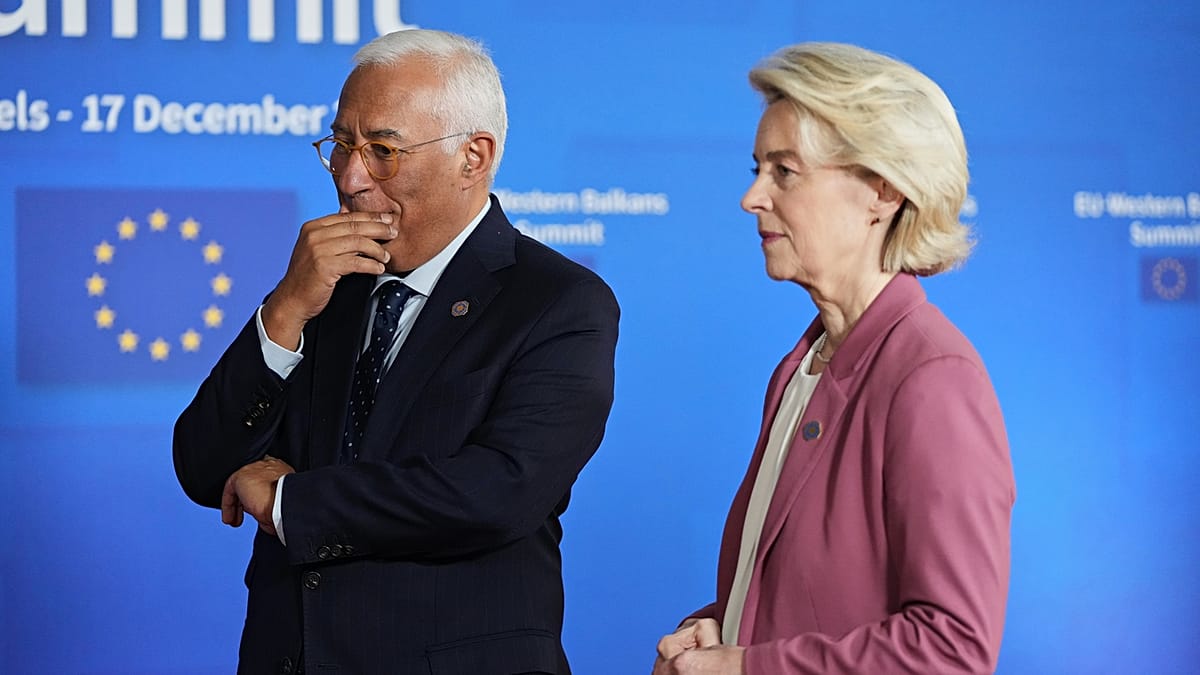
European Council President António Costa, European Commission President Ursula von der Leyen and High Representative Kaja Kallas have also voiced their support for that position.
“The messages we hear regarding Greenland are extremely concerning, and we have had discussions also among the Europeans. If this is a real threat, and if it is, then what would be our response?” Kallas said on Thursday, speaking from Egypt.
“The international law is very clear, and we have to stick to it. It is clear that it is the only thing that protects smaller countries, and that is why it is in the interest of all of us.”
Yet none of these high-profile declarations contained any language about potential retaliatory measures, military or economic, that the EU might be willing to apply to protect the sovereignty and territorial integrity of one of its member states.
The Commission is yet to clarify whether Greenland, which is not part of the EU, would be entitled to benefit from the bloc’s mutual assistance clause in the event of a US attack.
French Foreign Minister Jean-Noël Barrot made headlines when he said his country, the bloc’s only nuclear power, had begun working on a plan to defend the island.
“Whatever form intimidation takes, we want to take action with our European partners,” Barrot said in a radio interview.
He provided no details of a plan, and the French foreign ministry did not immediately reply to a request for comment seeking clarification. His comments contrasted with the position of Danish officials, who are focused on pursuing a diplomatic solution with the White House and have refrained from any bellicose rhetoric.
Caught between a cacophony of views and the prospect of Trump’s scorched-earth reprisals, Brussels is sticking to the tried-and-tested script it knows best.
“The US remains a strategic partner of our union,” a Commission spokesperson said when asked about whether Trump’s behaviour merited a review of EU-US relations.
“As with all other partners, we work in the areas where there are common interests, and we will continue to do so.”