
As demand for air travel expands, French aircraft manufacturer Airbus is testing new technologies that could change how aircraft move through increasingly crowded skies and airports.
The company says the number of aircraft flying could double over the next two decades, while airport infrastructure will not grow at the same pace.
That means aircraft will have to operate in denser and more complex environments, from busy taxiways to more unpredictable weather conditions due to climate change.
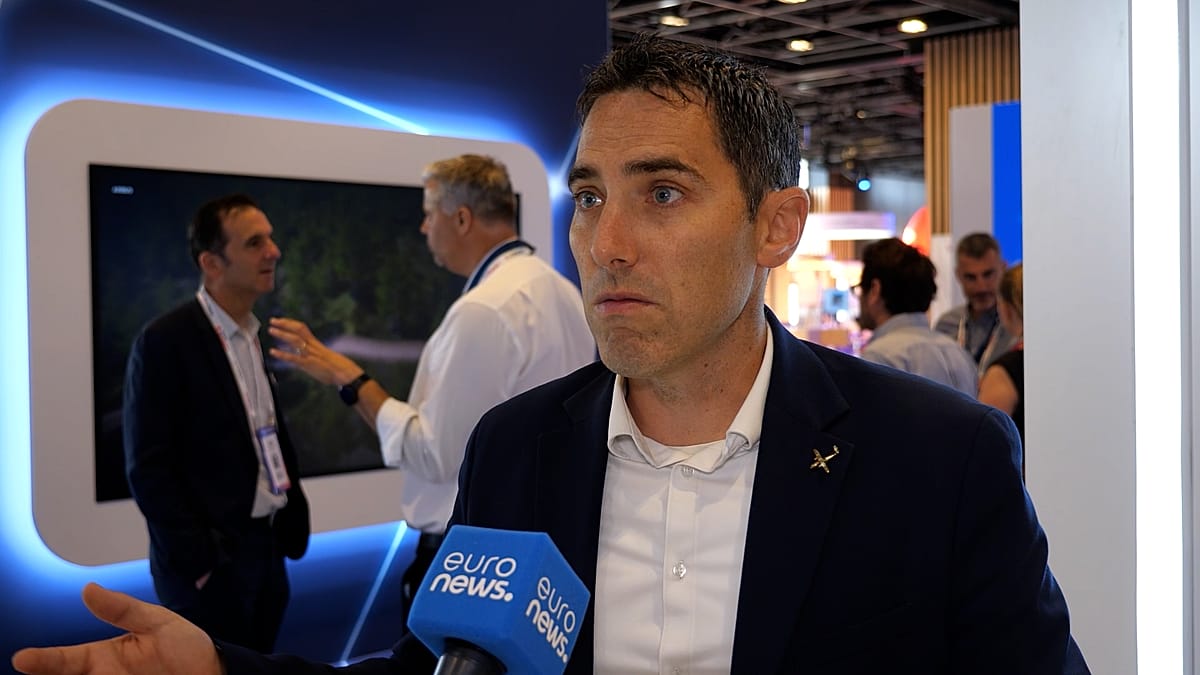
“We need to find different ways to think [and] use the technology we have to overcome those complexities,” Jonathan Rigaud, head of Airbus’ Optimate demonstrator project, told Euronews Next at VivaTech in Paris.
Optimate is a test project for smart automation technologies, using tools such as artificial intelligence, quantum sensing and data fusion, according to the company.
Rigaud says the project has three main goals – protecting an aircraft’s route, optimising operations, and helping pilots in difficult visibility conditions such as heavy rain or fog.
Making flights safer and more predictable
Airbus is also testing radar, LiDAR, cameras, computer vision and artificial intelligence (AI) to help aircraft detect obstacles or risks around them.
Rigaud says AI can help identify whether something is familiar or needs to be avoided.
The Optimate project is also looking at how to improve taxiing, the stage when aircraft move around the airport before take-off or after landing.
Rigaud said aircraft now spend more than 20 minutes on average “rolling and not flying,” making ground movement an important area for improvement.
Airbus is testing ways to help aircraft, airlines and air traffic control share information more efficiently, choose better taxi routes and avoid burning fuel unnecessarily.
That could include helping aircraft start their engines later to save fuel and reduce emissions, based on traffic information.
“The goal is to be as optimised as possible,” Rigaud said.
Airbus has tested some of these technologies using a truck-like demonstrator, which it describes as an “aircraft on wheels,” to trial new functions before deciding what could be added to current or future aircraft.
Rigaud said Airbus has carried out more than 400 hours of testing at complex airports such as Paris Charles de Gaulle, which he said has more than 115 kilometres of taxiways.
“Now we have tested it over the last two years, and we start to have a glance at what we need to put in our current and future aircraft.”
Navigating without relying only on GPS
Another area Airbus is exploring is navigation that does not rely on a single system, such as GPS.
Recent geopolitical tensions have made risks such as GPS jamming and spoofing more visible, increasing the need for backup navigation systems.
Rigaud said GPS is not the only way aircraft navigate today, with planes also using inertial systems. Airbus is testing technologies including quantum sensing, visual navigation on the ground and sensor fusion.
Quantum sensing uses quantum physics to measure movement or acceleration with high precision, which could help aircraft navigate without relying only on satellite signals, while sensor fusion combines data from several sources to give a more reliable picture.
“With the computation we have tested different ways…to not be linked to one system and to be robust,” he said.
He insisted that pilots would remain the ones making decisions, with automation helping them by providing better information.
For more on this story, watch the video in the media player above.
Video editor • Roselyne Min