
Published on
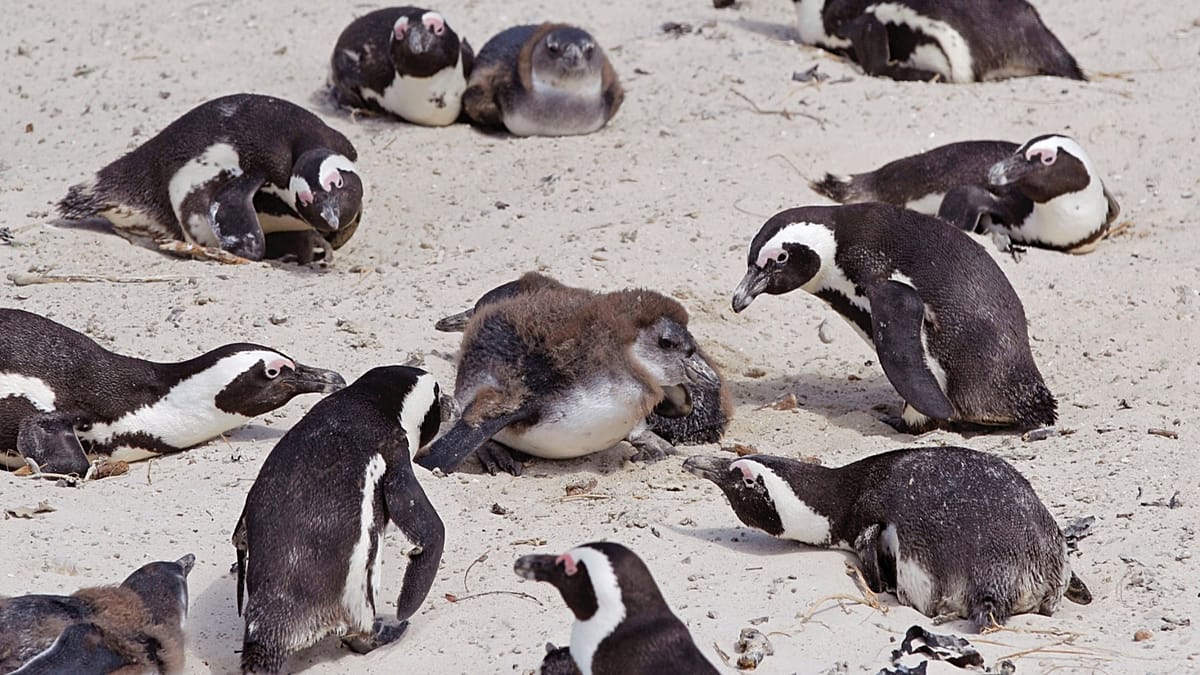
Penguins living off the coast of South Africa have likely “starved to death en masse” amid collapsing food supplies.
A new study from the South African Department of Forestry, Fisheries and the Environment and the University of Exeter found that between 2004 and 2011 around 62,000 African penguins died as a result of severe food shortages.
Researchers warn that populations have declined in two of the most important breeding colonies of the species (Dassen Island and Robben Island), with around 95 per cent of the birds that bred in 2004 believed to have died over the eight-year period.
Why are African penguins dying in such large numbers?
African penguins moult every year, shedding their worn-out feathers and replacing them with fresh ones to keep their insulation and water-proofing.
During this time, the birds must remain on land and therefore cannot hunt. It takes around 21 days for the moulting period to complete, meaning penguins must first “fatten up”.
“They’re evolved to build up fast and then to fast while their body metabolises those reserves, and the protein in their muscles, to get them through moult,” explains Dr Richard Sherley from the University of Exeter.
“They then need to be able to regain body condition rapidly afterwards. If food is too hard to find before they moult or immediately afterwards, they will have insufficient reserve to survive the fast.”
Researchers say this is exactly the “peril the penguins have faced” in the last couple of decades, as growing food scarcity continues to threaten the critically endangered species.
How climate change is disrupting sardine spawning
African penguins rely on sardines as a key food for survival. However, for every year except three since 2004, the biomass of the sardinespecies Sardinops sagax off the western coast of South Africa has fallen to 25 per cent of its maximum abundance (the greatest possible amount).
The study blames changes in the temperature and salinity of the west coast of Africa for making the fish’s spawning less successful.
Much of the excess heat from greenhouse gas emissions is being funnelled into our oceans, making it the planet’s largest carbon sink. However, rising temperatures threaten this function and risk transforming large areas from sinks to sources of emissions.
According to experts, sea surface temperature increases have jumped from 0.06℃ per decade in the 1980s to 0.27℃ per decade now as a result of human-made climate change.
Changes in temperature and salinity actually made sardine spawning off the south coast more successful, but most fishing remained to the West – leading to “high exploitation rates”.
“High sardine exploitation rates, which briefly reached 80 per cent in 2006, in a period when sardine was declining because of environmental changes, likely worsened penguin mortality,” Dr Sherley adds.
Will reducing overfishing help penguins recover?
Researchers say helping South Africa’s penguin populations is “difficult”, as necessary improvements in sardine spawning are dependent on environmental conditions.
However, tackling overfishing could be an important first step.
Dr Sherley argues that managing fisheries so that they don’t exploit sardines when their biomass is less than 25 per cent of its maximum and allowing more adults to survive the spawning period could help penguins recover.
Conservation efforts can also offer a solution, and have already been put in place. This includes using artificial nests, managing predators, and hand-rearing adults and chicks.
Commercial purse seine fishing, which uses large fishing nets to catch schooling fish in open oceans, has recently been banned around six of the largest breeding colonies in South Africa.
With the study now complete, researchers say they will continue to monitor the breeding success, chick condition, foraging behaviour and population trajectory of African penguins.