
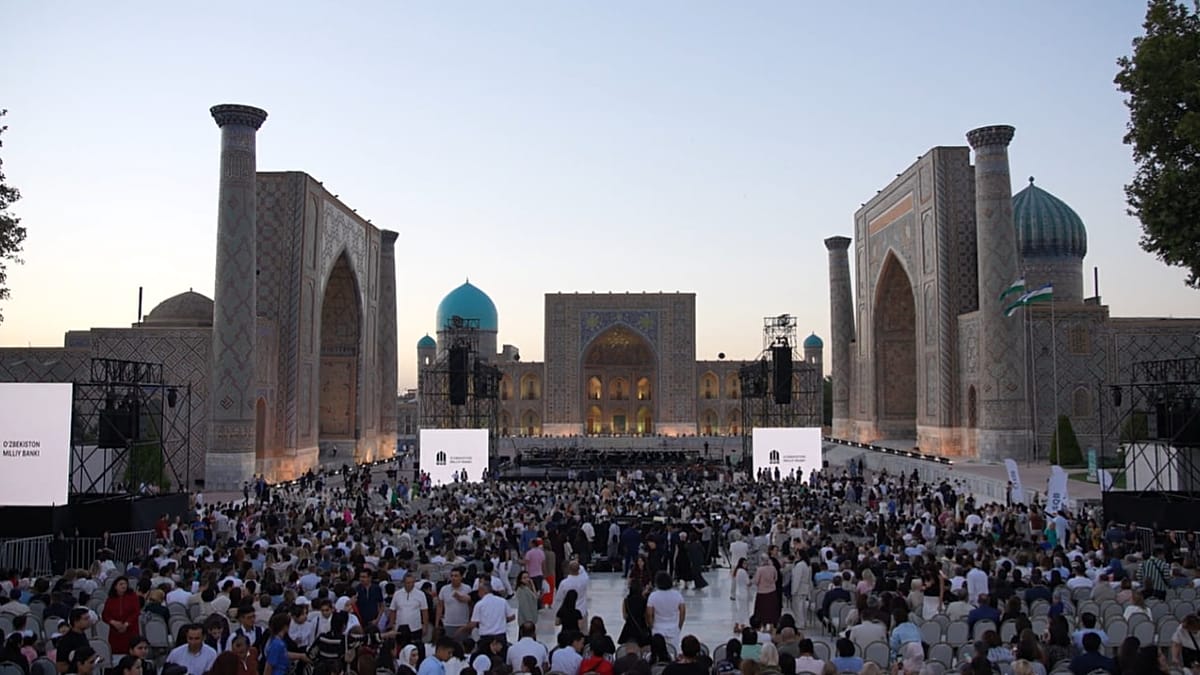
Uzbekistan is trying to turn rising visitor numbers into longer stays and higher tourism revenue, as new air links become central to the country’s travel plans.
Growth has accelerated over the past three years. Official figures show inbound tourist trips by foreign citizens rising from 6.63 million in 2023 to 7.96 million in 2024. Preliminary official data put the 2025 figure at 11.68 million trips, an increase of 46.8% from the previous year.
The economic value of tourism has also increased. Tourism services exports rose from $2.14 billion (€1.88 billion) in 2023 to $3.52 billion (€3.09 billion) in 2024. In 2025, exports of tourism services reached $4.8 billion (€4.2 billion), according to figures published by the Uzbek presidency.
The figures help explain why officials are linking tourism growth to long-haul flights, regional itineraries and higher visitor spending.
From more arrivals to higher-value tourism
“One of our strategic priorities is to attract more long-haul travellers from Europe, Asia and the Americas, as well as to develop joint regional tourism packages together with our neighbouring countries,” Abdulaziz Akkulov, chairman of Uzbekistan’s Tourism Committee, told Euronews.
Akkulov said the strategy is focused on the economic value of each visit.
“Today, our priority is not simply increasing the number of tourists. We are equally focused on attracting higher-value visitors who contribute more to the economy through their spending,” Akkulov said.
The approach marks a shift from counting arrivals to increasing the value of each trip. The country is already well known for Silk Road destinations such as Samarkand, Bukhara and Khiva, but tourism officials want more visitors to travel beyond the best-known heritage routes and include other regions in longer itineraries.
Akkulov said Uzbekistan is also promoting itself as a safe destination at a time of global uncertainty, while the latest official figures show continued growth in inbound tourism.
The government is supporting the sector through financial incentives. A decree adopted in June introduced subsidies for tour operators and airlines to help attract more international visitors. Tourism companies and hotels are also eligible for a 50% refund of value-added tax during the summer season.
Air links become central to the tourism plan
For Uzbekistan, attracting more long-haul travellers depends heavily on international air access.
“Five years ago, we operated 26 aircraft. Today our fleet has grown to 45 aircraft, serving both international and regional destinations,” said Shukhrat Yadgarov, deputy chairman of the board for commerce and tourism at Uzbekistan Airways.
The national carrier is expanding its fleet and route network as it works to strengthen connections with Europe, Asia, the Middle East and North America.
Uzbekistan Airways has signed a firm contract for 14 Boeing 787-9 Dreamliners, with options for eight more aircraft. Deliveries are due to begin in 2031, making the order part of the airline’s long-term wide-body fleet expansion.
The airline already operates Boeing 787-8 aircraft on long-haul routes. The new aircraft are expected to add capacity and support future international connections rather than immediately transform current services.
For tourism authorities, additional direct flights are important because they can reduce travel time and make Uzbekistan more accessible to visitors from distant markets.
“We are strengthening direct cooperation with European countries, showcasing Uzbekistan’s tourism opportunities at major international tourism exhibitions, and working together to increase the number of direct flights to Uzbekistan,” Akkulov said.
Regional packages for Central Asia
For long-haul travellers, direct air access is also linked to multi-country travel. Uzbekistan wants visitors arriving from distant markets to see the country as part of a wider Central Asian itinerary, rather than as a single-country stop.
That could include routes linking major cultural sites, regional capitals, mountain destinations and historic Silk Road cities across several countries.
Akkulov said neighbouring states will remain important source markets, but he also pointed to Europe, Asia and the Americas as priority regions for future growth.
Making travel inside Uzbekistan easier
Improving access to the country is only one part of the challenge. Once visitors arrive, domestic travel can still involve long distances, particularly on routes from Tashkent to regions such as Karakalpakstan.
Akkulov said the rapid increase in visitor numbers has made transport development more urgent.
“Transport is one of the sectors that has seen particularly rapid progress over the past decade,” he said. “At the same time, however, the number of tourists has increased several-fold. This rapid growth means we must move even faster in expanding transport infrastructure and introducing new solutions.”
Authorities are working on new high-speed transport corridors, expanding the fleet of high-speed trains and developing new airports across the country.
The aim is to make it easier for visitors to travel beyond the main tourism centres and reach a wider range of destinations.
Tashkent’s role as a transit point
The same connectivity push is also shaping the airline’s international ambitions. Uzbekistan Airways also wants Tashkent to become more than a destination airport.
“Our goal is to establish Tashkent as a strategic hub between Europe and Asia, and between America and Asia,” Yadgarov said.
The airline sees transit passengers as a future growth area, with Tashkent positioned as a connection point linking Europe, Southeast Asia, North America and the Middle East.
Yadgarov said stronger air links could also support business travel and investment.
“Aviation is about speed, comfort and efficiency,” Yadgarov said. “If those journeys pass through Uzbekistan, we will only benefit.”